
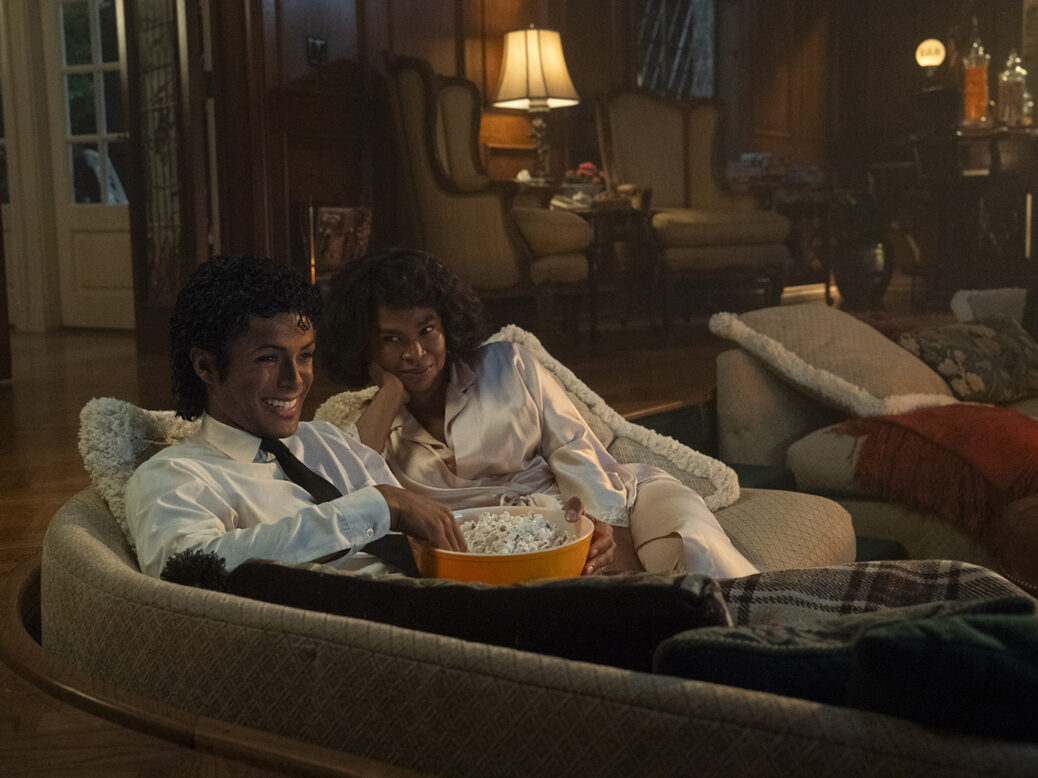
When I heard the film critics spluttering about Michael outside the screening room – it ends abruptly in 1988, with no mention of his copious child abuse allegations – I felt faintly sad. Not for the Jacksons, who controlled the production, nor for the disgraced Pied Piper of pop, wherever he may now be. But for those far down the food chain of the movie. The CGI team who rendered the faces of the menagerie – snakes, llamas, a stately giraffe – that stalks the Jackson family home. The audio team, who took an imitation of an inimitable voice, added just the right amount of crowd and echo, and turned it into a Wembley Stadium performance. I felt sad for Jafaar, Michael’s nephew, who as the lead role, calls into question the movie’s refrain of “there is no one like Michael” by delivering every yelp and move so well. And for the producer Graham King, who planned to begin this movie with the child abuse allegations, to “humanise but not sanitise” Jackson, until the estate found a convenient clause in Jackson’s settlement with his alleged victim Jordan Chandler which said the boy could never be portrayed or mentioned on film. Most of all, I felt sad for every cent of the $200m the movie cost to make, which would have been better donated somewhere, like the children’s burns unit Jackson set up at Brotman Medical Centre after his hair caught fire in that Pepsi commercial. What were they thinking, showing him visiting sick kids in hospital, with managers smiling approvingly through the glass? Jackson met and befriended one of his primary accusers when the boy was a cancer patient. It’s like someone making a film about Jimmy Savile, concentrating on his charity work and his pioneering skills as a DJ.
Yet that comparison still doesn’t feel right, despite the parallels. I’ve spent a lot of time wondering why Jackson has not been cancelled, in as far as anyone is ever cancelled, and I’ve come to the conclusion that we pick and choose – because there are some cases in which the product someone brought to the world is just too much to give up. Jackson’s songs were too brilliant; his dancing too good. The video for “Thriller” remains the most exciting moment in pop history. Music is a direct line to the soul, and tiny oblivious children will still stand in front of YouTube embodying Jackson’s moves. Michael is not an attempt at rehabilitation – the family would not be that naive. Rather, it was made for the millions of fans still in existence, and growing year on year, who, through necessity, have closed off part of their minds to the things Jackson seems to have done.
In that spirit, they really go for it, repeating every pop playground myth we heard growing up about the man they called “Wakko Jakko”. At Michael’s first nose job (his nose gets smaller throughout the film) he complains to the surgeon that he has vitiligo, which was always a convenient explanation for the entire shift of his skin colour from black to white. The story arc focuses on the control that Joseph Jackson (Colman Domingo) had over his son: it is still shocking to think that, even after Thriller, he was forced to tour with his brothers. Yet Michael is a victim only, and his simpering voice and beneficent smile are not explored as the defensive armour they clearly came to be. At one point I seem to remember him saying, “My only desire is to shine a light and to heal.”
In the run-up to the release of Michael, the BBC brought out a serious three-part documentary, Michael Jackson, An American Tragedy, and here are a few of the things I learned from it. One: that his 1988 album Bad was seen as an epic fail, selling only one million copies to Thriller‘s 25 million – his fortunes were on the turn by the point the new film ends, and he spent the next 20 years trying to regain the glory. Two: he campaigned with his mother door to door as a Jehovah’s Witness when he was already a superstar. Three: he truly believed his fans loved him; he was not distrustful of them on any conscious level and saw it as a real human relationship. And four: before his surgery and his bleaching, he would complain that he looked like a monkey – of course, he later bought one. I was struck by the fact that despite the prison of his family, Jackson really did “reinvent” himself – an entire overhaul, from the face to the voice, which was such a different beast in adulthood from the husky, mini Sam Cooke in his days as a child star. Viewed a certain way, Jackson’s whole aesthetic in Thriller and beyond was an experiment in the shadow, in the conflict between dark and light: he repeatedly played at revealing the monster inside, being “bad” in plain sight.

There are no roles for women in Michael, apart from that of his long-suffering Jehovah mother, played by Nia Long. At one point I thought, wait, where is Janet, multi-million seller sister of Michael?! She refused to take part – meaning that she does not even appear as a child character in his family home. It is as though she was never born. Although his daughter Paris also condemned the film as largely fiction, there are distant rumours of a sequel: at its abrupt end, the screen flashes with “His story continues.” I wondered, then, whether the Jackson estate knew exactly what they were doing; whether Michael was deliberately made as a cult movie – so bad it is good – simply to generate interest in Michael: Part Two, and however the hell they’re going to tell that one.
[Further reading: Will AI kill tribute bands?]
Content from our partners



Related

Join the debate
Subscribe here to comment