
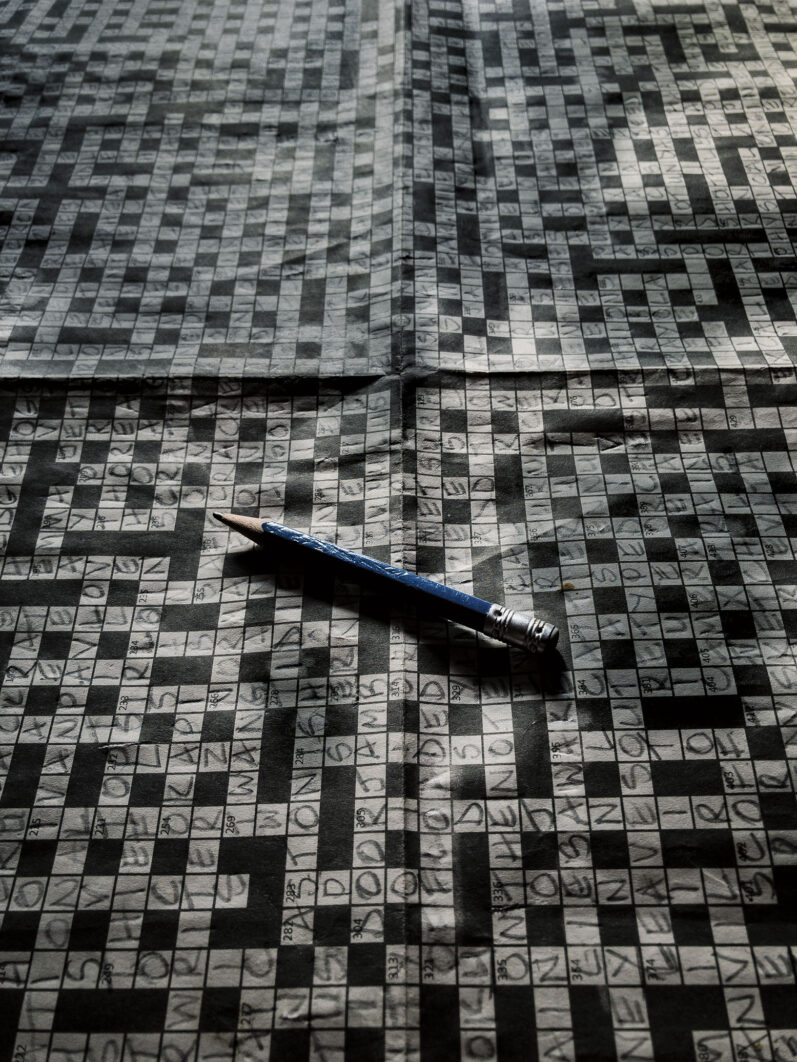
I am on a rush-hour Tube, sandwiched between commuters, obsessing over two words: “Penguin concerto? (7)”. While other passengers stare intently at their phones, I am holding a hard-copy newspaper in the hand that is also gripping the rail, and a pen in the other. I cannot say what is going through my fellow travellers’ minds, but somehow I doubt they are picturing what I am: an orchestra of penguins picking up their violins and trombones.
In January, I set myself a New Year’s resolution I thought would be both fun and actually possible to stick to: I wanted to learn how to do cryptic crosswords. I tell people my inspiration was the proliferation of health articles explaining how puzzle-solving can help stave off dementia. I’ve always found Sudoku boring and I lost interest in the Covid Wordle craze pretty quickly. Cryptics offered a more substantial challenge, testing not just vocabulary but general knowledge, linguistics and the ability to think around corners.
All that is true – but the real reason I wanted to learn is simpler. I was sick of my husband showing off. In the early stages of our relationship he would write cryptic clues with a risqué flavour for me to solve as a form of flirtation – “Theatre at sunset conceals things good girls get (6)” – but once the romance wore off, the smugness grew unbearable. His casual explanations for why exactly “Expelled unwelcome journalist from the east (8)” clearly means “deported” made no sense to me (it relies on knowing French and reading backwards). I had two choices: try to ignore him, or learn myself. For the sake of matrimonial harmony, I picked the latter.
What I have discovered is the key to an entirely new way of viewing the world. Cryptics are about wordplay and wonder and things never quite being as they seem. “A good clue can give you all the pleasures of being duped that a mystery story can,” as the renowned musical theatre composer Stephen Sondheim put it. “It has surface innocence, surprise, the revelation of a concealed meaning, and the catharsis of solution.”

Take the popular favourite: “Two girls, one on each knee (7)”. The last word is the definition (“patella”), the rest hints at how you might arrive at the answer another way – perhaps by joining together two girls’ names. Once you see the solution, it’s obvious. But get the parts of the clue mixed up and you can stare for hours at the jumble of letters and never unlock their secret.
Where did this labyrinthine form of playing with words come from? Cryptic crosswords, while much loved elsewhere, are a wonderfully British phenomenon. Perhaps it’s our language itself, a patchwork of linguistic and grammatical influences bastardised from all over the world, that allowed them to develop. They originated here in the 1920s, with the inventor of the cryptic crossword accepted to be the translator and poet Edward Powys Mathers, who set puzzles for the Observer under the pseudonym “Torquemada”. That Tomás de Torquemada was the first grand inquisitor of the Spanish Inquisition is exactly the type of esoteric knowledge crossword aficionados are expected to have on hand. And if there’s a bit of mental torture in struggling towards a solution, well isn’t that the point?
“We must expect the composer to play tricks, but we shall insist that he play fair,” wrote the compiler Alistair Ferguson Ritchie in 1946. “They are tricksy hobbitses!” I find myself fuming after spending forever looking up synonyms to a word that turns out to be a red herring. Still, I have persevered, and gradually I have come to see what John Halpern, one of the UK’s leading crossword setters, meant when he called them a celebration of “the hidden magic within language”. As a dyslexic, I have had to train myself to spot anagrams and patterns, breaking down words into parts like the ingredients of a mystifying but delicious gumbo soup. Letters are spells, capable to transforming gobbledegook into sense. Language is not a science but an art, the more flamboyant and creative the better.
I have also glanced through the windows of niche but fascinating subcultures to learn their ways and words. The publication I have chosen for practice (and I’m told each one has slightly different rules) is wide-ranging in the subject matter it employs for crosswords, but certain favourite themes emerge: nautical and military terminology, chess and cricket. Sometimes setters like to remind us of their naughtier sides, with allusions to drugs and adventurous sexual practices. A firm grasp of geography is key, as are the rudiments of French and German and – naturally – the Greek alphabet. The anagrams are getting easier; the cricket terminology less so. I can complete around half the puzzles I try without assistance. Good progress – but still a way to go.
Back on the train, I have given up trying to spot hidden words in the letters of penguin concerto. Then my brain shifts gear and the answer “emperor” slips into my mind. Of course, my orchestra of emperor penguins would be playing Beethoven’s Emperor Concerto! What could be more apt?
[Further reading: Welcome to the supermarket class war]
Content from our partners



Related


This article appears in the 12 Dec 2025 issue of the New Statesman, All Alone: Christmas Special 2025
Join the debate
Subscribe here to comment