
There’s one unequivocally great film about cancel culture. Tár, starring Cate Blanchett, was pretty much universally hailed as the film of the year in 2022, despite being pipped for the Best Picture Oscar by Everything Everywhere All at Once. It’s an art film that’s “just razor-sharp, pitch-black and hilarious. A very focused mirror held up to some of the worst of our human behaviours. It’s also a blast,” said Paul Thomas Anderson, presenting its director, Todd Field, with a prize at the Directors Guild of America awards. If somehow you haven’t seen it…
After the Hunt is directed by Luca Guadagnino, in succession to his teen cannibal romance Bones and All of 2022 and his ménage à trois tennis drama Challengers and William Burroughs tribute Queer, both from 2024. Based on a script by first-time writer Nora Garrett, After the Hunt is a Me Too drama, about believing women, arriving a few years after the movement’s heyday.
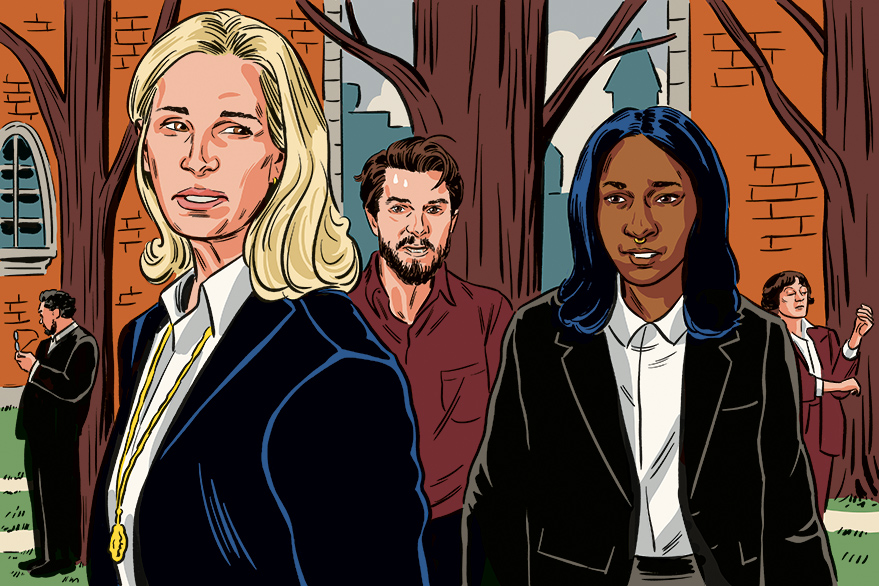
Alma Imhoff (Julia Roberts) is a stylishly dressed, feminist philosophy professor at Yale, focused on finally getting tenure, for her achievements rather than for inclusion reasons. We see her getting up, going to work, lecturing on Foucault, and then hosting a faculty party in the startlingly grand apartment she shares with her husband, Frederik (Guadagnino stalwart Michael Stuhlbarg), a touchy psychoanalyst, keen on cooking and conducting along to John Adams operas played loud. Among the guests is her argumentative colleague and rival for tenure, Hank (a beardy Andrew Garfield), more physically at ease with her than her husband is – perhaps even a past or present lover. Then there’s her favourite student, Maggie (Ayo Edebiri, chef Sydney in The Bear), who is queer and black, and whose adoptive parents happen to be Yale’s biggest donors.
There’s a button-pushing row about whether or not the younger generation revels in “performative discontent”, whether the straight, white, cis man is now being discriminated against, and whether or not figures like Heidegger, Hegel, Aristotle (a xenophobe) and Freud (a misogynist) deserve to be cancelled. Alma is infuriated by the idea that her prospective tenure isn’t a just reward for the many professional “accolades” she has “accrued”. Those who, like many sensitive people, have a physical aversion to academic conceit should be warned that in this film it’s more sick-making than any of the flesh-gobbling in Bones and All.

Hank and Maggie leave together. The next day, Alma finds a distraught Maggie crouched outside her door, saying Hank assaulted her. “What are you saying he did?” Alma asks. “Isn’t it obvious? He crossed the line. He kept going after I said no. Why do you need to know? He assaulted me!” She never clarifies exactly what happened but nonetheless expects Alma’s backing.
So Alma’s loyalties are torn, her professional standing compromised whichever way she turns. Hank claims he upset Maggie by talking to her about the blatant plagiarism in her dissertation – but he also really thought she was coming on to him. Now it’s her word against his “lifetime of hard work and good deeds and advocating for women in philosophy”. Alternatively, he says, she’s “some lying bitch with a shitload of money exploiting this shallow, awkward moment in the culture”.
So here’s all the material for a heated debate. Guadagnino says he hopes people will want to talk about this movie for a long time. Julia Roberts, too, wants people to leave the cinema for a good argument about the rights and wrongs over a drink: “I love bringing people together.”
The problem is that this enormously talky film, painfully over-scored by Trent Reznor and Atticus Ross, is never involving, nothing of what happens emerging persuasively from the characters we see, despite the quality of the acting, direction, design and editing. The script seems to have been retro-engineered from the debating points it wishes to incorporate. It resorts also to some creaky, implausible devices: Maggie, for example, happening upon a hidden package revealing Alma’s secret life taped up in a bathroom cupboard at their party while she is searching for more loo paper; Alma suffering from unexplained stomach pains that lead her, disastrously, to fake a prescription; Hank being abruptly fired without any process.
Julia Roberts has been tipped for an Oscar nom at least, for playing so much against type here. It’s quite the performance, but it serves only to contribute further to the film’s alienation of any sympathy, even interest. Altogether After the Hunt lags far behind Tár; behind the times too.
“After the Hunt” is in cinemas from 17 October
[Further reading: Diane Keaton showed women how to be unconventional]
Content from our partners



Related



This article appears in the 16 Oct 2025 issue of the New Statesman, The Emperor
Join the debate
Subscribe here to comment