
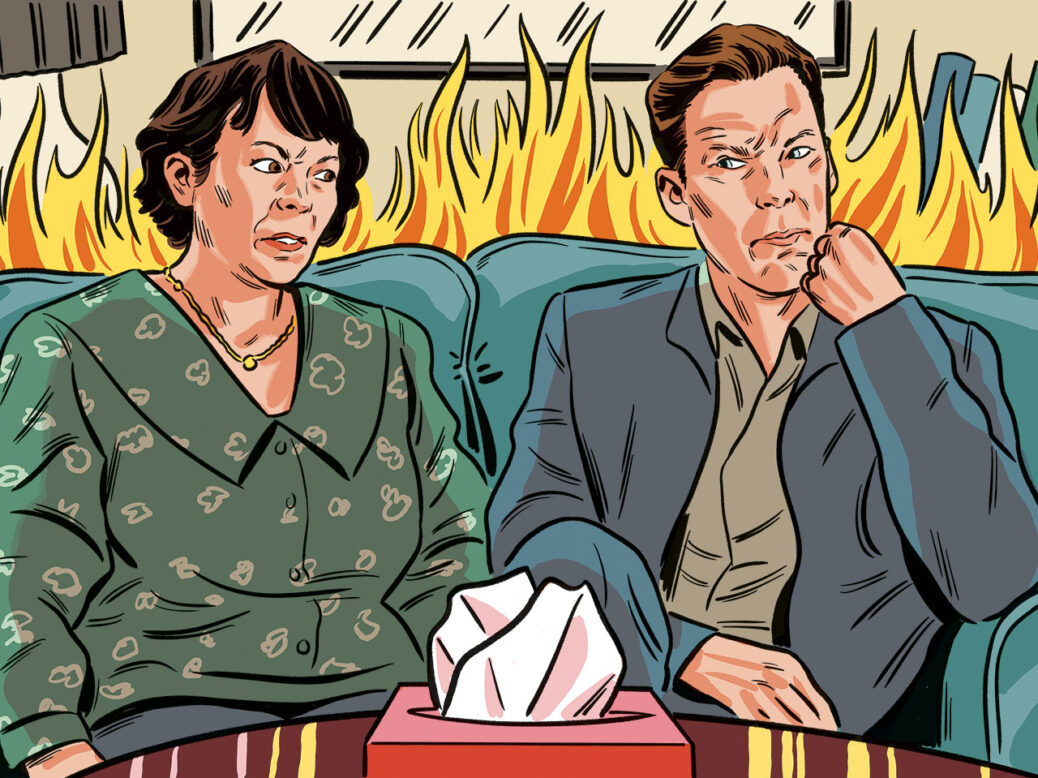
Both Warren Adler’s 1981 novel The War of the Roses and the 1989 film of the same title that starred Michael Douglas and Kathleen Turner, were brutal productions.
Adler’s novel is a vicious reaction to the way feminism had encouraged women to feel unfulfilled by homemaking and motherhood. Once battle is underway, Jonathan and Barbara Rose both behave atrociously in their fight over their prized Washington mansion, but the reason their marriage of 18 years has ended is attributed unequivocally to Barbara’s discontent, rather than any failure of Jonathan’s.
When Jonathan is rushed to hospital with a suspected heart attack, Barbara doesn’t bother to come, having realised that she wants a new life without him. “I just can’t stand the idea of living with you for another moment,” she informs him when he returns home. It’s not really his fault, she eventually admits. “You were just there at the wrong time and the wrong place.” That’s Jonathan’s basic take too. “All the girls of our generation… with your checklists of unfulfilled dreams, lusts and fantasies. We’ve busted our asses to make you content! Now you shit on us.”
Barbara is unambiguously the instigator of the disaster. Adler unpleasantly observes: “Only one emotion seized her, the joy of having bested him. Her body was aroused with an exquisite sensation of unspecific ecstasy, a post-orgasmic after-thrill. Her nipples were erect, her inner parts wet.”

Danny DeVito turned the novel into a monster movie. As well as directing, he played the lawyer recounting the tale as a warning against divorce altogether, while Kathleen Turner, seemingly always close to anger, and Michael Douglas, ditto, were perfectly cast, especially since they had already appeared as romcom partners in Romancing the Stone. Only one of the novel’s horrors was softened (Barbara feeds her husband paté telling him later that she made it from his dog; in the film, the mutt is seen alive afterwards), while fresh enormities were added (Barbara going down on her husband to bite him). If some divorcing couples were relieved to find others could behave even more deplorably than they had, many children of divorce found it unendurable.
Now, it has been not rebooted but “reimagined” by an apparent dream team. Directed by Jay Roach (Meet the Parents, Bombshell), scripted by Tony McNamara (The Favourite, Poor Things), The Roses casts Benedict Cumberbatch and Olivia Colman as the Roses, renamed Theo and Ivy.
Theo, an ambitious architect, bumps into Ivy, an ambitious chef, in the kitchen of a restaurant in London. Moments later they’re screwing in the cold-room. She’s about to relocate to Mendocino, California, and he follows her, thus setting up a comedy of West Coast incomprehension in the face of the English couple’s sarcasm. As it happens, The Roses was filmed in Devon and Ascot racecourse, as if extra inauthenticity was needed.
We rejoin the Roses ten years later, happily married, with two children. His trophy design, a Maritime Museum in San Francisco, is about to open; she’s launching a passion-project seafood restaurant, We’ve Got Crabs. There’s a storm. That night the museum collapses and a famous food critic gives We’ve Got Crabs a rave review. The couple’s roles are reversed. Ivy becomes a huge success, Theo is reduced to childcare.
The strain begins to tell. Theo’s a failure and women don’t like that, a friend points out. Her successful chain of restaurants having made her rich, Ivy backs Theo to design them a dream house and restore his reputation. Then they fight over it and everything else. There’s a catastrophic dinner party to display the house, in which the Roses’s Brit ironies floor their therapised guests. “Sometimes Ivy’s mad at me and I can’t even tell,” one jokes. “Sometimes he’s got his cock in me and I can’t even tell,” Ivy smartly responds.
So the causes of war have been updated, from basic inequality of roles to the stresses created by both striving for career fulfilment. Unfortunately, the film doesn’t work on any level. The English/American gambit is completely off-target. These fine actors are miscast, their relationship never plausible. They missed the boat, perhaps? Douglas and Turner turned 45 and 35 in 1989; Cumberbatch and Colman are 49 and 51, making their crucial meet-cute grotesque. Colman appears throughout as a kind of middle-aged manic pixie. There is never even the most momentary grounding in any social reality. Marriage Story is a better tale of how wedded bliss can unravel.
“The Roses” is in cinemas now
[See also: The millennial parent trap]
Content from our partners



Related


This article appears in the 27 Aug 2025 issue of the New Statesman, The Gentle Parent Trap
Join the debate
Subscribe here to comment