
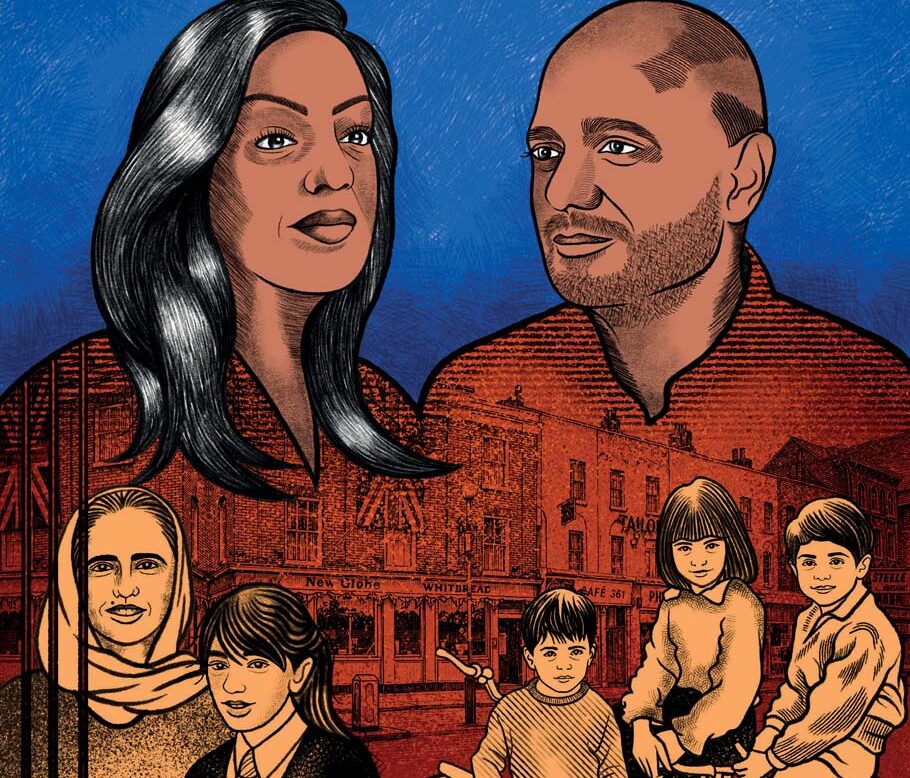
In the year 1919, my grandfather Shamsul Haque arrived in London’s East End after jumping ship at Tilbury docks. He was a teenage lascar, belonging to a class of sailors in the merchant navy usually from South Asia, on a contract akin to indentured labour. Haque had a knack for making money; within a few years, he opened a curry house in east London – one of the country’s first– before expanding into factories and travel agents from Bradford to Karachi. He and his brother (my great-uncle) Ayub Ali, a famous trade unionist, helped other lascars get out of their onerous contracts. My grandfather and great-uncle assisted the sailors with remittances, wrote letters, set up the Indian Seamen’s Welfare League. This group included a hostel that served as a place to offer Friday prayers, which later became the East London Mosque, the largest in Europe.
Together, they were part of the first generation of Muslim community leaders or politicians in the UK. My grandfather’s politics focused on the British empire and goings-on in South Asia. His concern was with the Indian subcontinent’s independence from Britain, the partition dividing it into India and Pakistan and, later, with Bangladeshi independence from Pakistan. In his restaurant, he hobnobbed with the future luminaries of South Asian politics, from the founders of Pakistan, Mohammed Ali Jinnah and Liaquat Ali Khan, to senior figures in the Indian independence struggle, Subhas Chandra Bose and VK Krishna Menon. The brothers hosted meetings of the India League and the Muslim League, political organisations that would be associated with the future governments of India and Pakistan. It’s said that they were troublesome enough for the British security services to keep an eye on them. Despite the scrutiny, in their own way, they advanced their political aims: independence from colonial rule and freeing lascars from oppressive contracts. What is more, the imprint they left on the East End remains, from the institutions they founded to the memories that linger on. Occasionally, an old-timer stops me to recall my grandfather.
How would the early pioneers of British Muslim political leadership – represented by my grandfather and his brother – view their heirs today, people like Sajid Javid and Naz Shah, born generations later in the 1960s and 1970s? Their respective new memoirs, The Colour of Home and Honoured give us an occasion to reflect on this. Both politicians – Javid, the former Conservative cabinet minister, and Shah, Labour MP for Bradford West – represent the postwar migration generation who did not look to “back home”. For them, back home was in the UK – unlike for my grandfather, who remained embedded in South Asian affairs. Read together, these two memoirs are not merely personal stories, they are key documents of a generation, one that moved from the margins of British society to the centre of political power.
Both Javid and Shah were products of the 1947 partition. Javid’s grandfather, a well-to-do Punjabi farmer, made the perilous journey to what would become Pakistan; his son travelled on to England, where Javid was born in 1969. Shah was born four years later, in 1973; her parents had also come from Pakistan – arriving from Kashmir to serve the mills of northern England, hungry for cheap labour. Britain needed immigrants to rebuild its industries after the war. Javid and Shah both grew up during the upheavals of industrial decline and racial tension, as well as the slow institutional opening up of British politics. Unlike their parents’ generation, Javid and Shah understood Britain as their only home and the only plausible setting for a political career.

Their political ascent seemingly represents the integration of British Muslims into the British state. Their careers appear to show that ethnic minorities can beat their white political rivals at the ballot box and even sit at the cabinet table. Yet a question remains: were either able to reshape society or tilt it even slightly in their favour? Their presence in government has not resolved the question of British-Muslim political belonging, though it has offered a model of how one might succeed within British political life. The professional success of Javid and Shah provide stories of how this generation occupied positions of power and what decisions were subsequently made, which these two memoirs have the greatest potential to reveal.
Javid’s journey into the upper echelons of government is marked by estrangement and racism. It unfolds first in Rochdale, where his hard-working father started as a day labourer in a cotton mill before becoming first a bus driver and later a businessman. Though Javid describes his father as a failed entrepreneur, he is also grateful for what he provided. The grit of his parents kept five children afloat and allowed Javid to study economics and politics at Exeter University, where – apart from being introduced to alcohol, losing his virginity and discovering that he had been betrothed to a cousin – he joined the Conservative association. He did so to make friends rather than to politic. The rest as they say is history.
The Colour of Home is a wistful memoir. Javid spends an inordinate amount of time describing his childhood: pink bicycles sprayed silver, the record player he saved up for, skanking the slot machine for coins. These details were no doubt formative for the future chancellor. Money, or the lack of it, is a recurring theme. There is a persistent drive to acquire it, and the memoir recounts many Del Boy-type schemes. His road-to-Damascus moment was discovering the Financial Times.
There is candour here too, not only about racism but about the shame of participating in it, alongside his friends, so he didn’t stick out. In public discourse, Javid is often accused by fellow South Asians of being a “coconut” – brown on the outside but white on the inside. That seems unfair. He does not appear ashamed of his heritage or faith and discusses them with surprising frankness, something he rarely did in office.
What I find odd about The Colour of Home, as someone who has co-written the memoirs of two politicians, is how much has been left out. Javid hardly reflects on his political career. Apart from brief mentions of labour strikes and his admiration for Margaret Thatcher, he says little about his election campaigns, political alliances or his time in government. The fascinating part of his life is largely absent. We never truly learn why he wanted to become an MP or how he experienced power at the Home Office; he refers to his tenure as home secretary only in passing, when describing the tragic suicide of his older brother Tariq or when he presided over the graduation of another brother, Bas, from the College of Policing. This is a politician’s memoir in which politics remains a black hole.
Javid’s decisions while holding two of the great offices of state, beginning as home secretary in 2018 and ending as chancellor of the Exchequer in 2020, affected many people, not least me. A considerable part of my career was spent reporting on his decision to strip the former Bethnal Green schoolgirl Shamima Begum, who travelled to Isis-held territory in Syria as a teenager, of her British citizenship. I broke the story after obtaining the letter to Begum’s family lawyer Javid had signed off on. Javid says nothing about this dramatic moment in British political history when a British-Asian politician made the decision to strip another British-Asian of the right to enter their country of birth – setting a precedent that the British far-right consciously wishes to make use of in their plans for deportation. Javid became home secretary after Amber Rudd resigned over the 2018 Windrush scandal, in which black British citizens from the West Indies were illegally deported by the state. These profound questions about citizenship, rights and identity surely warrant reflection.
Rather than confront such questions, he recounts experiences that evidently feel more important to him. His meeting and marrying his white, non-Muslim wife, Laura, lovingly portrayed, as well as his thrilling finance career in which he was able to become a vice-president, aged 25, at Chase Manhattan. After securing an $80,000 bonus, despite being pleased, he looks his manager in the eye and says: “Eighty thousand, you say? I was expecting a little more… If it doesn’t improve next year, I’ll have to think about my options.” Here, perhaps, is a clue for aspiring Muslim politicians climbing the greasy pole: be chamaeleonic and able to conceal one’s true feelings. In this memoir, too, much feels concealed.
Javid’s entry into the establishment, he would claim, opened it up to others from minority groups. But it also reinforced its barriers, however inadvertently. It is a pattern seen with others who followed – Priti Patel, Suella Braverman, Shabana Mahmood and, perhaps most ominously, Zia Yusuf. In in a recent interview with the Times, Javid suggested that he would not, today, let the likes of his father and mother into the country, describing those who wish to settle in the UK but are not fluent in English as the “biggest block to community cohesion”. My grandfather helped lascars escape indentured servitude; Javid, by contrast, left Begum in a prison camp in Syria where she lost her newborn child.
Honour – the South Asian ideal of which is known as izzat – is a theme running through both these memoirs. Javid’s actions would be regarded by many South Asians as dishonourable. And izzat has interfered, more ominously, with Shah’s life too. But if Javid’s memoir is marked by omitting to reckon with a legacy that might be perceived as dishonourable, Shah’s memoir, Honoured, is striking for what it unashamedly insists on remembering. Trauma, faith and family honour are not smoothed away for a Westminster audience but presented as the forces that shaped her politics. The book lands like a punch in the face – raw, emotional and at times overwhelming.
Shah grew up in Bradford in a family said to be descended from the Prophet. Unlike Javid’s upstanding father, Shah’s ran off with a teenage neighbour and went on to sell heroin, leaving Shah’s mother to raise three children and bear the blame for the loss of honour that this scandal represented in the community. Her mother endured rape and years of abuse from her partner, a married man, whom Shah had been raised to believe was a benevolent “uncle”. To be spared the abuse, Shah was sent to semi-rural Pakistan aged 12, “shovelling buffalo shit”, and was eventually married off to a cousin when she was 15. Meanwhile, her mother ended up killing her abuser, for which she served 14 years in prison. It is a life that appears almost Hobbesian – brutal and unstable – in stark contrast to Javid’s relatively settled upbringing. Crisis followed crisis. Shah’s motivation became freeing her mother from prison, even as her own trauma remained unresolved.
Yet the ordeal deepened her Islamic faith, which she discusses without apology and incorporates into her daily life. Where Javid’s memoir suggests the careful management of difference, Shah’s reads as a refusal to translate herself fully into the language of Westminster respectability.
Shah’s memoir also chronicles her time on the campaign trail. Her activism for her mother, her work in the NHS and her local political organising prepared her to challenge the Respect candidate, George Galloway. To defeat him was, for Shah, a remarkable feat.
I have met Shah on several occasions; she does not hold back about her politics. That outspokenness may have limited her path to the very top of British politics. Accusations of anti-Semitism, which she has admitted to and apologised for, saw her suspended temporarily from the Labour Party. It seems she is unable to be chamaeleonic. Although she served as shadow home secretary in opposition, her career has not translated into proximity to power. She is, perhaps, too authentic.
Undoubtedly, both Javid and Shah have, as politicians, helped make it acceptable, in the public imagination, for a South Asian to reach the upper ranks of British politics. Yet their presence has not made racism disappear. One need only listen to Sadiq Khan reading out the abusive tweets he receives daily. But Javid and Shah have likely helped open doors for others – such as Rishi Sunak, Mahmood – and the rise of this generation of British-Asian politicians marked an extraordinary shift in our national life. In my grandparents’ time, Muslim migrants were struggling to be recognised as citizens.
But the ascent has come at a cost. Minority politicians in Britain have often had to prove their toughness by enforcing policies that sit uneasily with the communities from which they come. Rarely do they challenge the continuing legacy of Britain’s imperial past or seriously contend with the structural inequalities that leave minorities at the bottom of the social ladder. Instead, the children of partition adopt the strategy of the chamaeleon, adapting to existing power structures rather than transforming them. In doing so they perform a kind of metaphorical parricide – burying the histories and opportunities that gave birth to them and made their ascent possible.
My grandfather’s politics were conducted at the dining tables of a restaurant filled with sailors, students and exiles dreaming of freedom thousands of miles away. The generation that followed reached the cabinet table here in Britain. The question that remains is whether that journey has changed Britain for good, or merely proved that Britain could absorb them without really having to change at all.
The Colour of Home
Sajid Javid
Abacus, 304pp, £25
Honoured: Survival, Strength and My Path to Politics
Naz Shah
Weidenfeld & Nicolson, 272pp, £22
Purchasing a book may earn the NS a commission from Bookshop.org, who support independent bookshops
[Further reading: Gisèle Pelicot is not your hero]
Content from our partners



Related

This article appears in the 11 Mar 2026 issue of the New Statesman, The Great British Crisis
Join the debate
Subscribe here to comment