
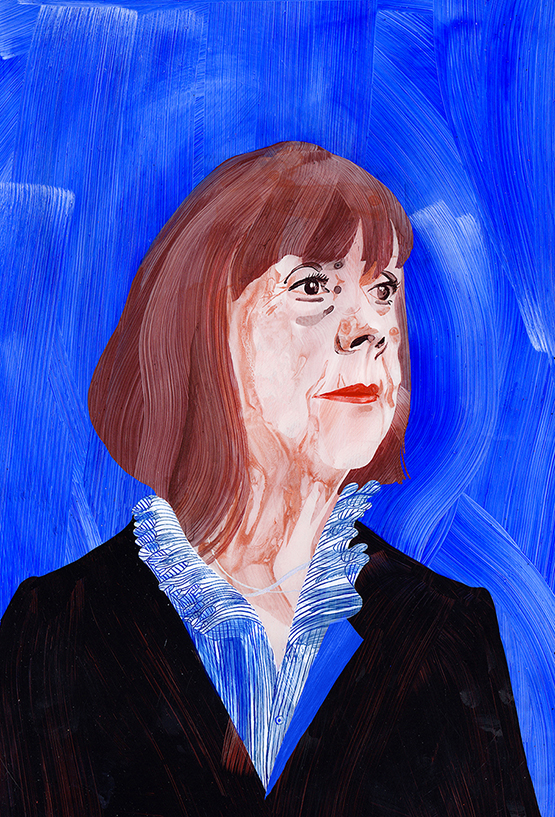
When Antoine Camus, Gisèle Pelicot’s lawyer, rose to deliver his closing argument in November 2024, he declared that his client’s case would put rape culture on trial. It would “invite the whole of society to take up this case, to make our debates the breeding ground for a new awareness, a change in mentalities”. Whispering to the room, he announced: “This trial is our Vietnam.”
Gisèle Pelicot did not quite feel the same way. Whatever the court decided, it would never be enough to account for the loss and devastation suffered by her and her children. As she pushed through the dense crowd – the verdict having just been delivered that her then-husband, Dominique Pelicot, and 49 other men had been found guilty of raping or sexually assaulting her – she looked into the pained eyes of the women surrounding her. These were women who had attended every day of the trial, forming a guard of honour for her, some handing her letters detailing their own assaults. Then, outside the Palais de Justice in Avignon, a “doughty women’s chorus broke into song”. A banner bearing the words “Merci Gisèle” unfurled. “It was all too much for me,” she writes in her new memoir, A Hymn to Life. “Now I was no more than a reflection, the object of public discussion, an image, an icon even, for some people. I was exhausted.”
In November 2020, Gisèle was summoned to her local police station – her husband of 50 years had been caught by a supermarket security guard filming up women’s skirts. But the contents of his computer revealed something far more incriminating: for nearly a decade, he had been secretly drugging and raping his wife, and inviting dozens of strangers into their home to abuse her. Four years later, when he and some of the other men stood trial, Gisèle’s decision to waive her right to anonymity made headlines around the world.
“Shame must change sides” is a phrase she used in court that became the defining refrain of her public life. The trial prompted extensive global discussion of sexual violence and consent, particularly drug-facilitated sexual assault, known in France as soumission chimique. Her image began to appear in street art; Queen Camilla sent letters of support; Emmanuel Macron thanked her for her dignity and courage. The German chancellor and the Spanish prime minister expressed their support on X. A petition was launched calling for her to be awarded the Nobel Peace Prize. She appeared on the cover of British Vogue.

What A Hymn to Life sets out to do is strip away some of the gilt from the monument, to bring Gisèle Pelicot down to a tangible scale. In so doing, a more nuanced, richly layered portrait emerges – a woman enraged, certainly, by the violence inflicted upon her, but also profoundly grieved by the loss of her marriage. On the day she gave her first statement in 2020, she went home and washed Dominique’s clothes. She wanted to sleep in her bed, the scene of her rapes. “He was nothing but a monster in the eyes of his children. It was heartbreaking to listen to,” she writes of the early days of his arrest. “I can still feel the sensation that swelled inside me the day I met him; it burns in me to this day, it hurts, but no one can take that away from me.”
In wrestling with these two irreconcilable images of her husband, and in cloaking herself in the uneasy haze of cognitive dissonance, Gisèle must confront an agonising – and profoundly divergent – response from her daughter, Caroline, for whom the collapse of the familiar into the monstrous is immediate and incredibly anguished. The morning after she discovers what her father has been accused of, Caroline grabs her mother’s plates and smashes them on the ground. “Did she let out screams that I held in, allowing herself to collapse as I did not?” Gisèle writes. Caroline tears down a painting her father had made of a naked woman. She rips up every family picture. When police discover two semi-nude pictures that appear to be of Caroline (this was never confirmed) in her father’s possession, doctors have to sedate her with a tranquilliser.
In the case of her daughter, it seems that Gisèle, so burdened by the weight of her own image of her husband shattering into that of a rapist, simply could not confront the possibility that he might also be an incestuous paedophile. “I was warding off the worst-case scenario, while [Caroline] was heading straight toward it,” Gisèle writes. In this tension, we witness the beginning of the disintegration of their family unit, as the Pelicots fracture and splinter throughout the book, in ways that are both devastating and deeply human.
Last year, Caroline released I’ll Never Call Him Dad Again, a memoir in which she stated that she and her mother no longer speak. “My mother let go of my hand in that courtroom,” she told the Telegraph. “She abandoned me.” During the trial, when Dominique was given a final chance to address his family, Caroline screamed at her father, saying he would “die like a dog”. Meanwhile, Gisèle was routinely described by the media as “dignified”. “The story was taking on a magnitude that we hadn’t anticipated… I had to embody it, set upright with my presence the tortured body that was being talked about all the time, give it a voice, a face, consciousness, elegance too, all the things that rape seeks to destroy,” she writes. “The Palais de Justice was suddenly at the epicentre of women’s suffering.”
What A Hymn to Life subtly exposes is a recurring tendency in the women’s rights movement of the 20th and 21st centuries: to take the most violent, devastating or tragic moments of a woman’s life and elevate them as symbols of the systemic misogyny faced by women everywhere. After Jackie Kennedy watched a bullet strike the upper right side of her husband John F Kennedy’s skull, she remarked shortly afterwards, “Now, he is a legend when he would have preferred to be a man.” What she could not have foreseen was that this fate would become her own: America’s widow, forced to carry the mantle of collective grief, her suffering subsumed by the world’s need for an emblem. When Malala Yousafzai was shot by a Taliban gunman in 2012 at the age of 15, the worst moment of her life, too, would come to define her public identity for years, while her real life continued, quietly and irreducibly, beyond it.
This stretches far into the past and pulses constantly in the present: Rosa Parks, Harriet Tubman, Anne Frank, Emma (now known as X) González. Women transformed into activists and figureheads by circumstance rather than intent are vessels for the pain and suffering of others, as if bearing witness to another woman’s struggle for justice might somehow ease the relentless weight of injustice in the world. Women’s suffering is often lifted out of its intimate, personal context and canonised, even as the women themselves struggle to reconcile the violence inflicted upon them with the complexity of their own lives.
There is an almost instinctive impulse to take the most harrowing experiences endured by women and, in an effort to make sense of them, to transform the victims into angelic, flawless, even deified figures. There is a further impulse to turn this canonisation into commodification, to slot these women into the same moulds someone like Michelle Obama or Hillary Clinton might occupy: to put them in Vogue, get them on popular daytime TV shows, adapt their stories for the big screen (Meryl Streep is reportedly in talks to play Pelicot in a TV series based on the memoir).
Yet for Gisèle Pelicot, the most powerful moments of inspiration during the trial came not from the glare of public recognition but in the quiet corners of the courtroom, in whispered exchanges with fellow survivors of sexual assault. A Hymn to Life is her attempt to resist canonisation: to tell readers how radically the trial altered her life, how in many ways it diminished it, how the crack does not always let the light in. It offers no consolation: she was not a superhuman, uniquely equipped to endure trauma. It almost killed her. She was a mother, too, rejecting her daughter. Yet, as the victim of one of the most horrific rape cases in history, she writes that she has, in her seventies, become “a martyr, the symbol of a new feminist wave that I hardly knew a thing about”. She would prefer her story to be “an example”, her name a “battle flag” – not the war itself.
There has been, beyond doubt, a meaningful shift in France in the wake of this trial. The French parliament redefined rape, embedding the necessity of explicit consent into law. The new legislation shifts the focus from proving violence, coercion or surprise to recognising any sexual act committed without consent. Caroline now leads the charity #MendorsPas (“Don’t Put Me Under”), raising awareness of drug-facilitated rape and supporting survivors. And yet the numbers resist any easy triumphalism. Thirty men in the videos of Gisèle Pelicot remain unidentifiable. As of 2025, 35 per cent of French women report having experienced physical and/or sexual violence since the age of 15 – four percentage points higher than the EU average. Perhaps that is why Gisèle takes a small measure of comfort where she can. “It fills me with relief to think that a woman who wakes up, unable to remember what happened the night before, might think of me – or rather my story,” she writes in the final pages of A Hymn to Life. Not as a martyr, but as proof that survival is possible. It is time, however, to release Gisèle from her status. She may be a legend, but we must allow her to be a woman.
A Hymn to Life: Shame Has to Change Sides
Gisèle Pelicot
Bodley Head, 256pp, £22
Purchasing a book may earn the NS a commission from Bookshop.org, who support independent bookshops
[Further reading: The depravity of Jeffrey Epstein’s reading list]
Content from our partners



Related



This article appears in the 04 Mar 2026 issue of the New Statesman, Trump's global terror
Join the debate
Subscribe here to comment