
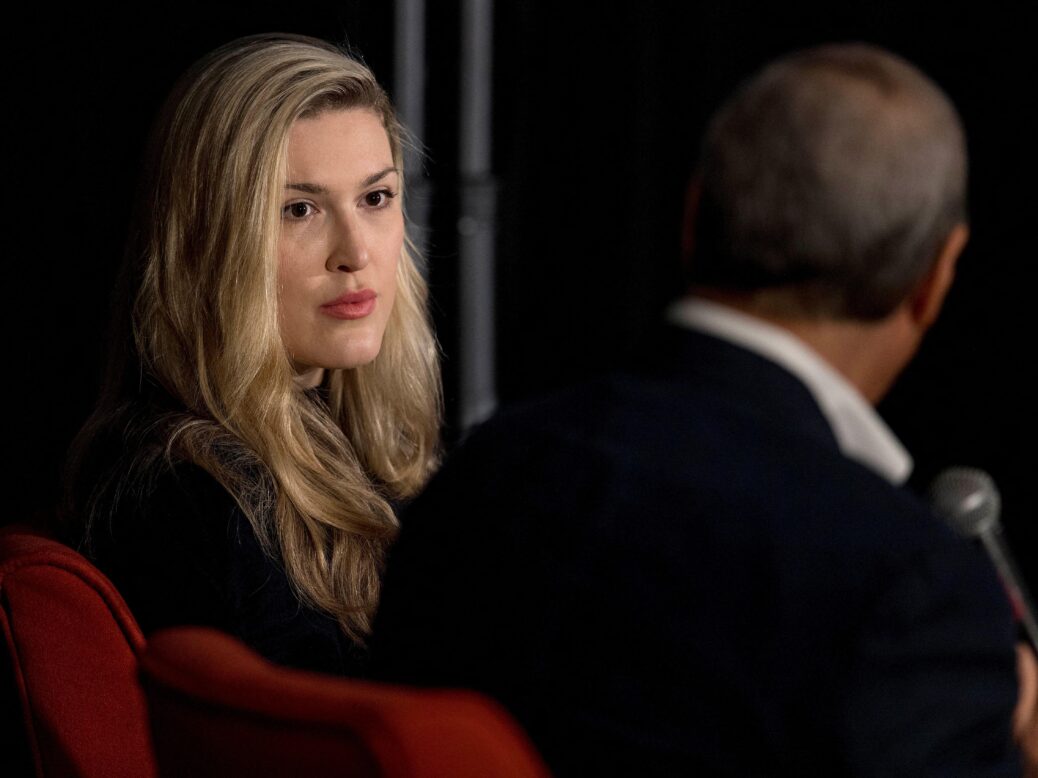
After a bullet bounced off Donald Trump’s upper right ear, it was New York magazine’s Olivia Nuzzi whom he allowed into Mar-a-Lago. “There, on the tiniest patch of this tiny sculpture of skin, a minor distortion that resembled not a crucifixion wound but the distant aftermath of a sunburn,” she wrote in September 2024. She revealed that Jeff Bezos had called him after, that Mark Zuckerberg had told Trump: “I will never vote for the people running against you after watching what you did.” In 2019, she had shared Bloody Marys with Rudy Giuliani, recounting how he fell against the wall but kept walking, how his fly remained unzipped throughout their meeting, how he swapped between his three phones, how he mashed olives in his teeth while he talked. When she profiled Stormy Daniels in 2023, she revealed that the woman who had been paid $130,000 to deny that she had an affair with Donald Trump had a doll, Susan, sitting in a highchair in her room that she believed was possessed by the spirit of a child from the 1700s. Then, in June 2024, she profiled Michael Cohen’s transition from Trump’s fixer to a key antagonist and witness, detailing the agony of his betrayal. “At times, I miss him,” he told her, “the old Trump.” Her exposé in July that same year, “The Conspiracy of Silence to Protect Joe Biden”, was the first of its kind in the mainstream liberal media, in which she thoroughly detailed how Biden’s staff and the First Lady acted as intermediaries between the President and the media: prompting Biden, shuffling him away from demanding reporters, guiding interactions. Three weeks later he stepped down.
Olivia Nuzzi was an exceptional journalist, endowed with the rare ability to put some of Washington’s most egotistical, hardline, middle-aged Republicans at ease. She discerned their insecurities and exposed them to the world. She punctured their machismo. She broke major stories and understood the intrepid, sex-driven triangle of American power. One of her cover stories sits framed above my bed. I read everything she wrote.
In American Canto, her first book, that Olivia Nuzzi is gone. She is as distant as Biden and Giuliani. Now she writes of herself as “the female avatar of Icarus”, her image a “ship that has sailed and sunk”. She is, somehow, both a baby deer – “half fawn and half mustang” – and an ordinary deer. She is a coyote, an antelope, Jonah and Ulysses. The town crier; a failed child actress; Hitchcock blonde; a victim and a witness; a “walk-on guest star” in her own magazine’s office. Grieving orphan, jilted fiancée, clandestine lover. The one thing she is not is contrite.
To put it more plainly than she appears to be able to, Olivia Nuzzi, 32, is the former New York magazine Washington correspondent who entered into a suffocating, frenzied, non-physical affair with RFK Jr, who was a candidate for the 2024 Democratic nomination when they met. She was, at the time, engaged to the chief Washington correspondent for Politico, Ryan Lizza, who, prior to their engagement, had been fired from the New Yorker for “improper sexual misconduct”.

Readers will have forked out for American Canto hoping to resolve a single, obvious question: Why did you have a relationship with an anti-vaccine frog whose brain was found to contain a parasitic worm larva rattling around in it? To answer it, they may willingly drag their weary eyes across 303 pages of unabridged, seemingly unedited claptrap. She leans heavily on staccato, single-word sentences – “Fist. Flag. Flame,” reads one section. Each so-called “character study” of the nation is smothered in nonsensical metaphor: American flags “thrash in psychedelic distress” and “wink beside lanes that bend to borders”; a crowd at a Republican debate “had one heart and it was beating very fast. Like a hummingbird, but huge” (a condor, perhaps?). She attempts to cover the California wildfires, microplastics, drone strikes, a viral video of a raccoon eating cotton candy, Charlie Kirk’s assassination, Bashar al-Assad (“whose regime made people who smiled into bodies”), the Iraq War, the Afghanistan War, the Vietnam War, Nancy Pelosi, Salvador Dalí and… Law & Order.
But, despite the scale of her ambition, Nuzzi’s story and her public trajectory has already become co-authored. Following the serialisation of the first excerpt of American Canto in Vanity Fair, Ryan Lizza published the inaugural entry in a series of acidic Substack confessionals about the fallout of their own relationship, and Nuzzi’s various alleged betrayals (failing to mention the affairs she has accused him of). The first recounted the moment he discovered Nuzzi was unfaithful – not with RFK Jr, but allegedly with a candidate for the Republican presidential nomination in 2020, Mark Sanford. The subsequent entries detailed erotic poems RFK Jr, now the United States secretary of health and human services, had composed (“Yr open mouth awaiting my harvest. Drink from me, Love”), her covert involvement in his campaign and Kennedy’s pregnancy kink. Lizza, for what it is worth, emerges poorly – his interminable tirades resembling more a form of revenge porn than rigorous reportage.
American Canto is something else altogether. It is not a memoir, nor a tell-all, nor a book about Donald Trump, Nuzzi insists on the jacket copy. Instead, it is, allegedly, “something more artful and more interesting” – a “character study of a nation undergoing radical transformation in real time”. It is in fact a choppy, chapterless, transitionless 303-page dreamscape – a series of short passages that blend her reporting, her parents, her hikes along the Pacific Ocean, and, briefly, her fling with RFK Jr. The book was written on her phone as she walked. The project was perhaps imagined by her and her publishers as her De Profundis moment, an act of literary absolution. That letter, after all, was praised by Max Beerbohm for revealing “the spectator of Oscar Wilde’s own tragedy. His tragedy was great. It is one of the tragedies that will always live on in romantic history.”
If Wilde became the spectator of his own tragedy, Nuzzi has become the spectacle of hers. She casts herself in the imagery of an assassin on the run: she writes “from exile”; she is “being hunted”. She has taken a “vow of silence”; she gives fake names in coffee shops. She has been “grabbed by the hands of the country” – a country that later “snaked its hand up her skirt”. She “walked through hell and she took notes”. Tangled in her own metaphors, she is so intent on mythologising her public humiliation that she never stops to consider what any of it is actually about.
The cacophony of detail and allusions ultimately feels like an attempt to blur ethical boundaries – to convey to readers just how extraordinary the last decade of American history has been – and, ostensibly, to account for how she came to dub a very dangerous man her “big rabbit”. Didn’t we all lose our minds, she asks? Doesn’t it, in some perverse way, make sense? Isn’t this precisely what “she – and we – endured over the past decade”?
I, for one, do not recall finding the past ten years of politics so mind-boggling that I ended up in the DMs of a conspiracy-theorist lizard man. Nuzzi’s reckoning with this scuzzy affair, the one that ended her seven-year career at New York and humiliated her for violating one of journalism’s most fundamental ethical rules (don’t fall in love with the subject, and if you do, don’t continue to write about them), is incomplete. How can you objectively report on an individual running for the highest position of power if you are in a sexual relationship with them? How can you accurately compare them to their competitors when you are, quite obsessively, in love with them? “I would not like to think about the worm in his brain that other people found so funny. I loved his brain,” she writes. Nuzzi sounds like a friend in the early sessions of much-needed therapy, eager to rationalise every mis-step by invoking “what has happened to them in the past”. It is the TikTokification of moral retribution and repentance: the sub-Freudian notion that childhood trauma, the political climate, or simply being the woman in a sexual relationship with a man can absolve a person of free will.
Her personal life, she claims, merely “collided” with the public interest; her world “skidded to a halt”. When she “slipped” – ie, sexted a man who has directly contributed to more children dying from measles – she was “swallowed whole”. The blame falls entirely on the tabloid media, whom she unimaginatively accuses of “provoking a hard-to-contain blaze that would spread fast and burn hot”. She does not outrightly name the publication, but one can assume she is referring to the New York Post, which has written 31 articles about her since September 2024. This, she assures us, was hyper-domestic terror, as the tabloid media fixated on the rumour (which others might call the truth). RFK becomes merely “The Politician”, her ex-fiancé “the man I did not marry”. Presumably, Nuzzi does this to reclaim her narrative, excising the men who detonated her career. Instead, it reads as pure cowardice – a refusal to acknowledge their raw, ugly natures in her “retelling” of the last decade.
“I’ve done nothing wrong,” Trump reportedly told her nine times in 30 minutes after the FBI raid on Mar-a-Lago. “That we build our own reality is an idea supported at different degrees by different sciences,” she writes. The US President wanted to be in the movie business – a critical detail, she emphasises, never to be forgotten – before Nuzzi later segues into her own childhood acting ambitions. The whole affair, she claims, is “more meaningful and more meaningless than you might think”. Politicians, apparently, will do absolutely anything to get what they want, and are frequently delusional. This, in turn, might be a high-minded exercise in metaphor – standing naked before the mirror, like Bob Dylan’s president, to confront all one’s flab. Or it is a devastatingly ironic failure: an author so unable to face the flab that she must liposuction it into pseudo-profundity.
In Nuzzi’s telling of her relationship with RFK, she wandered too close to the Maga bonfire and was shocked when the inferno “swallowed her whole”. She admits that many of her friends are entrenched in the Trump administration. According to Lizza’s Substack, during late 2023 and all of 2024, her “near-total” obsession with RFK seeped into every corner of her life and affected every relationship she had. This included “her catch-and-kill operations on his behalf, the campaign strategy memos she wrote him, and the other journalistic transgressions that have still not been disclosed”.
Even still, she prays that he will be protected, that God will use him as a force for good. She might want to double down on those prayers. Kennedy’s nonprofit, Children’s Health Defense, has contributed to the hardening anti-vaxx atmosphere in the United States. This year alone, there have been 1,828 measles cases – 66 per cent of them in people under 19 – and three deaths.
The great tragedy of American Canto is not, as Nuzzi might have hoped, her need to flee to California – it is the years’ worth of material she has squandered on a haphazardly written book. For readers who followed Nuzzi during her early New York days, the content and quality of this book will come as a genuine shock. As the Washington correspondent, Nuzzi was best known for her nearly unparalleled access to Donald Trump – having, astonishingly, first interviewed him at only 21. Her prose was once taut, subversive and rich with details about Washington’s ruling class that few others could have obtained. In her seven years at the magazine, she had 15 cover stories.
Her 4,300-word profile of RFK Jr, which ultimately precipitated the affair, is one of her most compelling interviews. She called him a “Frankencandidate”. He was paranoid, insecure – he had a patchwork of scattered policies. It overflows with outrageous details; describing his Toyota minivan, she wrote: “Rearview mirror smashed to bits, seat belts chewed off, cushions gnawed open, filth and dog hair covering every surface. The death machine smells so bad I thought I might pass out after about 15 seconds riding shotgun… The dogs barking and toppling over in the area of the car that theoretically should contain back seats but instead holds a wooden bench. ‘Shut up, you idiots!’ he told the dogs.” (“He scared me. I liked that. It interested me,” she writes of this encounter in the book. Several pages later, after the affair is revealed, she also writes, “He yelled himself foreign. The man who yelled was not the man I thought I knew.”)
Within American Canto lies fragments of the book Nuzzi had long been destined to write – an incisive account of Trumpworld seen by an outsider who kept being pulled, reluctantly, back into its orbit. The President, she notes, was often the one who would call her directly. She reveals that he inherently distrusted anyone who worked for him. Unfamiliar with how group chats function, Trump inadvertently sent a message mocking his cabinet secretary to, among others, that very secretary. He asked Nuzzi to name anyone who spoke ill of him off the record. During his first administration, her phone had become a “hive of nefarious activity,” as backstabbing aides circulated tips about one another. On one occasion, the book details how he tore up a page of unfavourable press coverage, crumpled it, and hurled it at a military general.
Where Nuzzi strays from this, she veers into a complicated, underexamined relationship with her own physical appearance and how it relates to her work. The book is littered with various anecdotes of strangers approaching her to comment on how she looks. A high school girl tells her she resembles a baby deer. A man on a motorcycle blows her a kiss. Another man in a white car calls out to tell her that she is so beautiful it feels “like God”. A dozen boys, no older than 13, swarm around her with their phones out. There is a foreign White House photographer who she cannot understand “beyond the vague comprehension that he is communicating approving observations” about her appearance. A group of elderly women stop her to say how pretty she is. “Oh, thank you. So are you. I always say that. I usually mean it at least a little, but I always say it in a way that is false – a performance of the kind of femininity these women valorize. It always goes over well,” she writes.
The first time Donald Trump met her, he called her “very young and very beautiful” (though when he later disagreed with her coverage, he labelled her a “shaky and unattractive wack job”). A Trump adviser once claimed that Nuzzi had flirted with him and used her appearance to manipulate him (she denies this). She is acutely aware, she says, of her whiteness, her blondness, and her height. “Olivia, the secret to life is to be rapeable,” a movie star once told her at a Washington cocktail party, “you are rapeable.” This is the point in which you might hope that Nuzzi finally challenges this – where she confronts the cruelty and moral rot of the world in which she was enmeshed. This judgement does not come. Later on, she makes the point that her threshold for what she considers inappropriate behaviour from men is “much higher than modern standards,” which she views as “absurdly low”.
Then why is she telling us this? If none of these interactions seemingly meet her skyscraper threshold for slobbering men, then why mention them? Is this just an excuse to brag, or a not-so-subtle allusion to the awesome power of blondes in Trump’s America? Was she invited to inspect Donald Trump’s sunburnt ear because she has Mar-a-Lago face? None of this, it seems, is particularly worth pondering. Nuzzi appears more interested in cashing in on the culture than in diagnosing its sources of power.
In The Journalist and the Murderer, Janet Malcolm observed that “every journalist who is not too stupid or too full of himself to notice what is going on knows that what he does is morally indefensible”. They prey on vanity, ignorance or loneliness, gaining a subject’s trust before betraying them. The worst part, she wrote, is how they justify it to themselves: “The more pompous talk about freedom of speech and the public’s right to know; the least talented talk about Art, the seemliest murmur about earning a living.” And what might she have thought of Nuzzi’s “more artful and more interesting” American Canto?
Against Malcolm’s standard, the question answers itself. She has indulged her own vanity and violated the trust of her readership. “I lied for him,” she writes of RFK Jr; “It would not be the last time.” She went on to feature him in her reporting even after he had first hacked up an erotic poem for her. She was hardly stupid, but she may have been far too enamoured of her own mythmaking to recognise how ethically ruinous the situation had become. In American Canto, she makes a specific point of the fact that she entered the profession at a time when female journalists were handcuffed to the personal essay format. She makes a specific point that she is glad to never have done this. In 2015, she tweeted, “Why does Hollywood think female reporters sleep with their sources?” with an accompanying article by Marin Cogan. Cogan cites House of Cards – with its two women reporters who boast of being willing to “suck, screw, and jerk anything that moved just to get a story” – as well as Nightcrawler, Top Five and Thank You for Smoking. Female hacks in films, the piece argues, are simply “slutty ambition monsters”. A decade later, Nuzzi now jokes about who might portray her in a film adaptation of her book. In the end, she embodied precisely what every misogynistic X troll had accused her of – and what she had spent just as many years repudiating.
American Canto, then, is both Olivia Nuzzi’s greatest success and her most detrimental failure. She is now a household name to anyone with an X account or any familiarity at all with the New York Post. Lisa Taddeo, came out, rather bravely, to defend her and condemn “the attempted patriarchal mass murder of this woman’s career”, comparing it to a “freaksome lynching the likes of which we will look back upon with a dazed compunction”. Jessica Reed Kraus, who has long chowed down and regurgitated RFK’s most asinine conspiracy theories, invited her on the House Inhabit podcast, which, I’m sure, at least ten people watched.
But her tell-all-that-is-not-a-tell-all has phenomenally undersold after nearly every major, minor and minuscule publication panned it. Three days after its release, it sat at No 5,546 on Amazon’s bestsellers rank. She has now lost her new job as Vanity Fair’s West Coast Editor. She will, most likely, never work as a political correspondent again. On a recent episode of The Bulwark Podcast, when host Tim Miller asks her to reveal anything in the public interest that RFK has done, she replies, “I think people have taken from me quite a lot over this process; how much more do I have to violate myself?” The man she still seems to be infatuated with left her as soon as the first headline splashed across the New York Post. Eighty-seven per cent of respondents to a survey think she is a CIA operative.
None of this unfolded as she imagined. The rumour, the truth, the salacious, impassioned love affair she had hoped would resemble Luchino Visconti’s The Leopard looks more like a gropey kiss in a Magaluf nightclub. Perhaps in a few years, with Trump in his third term, Nuzzi will rise from the California ashes, grinning through the tears as White House press secretary with a croaking septuagenarian on her arm. Perhaps, like all great cancellation tales, she will become the face of an underperforming podcast. For now, this Hitchcock blonde finally has her starring role, even if she seems to have forgotten what happens to them in his films. Perhaps that was all she ever wanted. Perhaps that is all she deserves.
[Further reading: Piers Morgan on monarchy, Rupert Murdoch and Paul Marshall]
Content from our partners



Related

Join the debate
Subscribe here to comment