
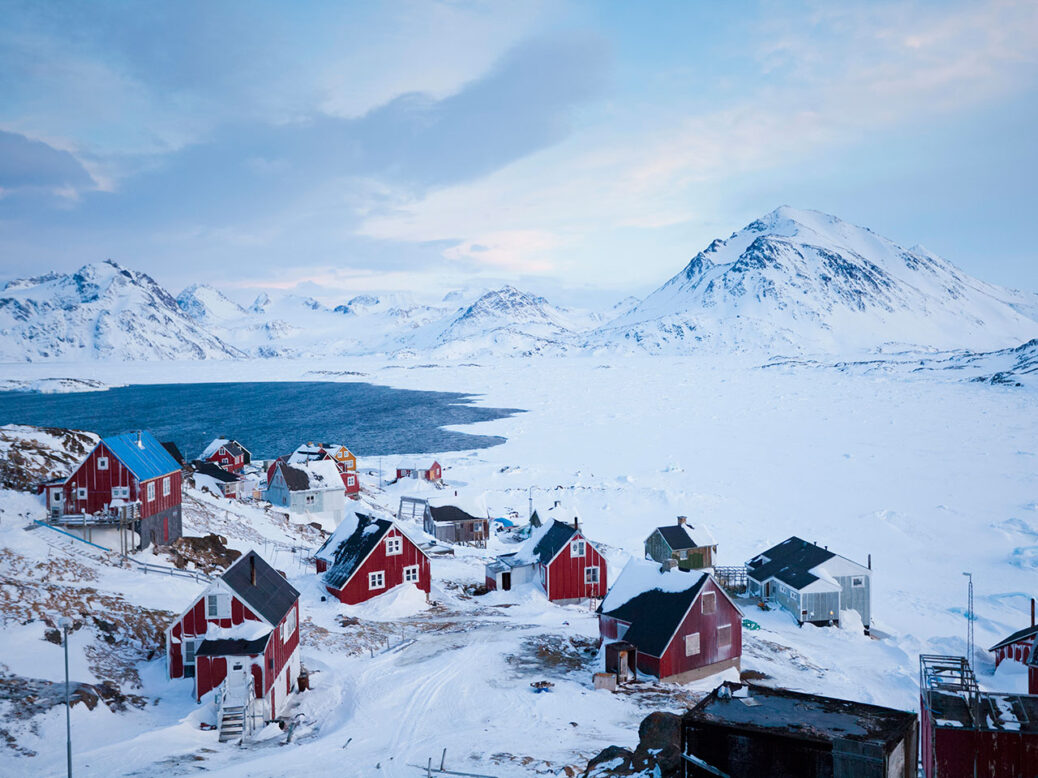
Early one morning in the waning days of Donald Trump’s second term, a contingent of US marines leaves the Pituffik Space Base in northern Greenland under the guise of a training exercise. They secure the territory’s airports and take control of key ports. US Special Forces land in the capital, Nuuk, where they confine the roughly 100 personnel at Denmark’s Joint Arctic Command to their homes and seize Greenland’s Ministry of Justice. The internet goes down across the island; all communication with Copenhagen is severed. At 6am, Trump posts an update on Truth Social: “Greenland now belongs to the United States of America.”
This scenario is obviously fictional, explains Elizabeth Buchanan in So You Want to Own Greenland? Lessons from the Vikings to Trump. But the US president’s interest in the Arctic island – and the strategic rationale behind it – is real, and we should take seriously his talk of making Greenland the 51st state. Since returning to the White House Trump has insisted the US needs Greenland, an autonomous territory within the Kingdom of Denmark, “for national security” and “international world security”. He refuses to rule out the use of military force to take control, vowing in a speech to Congress in March, “one way or the other, we’re going to get it”.
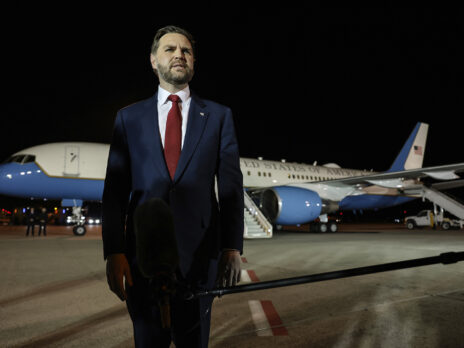
When Trump raised the possibility of buying Greenland during his first term in 2019, the idea was treated as a joke. The president himself posted an image of a gold-coloured Trump casino superimposed on the Arctic landscape with a promise “not to do this to Greenland!” But the Danish government, a long-standing US ally and founding member of Nato, and Greenlanders themselves, were less amused, stressing the territory was not for sale. Trump appears undeterred. In March, the US vice-president JD Vance was dispatched, along with the then national security adviser Mike Waltz and the energy secretary Chris Wright, to tour their base in Pituffik, the highest-ranking US delegation ever to visit the territory.
There, Vance accused Denmark of failing to secure Greenland against supposed threats from Russia and China, and not doing enough to support the island’s approximately 57,000-strong population. “Because we think the people of Greenland are rational and good,” Vance said, “we think we’re going to be able to cut a deal, Donald Trump-style, to ensure the security of this territory, but also the United States of America.” Greenlanders themselves are less convinced. Just 6 per cent of those questioned in a January poll said they were interested in joining the US. Twenty-four hours after Vance’s visit, Trump reiterated that he would not take forcible annexation “off the table”. “We’ll get Greenland,” he assured NBC News. “Yeah, 100 per cent.”

Buchanan, a senior fellow at the Australian Strategic Policy Institute who co-founded the polar warfare programme at the US’s West Point military academy and has authored books on Arctic strategy, views an outright US military takeover of Greenland as unlikely. She lays out four scenarios for the territory’s future that range from full independence from Denmark to integration with the US, or, in her assessment the most likely option, a continuation of the status quo, albeit with a bigger US military presence and more foreign investment as Greenland seeks to reduce its economic dependence on Copenhagen. But she warns that climate change, which is melting Greenland’s ice sheet and opening up new maritime trading routes in the Arctic, is reshaping the region and transforming it into the “next geopolitical flashpoint of our time”, only strengthening its strategic importance for Washington.
“There is simply no denying it: Greenland is a strategic North American island – a barren, loosely defended stepping stone into the American homeland for the enemy,” Buchanan writes. “This valuable piece of real estate is beautifully placed between the US and its long-standing competitor, Moscow. Any military wonk or planner would see the utility in a well-sourced forward base for US defence interests in Greenland.” Then there are the vast mineral resources thought to be buried beneath the territory’s rapidly receding ice. “The reserves of critical minerals may be such that Washington can overtake China in the production and supply of resources,” she argues. “Breaking Beijing’s stranglehold on global supply chains in the critical mineral space is necessary to maintain strategic advantage in geopolitical terms and stay at the tippy-top of global power.”
Yet Greenland’s history offers a cautionary tale to foreign powers attempting to “own” the territory, beginning with the Vikings in the tenth century. Around AD 982, an intrepid Viking named Erik Thorvaldsson – known as Erik the Red – was exiled from Iceland for killing a neighbour and discovered the much larger island to the west, which he called “Greenland” in an attempt to attract fellow settlers. Approximately 25 boats, and around 500 people, duly followed him to Greenland, and established two colonies in AD 985, where they raised cattle, sheep and goats, and traded ivory from walrus tusks and seal furs for the next five centuries. But then the Greenland Vikings abruptly disappeared. Archaeologists have since searched for answers as to what happened; whether they could have been wiped out by disease, conflict with the local Greenlandic Inuit population, or sustained drought.
Buchanan finds little evidence to support the idea of a “colony-ending war” or the mass graves that would indicate a catastrophic outbreak of disease. More likely, she concludes, the Viking colonies in Greenland simply died out, less able to adapt to the changing climate than the nomadic Inuit, and with their primary export – ivory – rendered much less valuable by the growing trade in African ivory. Portugal briefly laid claim to Greenland in the late 15th century, but it was not until 1721 that the next foreign mission arrived. Hans Egede secured permission from the king of Denmark and Norway to travel to Greenland and share the Lutheran faith with the Inuit population, which proved remarkably successful. More than 90 per cent of Greenlanders today say they belong to the Lutheran Church. Egede’s mission also marked the beginning of Denmark’s colonisation of the island.
The US approached Denmark multiple times to inquire about the possibility of purchasing Greenland, first in 1867, shortly after buying Alaska from Russia, and then again in 1910, eventually acquiring the Danish West Indies, now known as the Virgin Islands, for $25m in 1917. After the Second World War, the then president Harry Truman proposed buying Greenland for $100m in gold. A declassified memo from a US State Department official in 1946 assessed control of Greenland as “completely worthless” to Denmark and “indispensable to the safety of the United States”. Copenhagen did not agree.
In 1953, Greenland officially transitioned from a colony to a district within the Kingdom of Denmark, and then, in 1979, into a “distinct community” within the Danish realm, with its own parliamentary assembly and the promise of future autonomy. In 2009, the Act on Greenland Self-Government established Greenland as a “distinct nation” under international law, which was guaranteed the right to self-determination and given more responsibility for domestic affairs, although Denmark still retained control of foreign affairs, defence and security policy. While nominally now on track towards full independence, which the main political parties in Greenland all advocate, the territory has struggled to determine how to extricate itself from its economic reliance on Denmark which provides an annual block grant equivalent to approximately 20 per cent of Greenland’s GDP.
“An apt sentiment that captures Greenland’s position is that famously espoused in the film Brokeback Mountain: ‘I just can’t quit you,’” writes Buchanan. “There is no way of avoiding the inconvenient truth that Greenland relies overwhelmingly on Danish funds to support socio-economic development and make possible its day-to-day prosperity.” Perhaps the longest-running struggle to “own” Greenland is by the Greenlandic people themselves.
So You Want to Own Greenland recounts the territory’s extraordinary history from the rise and fall of those first Viking colonies to the US military presence on the island during the Second World War, when Denmark was occupied by Nazi Germany, and the subsequent US operation to build a secret underground military facility under the Greenland ice sheet during the Cold War. Despite spanning two millennia of complex geopolitics, Buchanan’s prose is mercifully brisk and punctuated by frequent asides – “more on that later”, “looking at you, Russia”, “boring, I know” – which will either strike the reader as witty and engaging or somewhat cringeworthy, depending on your constitution. The overall experience is the textual equivalent of sitting down for a beer with someone who just happens to be an expert on Arctic security and wants to fill you in on the backstory to Trump’s recent overtures.
Those efforts appear to be ramping up. On 27 August, Denmark’s foreign minister summoned the top US diplomat in Copenhagen over reports that American citizens were attempting to infiltrate Greenland and promote independence. Danish intelligence agencies warned that the territory was the target of “various kinds of influence campaigns” that aimed to “create discord in the relationship between Denmark and Greenland”. He might not yet be preparing to deploy US marines, but no one thinks Trump is joking about his determination to acquire the Arctic island any more.
So You Want to Own Greenland? Lessons from the Vikings to Trump
Elizabeth Buchanan
Hurst, 208pp, £15.99
Purchasing a book may earn the NS a commission from Bookshop.org, who support independent bookshops
[See also: How Labour learned to love the flag]
Content from our partners



Related


This article appears in the 10 Sep 2025 issue of the New Statesman, The Fight Back
Join the debate
Subscribe here to comment