
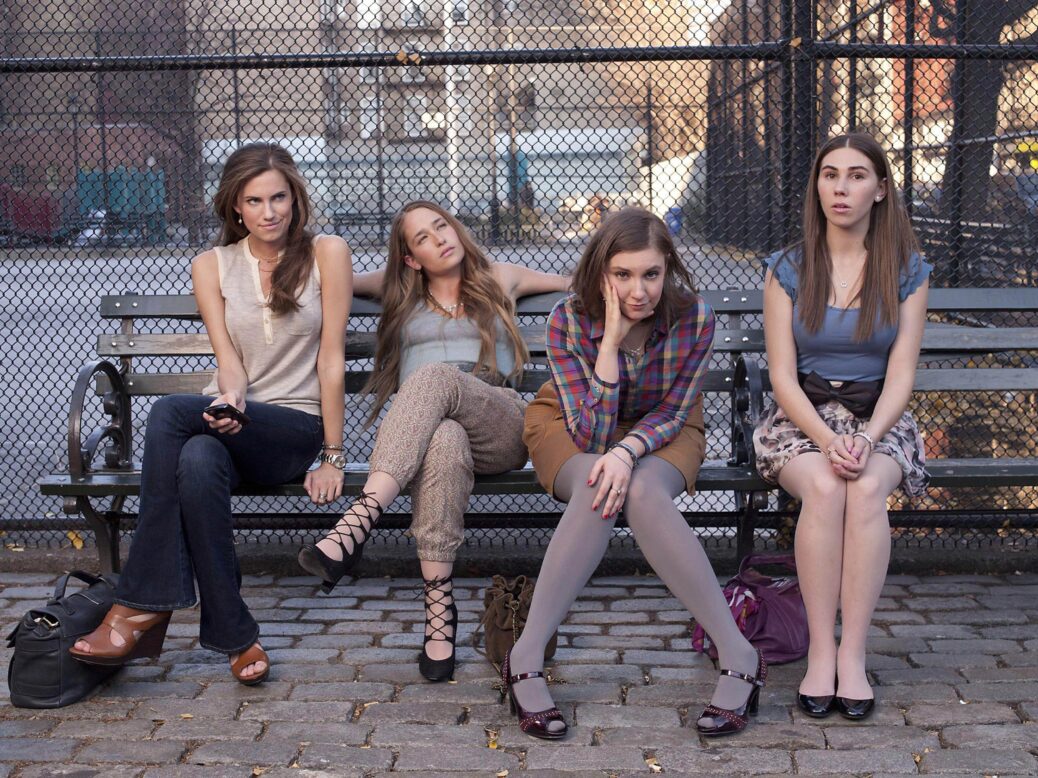
Sometimes a voice, no matter how solipsistic, might stand for a generation: it was certainly how people described Lena Dunham in 2012. For Dunham the auteur, whose stock-in-trade is to reveal the most bizarre and compulsive parts of the psyche, what happened after her extraordinary burst of fame, as explored in Famesick, is entirely clear. Starting around 2012, in the Wild West days of social media, she lived online while filming her six-season smash TV show Girls and read everything that people were writing about her. This often focused on her weight, her face, her voice and her entitlement. The actors in her show were “nepo babies before the term existed” – Zosia Mamet (Shoshanna Shapiro) was the daughter of David, and the transatlantic ingenue Jemima Kirke (Jessa Johansson), “part Lolita, part Keith Richards”, was the daughter of the drummer from Free. When Dunham saw a negative post, she replied to it: then she searched for a positive one to balance out the feeling in her body. This process had a “profoundly corrosive” effect, and Dunham’s body kept the score. She spent the first part of her adult life (she is now 39) trying to manage physical illness, including endometriosis, addiction to anti-anxiety drugs, and dissociation – but she never stopped working, and that’s really what this book is about.
By the late Noughties, you could see the beginnings of an appetite, in music and film, for women to tell write about their amusing, messy realities. Dunham’s effortless pitch for a Sex and the City about girls who had not yet established themselves in New York, and were languishing in shitty internships thinking they were deserved so much better was leapt on by HBO and executive producer Judd Apatow. Yet the funny-messy perspective was not the common filmmaking lens it is now, and Dunham – raised by parents who “took me to see performance art where women writhed and yelled and jerked off” – was a victim of the cultural transition. In her 2014 essay collection Not That Kind of Girl she described, at seven, examining her younger sister’s vagina out of curiosity, bribing her with sweets to kiss her on the lips. The conservative media site TruthRevolt (in the same tone of voice that now governs American media) dissected the passages – not with the satire that, say, Jezebel did, when it put a $10,000 bounty on unretouched photos from her Annie Leibovitz Vogue shoot – but as a clinical accusation of child abuse. This moment changed the perception of Lena Dunham, while suggesting that we did not, in fact, want this kind of truth from women. It marked the beginning of her retreat from public life: after she’d been in bed for three days, her artist father, always her “comfort object”, told her: “Don’t you get it? You’ve won. You’re only 28 and you’ve been called a racist, a fat whore, an ignorant rich girl and a child molester. What else is left? Nothing. You’ve won.”
At the heart of Lena Dunham is the intense “quad” that is her family – when her father, Carroll Dunham, calls her from his studio instead of the main landline “it felt like we were having an affair”. He is always attuned to her feelings. Then there is Laurie Simmons, the mother, who will not engage with her daughter’s inner life but is fiercely protective of her eccentricity; she makes the kind of pronouncements that will shape a girl’s reality when they come from Mum. When Dunham told her she wanted to write this memoir, Simmons replied, “Oh Lena, but it’s such a sad story!” Dunham seems to have figured out the complexities of the relationship by her early twenties. She read Laurie’s diaries, recognised herself there, and wrote her acclaimed debut feature film, Tiny Furniture, for them to star in together.
Yet despite the cultural camaraderie, some early maternal connection of the simplest kind seems forever to have been sought by this brilliant, needy hole of a child. The more successful she is, the more she wants her parents – on triumphant nights such as the Golden Globe Awards, she sleeps on the sofa rather than in her childhood bedroom, so she can be a few feet closer to theirs. The love for her parents informs her relationships, appearing as a powerful projection with Jenni Konner, her mentor and co-showrunner on Girls. The meeting of minds is marred by soul-shaking moments of inconsistency, leaving Dunham feeling “unprotected” – like when Konner tells her she is too thin for the part, makes her eat cheeseburgers and says, “Good girl”.

We all know someone like Dunham, who takes up all the space in the room, who needs constant reassurance, who is brilliant but exhausting and always on the verge of self-destruction. In Famesick, this unfathomable personality type becomes a little easier to get a grip on. Bruce Springsteen told Dunham, “You do not have to tell the whole truth. You just have to show them how your mind works.” I believe she did not want fame but wanted, to the exclusion of everything else, to make films. That does not suggest a lack of ego, because indeed all the work is about her. But this is pathological and fascinating. There is barely a line between art and life. Dunham’s relationship with her Girls co-star Adam Driver is a case in point. Modelled on an unnamed, avoidant man who liked to use his fists, Driver’s part was a focus for Dunham’s real-life feelings. Yet she develops an infatuation with the actor, perhaps mutual yet confusingly unfulfilled. She goes through a version of the relationship again, just about holding on to her power because she is holding the camera. It seems to be an endless cycle in the work.
The press has pounced on the moment when Driver threw a chair at her, as they have on details of her five-year relationship with the record producer Jack Antonoff, to whom she once sobbed, “please don’t cheat on me, even though my insides are all gunked up and people are calling me a paedophile!” Dunham knows fame as Carrie Bradshaw knew sex, and gives elegant put-downs, my favourite being a moment with the TV host Barbara Walters, who said backstage on the set of The View, “There’s a lot to talk about in this show. I mean, anal sex in the first episode.”
“‘You mean sex from behind?’ I asked her. ‘Yes,’ she said, nodding. ‘Anal sex.’ I still think about this all the time – who told Barbara Walters that the only kind of sex you could have from behind was anal? What had her twenties looked like as a result?”
Yet the true value of Famesick is its insight into those people who really do live through their work. It is a rare analysis of the process of making art, and its neurotic effect on the nervous system when there is such a fine line between fiction and truth. Dunham’s friendships in the real world feel vague and unformed, but her Girls co-stars are lovingly illuminated through a director’s eye. She talks about the times she is unable to recognise her own face in the mirror, yet her art is a kind of disassociation too, as she stands just an inch outside herself and her friends, making it all look ever so slightly different for the screen.
The real body suffered, and Dunham’s litany of problems is endless – 37 lesions removed from her bladder, liver, abdomen and spine (“the doctor didn’t know how I had been walking”); an untreated broken elbow in the final scene between her and Driver, making the goodbye tears authentic. Some of the funniest writing comes on reproductive health, with the “comfortingly boundaryless endo surgeon of grandpa-age” who referred to smear tests as a “bagel and a schmear”. “I have loved being a woman, but I have hated operating the equipment,” she says. At an agonising pelvic examination, she wishes there had been a camera capturing the single tear rolling down her cheek; without it, “I would never be able to truly impress on anyone else the magnitude of what had happened”. I wondered then if all the work was a way of bearing witness to her internal suffering. She remains curiously adamant about focusing on the physical rather than the mental – I do not recall seeing the word “depression” once – perhaps because she does not like to think that her mind has, in any way, “failed” her.
The last ten years have been about attending to her health – a full hysterectomy, acceptance of her own body: “These days I tuck my stomach into my pants like an undershirt made of flesh.” There was a move to London, where she met the man she married, who slowly persuaded her she might be able to, you know, take a walk like a normal person, as well as finish a screenplay. The tenor and success of her future creative output as a writer and director remain to be seen. But at least we can no longer ask, “what happened to Lena Dunham?” Had that question been the end of the story, we would have to accept that we had not come very far at all.
Famesick
Lena Dunham
Fourth Estate, 416pp, £18.99
Purchasing a book may earn the NS a commission from Bookshop.org, who support independent bookshops
[Further reading: Is it still cool to be Jay McInerney?]
Content from our partners



Related



Join the debate
Subscribe here to comment