
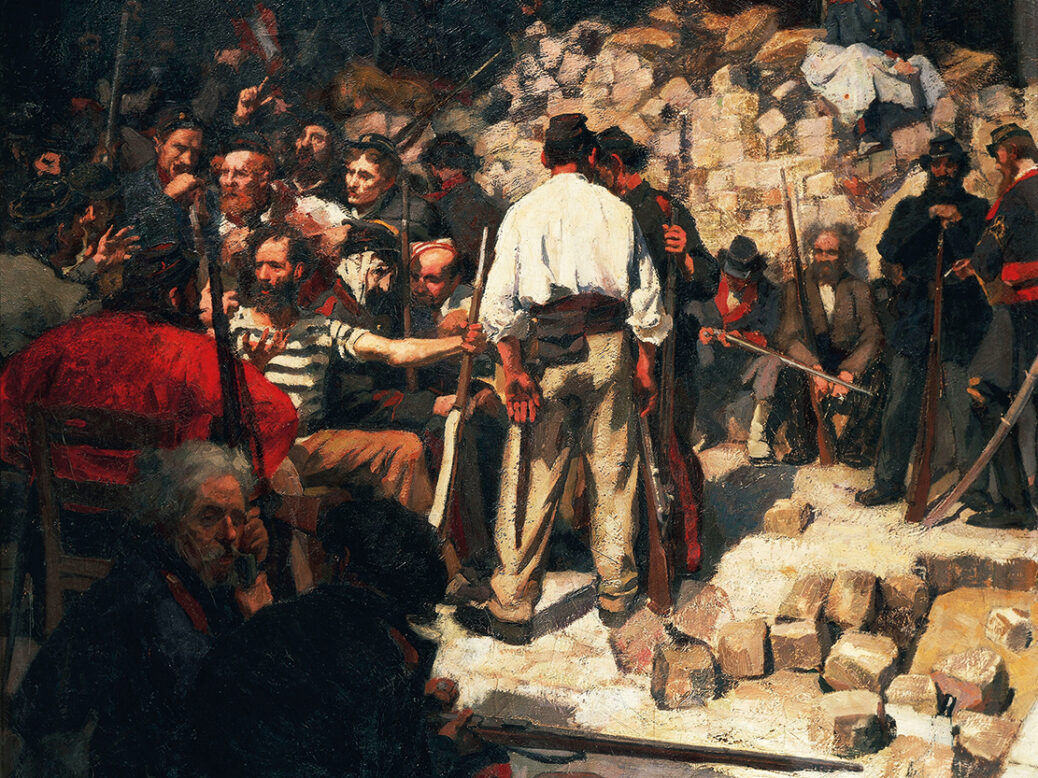
“Nations are not something eternal,” Ernest Renan warned in 1882. “They had their beginnings, they will end.” But when might that be, and what might follow? Renan thought that the 19th-century world of nation states would eventually give way to a European confederation, but that the time had not yet come for such a transformation. When he wrote his famous essay, “Qu’est-ce qu’une nation?” (“What Is a Nation?”), he believed that, for the time being, the continued existence of nations was “a good thing, a necessity, even”. Nations were spiritual bodies defined by the wills of their inhabitants, not by the blunt and brutal categories of race, language, religion, interest or geography. In his view, nations existed to unify the soul of a people, to protect their liberty, and to guarantee their rights and freedoms. Whenever that ceased to be the case, Renan suggested, new political formations would inevitably emerge.
In his new book, After Nations, the novelist and essayist Rana Dasgupta announces that this time has finally come. “The nation-state system falls short of the most common-sensical conceptions of equality and justice,” he writes. It has lost its “Byronic pathos”, for it has mutated in such a way that it is no longer a guarantor of individual rights and freedoms, but rather a threat to them. “We are at risk of losing protections built up over decades, even centuries, of struggle – and so finding ourselves politically naked,” he warns. Today’s states are little more than profit-making machines; citizenship is now a commercial good, human rights have been eroded and democracy is in retreat. Liberalism, “the religion of the modern nation state”, has lost its lustre and the apparent American embrace of imperialism threatens to inaugurate a dark new era.
For Dasgupta, these shifts mean the grand bargain between state and subject – the exchange of individual freedom for sovereign protection – has been fundamentally betrayed. In a recent essay in the Yale Review, he explicitly argues that a state becomes “more or less aligned with the interests of its citizens” as it moves up or down the economic ladder. According to this oddly linear equation, the US, having ascended to the top of the global hierarchy, is now approaching maximal unalignment, he suggests. This is not only because of the whims of the current occupant of the Oval Office, but also because it has lost control of the global distribution of resources; it is threatened by the rival power of its own corporations; it has made the law an instrument of extraction and subjugation; and because it can no longer guarantee work as a source of income for its citizens. In Dasgupta’s cosmology, the end of the liberal world order – the American order – also means that the “system of states itself” has lost “legal respectability”. He laments that we have strayed far from the Kantian idea of a world made up of independent states that form “a federation regulated by legal principles determined by a common code of international law”.
After Nations is a sprawling, affected, yet occasionally surprising tome. Dasgupta suggests that to salvage the emancipatory promise of the nation state, we must understand how it went so wrong. To that end, he offers several overlapping genealogies of the modern state, tracing its development from 13th-century France to Cold War America to contemporary China and everywhere in between. His narrative is dense with detail and historical ephemera, moving from the sale of Christ’s crown of thorns in 1237 to the collapse of the League of Nations to the recent market shock that was DeepSeek. It is a history of everything – God, finance, law, energy – that rushes through time at a furious clip. Dasgupta tells a grim tale of the nation state’s evolution, arguing that what was envisioned as a liberatory political formation has become a criminal capitalist enterprise, an engine of dispossession and domination. His proposed solution for this predicament is not to abandon the system but rather that “we build back, in another form, our shrivelling systems”. Build back better, then. But how?

Alas, After Nations does not provide a compelling blueprint for how the international order might be re-envisioned. The titular provocation is substantially addressed only in the concluding chapter, where Dasgupta offers a series of highly speculative and techno-utopian ideas for what a new world order might look like: he envisions a world community of “digital citizens” whose e-IDs make no note of their country of origin, and suggests “high-tech international integration” would offer “new ways of ‘shutting off the power’ to illegitimate governments” – without sparing a thought for civilians who might remain stuck inside. He rightly warns that “government by machines” could take an exploitative turn and that we should prevent the corporate capture of AI. But he also dreams of a world in which we have “AI systems that can monitor the opinions of an entire community”; where digital citizens “develop a body of international law worth the name”; where states “institute less rigid divisions between citizens and non-citizens”; where taxes are collected via blockchain; where a “new theology” takes hold across the planet and a “macrocurrency, backed by renewable energy and other scarce resources,” prevails.
This idealistic wishlist could not be more discordant with the times – and that is the point. Dasgupta is right to call for renewed political creativity, for hope rather than despair. Yet his insistence that these innovations could co-exist with much of the existing system, where digital citizenship evolves in “parallel to the existing kind”, and where new technologies supplement our corrupted political infrastructure, does not inspire confidence. Of course, states could institute some of these measures, and many already have. Digital ID systems are under fire as obvious security threats and surveillance mechanisms; in India, Kenya and the Dominican Republic, researchers have found that these systems can “lock in” statelessness, rendering minorities more vulnerable to hostile action. And while Taiwan’s experiment with algorithmic governance has been celebrated in the press, it is all too easy to imagine how AI opinion-monitoring systems could be weaponised against a population.
In his suggestion that there is a past to go “back” to, Dasgupta seems oddly nostalgic for a world that never existed. As he documents, the condition of all states is that they emerge from “giant expropriation”, and international law was developed in large part to sanction imperial domination and extraction. Nationalism, however romantic its origins, has always been accompanied by the threat of an unsheathed sword. Dasgupta writes admiringly of the 18th-century Italian nationalist Giuseppe Mazzini, who dreamed of a cosmopolitan network of nations bound by a “law of humanity” and believed that a revolution was necessary to bring such a confederation into being. Taking up the mantle, Dasgupta calls for the development of a new system of international law that would be subject to his “new theology” and would look “down from a great height on every parochial aggression”. These new laws, he argues, cannot derive from states (because “states are the criminals”) but rather must come from individuals.
There is no question that international law is overdue a reckoning. The legal scholar Yusra Suedi, for example, has suggested individuals should be able to appear before the International Court of Justice so that the rights of victims, not just those of nation states, can be recognised and protected in the Peace Palace. But compliance with international law has always been a function of political will and power and, absent the creation of a global police force, that will not change.
Dasgupta is a storyteller, and with this book he has attempted to tell a better story about how liberating “forms of sovereignty” might yet be saved. Like Renan, he has made a bid to jolt the “moral consciousness” of his time. Both men saw terrible things ahead and sought to write their way out of this predicament. For Renan, this meant allowing history to take its course: “Let us wait a while, gentlemen; let the reign of the high priests pass; let us bear the scorn of the powerful.” Eventually, a new dawn would come in which the opinions of the people would matter once more. After Nations rests upon this same conviction, but Dasgupta’s vision of the future of the nation leaves much wanting. Utopian solutions ring hollow in dystopian times. The modern nation state emerged from beneath the yoke of empire after much struggle, devastation and compromise, and the same will be true of the next tectonic shift. Until that day comes, let us all hope the trials ahead are swift, and that we can muster the sagacity to make it through.
After Nations: The Making and Unmaking of a World Order
Rana Dasgupta
William Collins, 496pp, £30
Purchasing a book may earn the NS a commission from Bookshop.org, who support independent bookshops
[Further reading: Gisèle Pelicot is not your hero]
Content from our partners



Related



This article appears in the 04 Mar 2026 issue of the New Statesman, Trump's global terror
Join the debate
Subscribe here to comment