
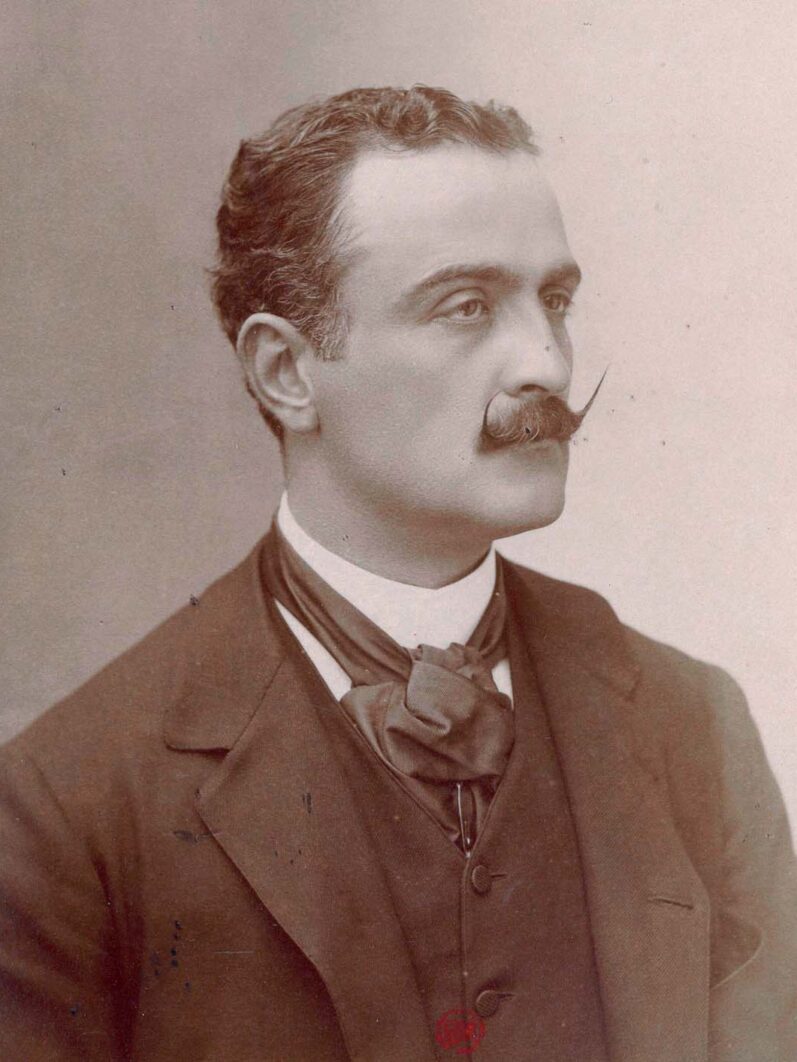
Where was fascism born? Many years ago, the Franco-Israeli historian Zeev Sternhell raised French hackles with his answer to the question. Fascism, he argued, was born not in early 20th-century Italy, but in fin-de-siècle France with the emergence of a new “revolutionary right” hostile to liberal democracy, obsessed with decadence and seeking a scapegoat for the ills of modernity in the form of Jewish people. One protagonist of this story was the Marquis de Morès, an anti-Semitic rabble-rouser whose strange and eventful life is now recounted in this new biography by Sergio Luzzatto, a leading historian of France and Italy.
Morès was born in 1858 into a rich aristocratic family with an imposing residence in Paris and a chateau in Cannes. Not unusually for young men of his background he joined the army, where he amassed gambling debts, enjoyed fencing and became an accomplished horseman. Having married the daughter of a Wall Street banker, and finding peacetime army life too boring, he set off to find excitement in the Badlands of the American Midwest.
His plan was to exploit the possibilities opened up for cattle farmers by the invention of refrigerated railway carriages. He built a large ranch in North Dakota from where he hoped to export his beef directly to the East Coast. Here he found himself transplanted into a lawless world of casual violence. This really was the Wild West. Ranchers like him had to organise vigilante groups to protect their herds against cattle rustlers. The most notorious of these called themselves the “Montana Stranglers”.
Soon after his arrival Morès was accused of having killed a cattle rustler. After some weeks in jail he was acquitted on the grounds he had acted in self-defence. This was not to be his first spell in prison.

Morès concocted ever-more ambitious and harebrained schemes: building his own North Pacific Refrigeration Car Company to cut out the powerful middlemen of the Chicago slaughterhouses; buying up New York retail butchers to get direct control over the sale of beef on the East Coast; marketing his own brand of Dakota tinned soup for export to France. All these projects failed. After five years he had to give up when both his father and father-in-law stopped bankrolling his fantasies any longer. On the verge of bankruptcy, he returned to France in 1887 after five years. This American experience had whetted his taste for violence and created grievances against the forces of big business, whom he blamed for crushing the efforts of independent entrepreneurs.
Morès now set his sights on French Indochina, where he proposed to build a railway network linking the port of Tonkin to China. His plans included the construction of a new city, just as in North Dakota he had founded the town of Medora (named after his wife) around his cattle ranch. Initially he managed to win the support of the French colonial authorities, but his schemes soon became caught up in political in-fighting in Paris. He left Indochina after a year, having added the politicians of the Third Republic to his lengthening list of enemies to explain his serial failures.
Morès returned to Paris in 1889 at a moment of great political turmoil. France, a democratic republic since 1875, had just escaped a threatened coup d’état by the insurrectionary General Boulanger. The general had fled France and killed himself in Belgian exile. But the discontents that had coalesced around him from both the left and right of the political spectrum created a new strand of populist politics that would outlive him. “Boulangism”, which many see as a kind of proto-fascism, was born at a moment of rapid social change and economic crisis. It fed off disillusion with the inefficiency and corruption of France’s democratic establishment. In Paris, it drew on the grievances of artisans and traders who resented the competition from trusts, department stores and banks.
It was in this febrile atmosphere that the journalist Édouard Drumont published his door-stopping bestseller La France Juive (“Jewish France”) in 1886. Although the word “Antisemitismus” had been coined in Germany six years earlier, Drumont’s book would become the foundational text of modern European anti-Semitism. He knitted together three previously distinct strands of hostility towards Jews: the traditional anti-Semitism of the Catholic Church (Jews as the killers of Christ); the hostility of elements of the left (including many socialists in this period) towards “Jewish” finance; and the supposedly “scientific” anti-Semitism popularised by new social Darwinist theories about racial degeneration.
Morès had already imbibed the conventional anti-Semitism of his milieu but reading Drumont was a revelation to him. It offered him a key to understand the world and an explanation for his own serial failures. When the two men met, the rather pudgy middle-aged journalist realised this dashing young aristocrat would be a useful ally to his fledgeling Antisemitic League. Morès threw himself into the new cause in a newspaper interview in January 1890 under the headline “La France Juive”. He identified the Jews as a “sect” whose “financial tyranny” was leeching off the nation. He also threw into the mix some vaguely socialistic sounding ideas about protecting the “little man” and the honest worker from exploitation.
In May 1890 Morès ran for election in a working-class district of Paris. He obtained only 926 votes, but the violence of his campaign was enough to get him a three-month prison sentence. Next, he tried to organise the butchers of the abattoirs of Paris whom he claimed were victims of competition from Jewish traders. He kitted his butcher-boy supporters out in cowboy-style outfits. Then he turned his attention to the industrial north-east of France, where he briefly sponsored a new paper called L’Anti-Youtre (“youtre” being a French racist slur for Jews). Tensions in this region were running high after nine textile workers had been shot dead by the army at Fourmies on 1 May 1891 during a peaceful demonstration. It was grist to Morès’s mill that the government official accused of having ordered this massacre was Fernand Isaac: a Jew.
The violence of Morès’s attacks on Isaac provoked a duel in March 1892 in which Isaac only just escaped with his life. Morès’s next opponent, the Jewish army captain Armand Mayer, was not so lucky. He was killed in a duel in June 1892. In an interview immediately afterwards Morès expressed no regrets: “Personal matters are nothing… we are at the beginning of a civil war.” Duelling was unofficially tolerated in France on the condition it did not prove fatal. Morès was acquitted in the subsequent trial because it could not be proved that he had intended to kill his victim. One of the witnesses at the trial was a certain Captain Esterhazy, who would go on to achieve notoriety a few years later in the Dreyfus Affair, when a Jewish army officer was falsely imprisoned for treason. The affair catapulted anti-Semitism to the centre of French politics. The Morès trial was also covered by the young Austrian journalist Theodor Herzl, who was provoked to filing his first article on the subject of anti-Semitism. Four years later, he would publish his influential pamphlet on the need for the Jews to establish their own homeland in response to European anti-Semitism.
Morès’s brief political career was abruptly ended in 1893 in a scandal over the financing of the Panama Canal, which implicated leading politicians of the Republic, some of them Jews. This might have been a godsend for Morès until it emerged that he himself had taken bribes from the Jewish financier, Cornelius Herz. The disgraced Morès left France for Africa in 1894 on a quixotic crusade to lead a Franco-Islamic alliance against the Jews and the British. He was killed by Tuareg fighters in the Sahara in June 1896, two years before the Dreyfus Affair would divide France and compel the novelist Emile Zola to write his celebrated open letter “J’Accuse…!”, in which he accused France of anti-Semitism.
Luzzatto’s gripping biography tells Morès’s story well and excellently conveys the political atmosphere of Paris in the mid-1890s. He possibly claims a bit too much for Morès’s importance, which certainly can’t be compared with that of Drumont or the nationalist writer and activist Maurice Barrès, who formulated the idea of “blood and soil”. Crucially, Morès had no original ideas and was as much of a failure in politics as in everything else. His only attempt to stand in an election won him fewer than a thousand votes. His handful of butcher boys in cowboy outfits never amounted to much. They threw stink bombs outside Paris’s Grand Synagogue at a Rothschild wedding, but this hardly made them a European version of the Montana Stranglers or a precursor to the Blackshirts. As for the killing of Mayer, it actually did nothing for the cause of anti-Semitism; it provoked a huge demonstration of solidarity with the Jews, the biggest crowds gathered in the city since the funeral of Victor Hugo.
In one article, Morès did briefly alight on the word “fasces” – the bundle of rods that had symbolised authority in ancient Rome – that was to be exploited years later by Mussolini, although there’s no suggestion that Italian political activists got it from Morès. His predilection for duels seems more a throwback to the past than a precursor of the modern politics of fascism. Perhaps the most interesting – and most modern – aspect of Morès’s career was his perception of the importance of the press. The late 19th century had witnessed the emergence of the “Yellow Press”, which traded in conspiracy stories and demonised political opponents – a not-so-distant ancestor to our fake news. Morès was quick to see its potential.
He had first attracted press attention with his exploits in the US, where he had become friendly with the journalist Gordon Bennett, a master of the dark arts of the new journalism. When Morès fought his first duel in 1890 against the Jewish journalist and politician Camille Dreyfus (unrelated to the wronged French officer), he had prepared in advance full journalistic coverage of the event. Bennett, at that time a correspondent in Paris, was hidden behind a haystack with a camera. The duel was front-page news in the New York Herald thanks to Bennett’s scoop. It carried a picture of the marquis in a Buffalo Bill-style outfit and photographs of the protagonists.
All that remains of the marquis’s memory today is the town of Medora (population 160) in North Dakota and a little Morès garden (Square de Morès) in Cannes on the site of the former family chateau. It was inaugurated in 1942 at the very moment that the collaborationist Vichy regime of Marshal Pétain was sending Jews to their death in Auschwitz. It still bears his name today. Given the current drift of French politics it sems unlikely that anyone will bother to rename it.
The First Fascist: The Life and Legacy of the Marquis de Morès
Sergio Luzzatto
Allen Lane, 496pp, £30
Purchasing a book may earn the NS a commission from Bookshop.org, who support independent bookshops
[Further reading: Julian Barnes departs on his own terms]
Content from our partners



Related



This article appears in the 04 Feb 2026 issue of the New Statesman, The Mandelson affair
Join the debate
Subscribe here to comment