
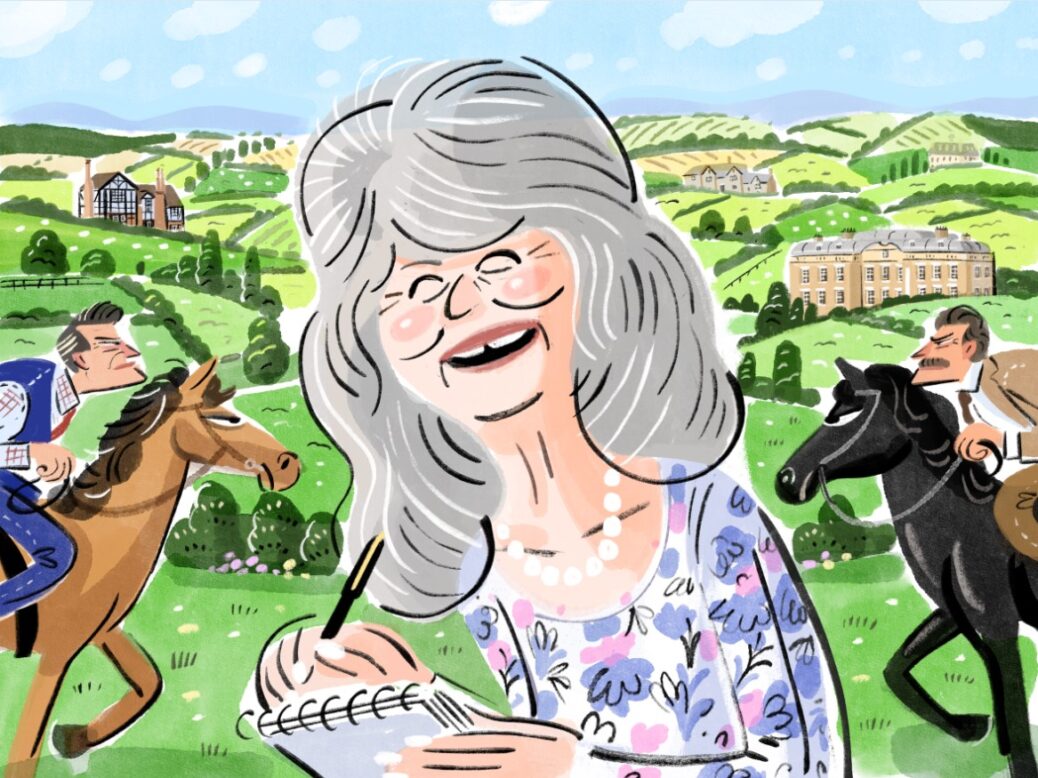
Jilly Cooper, who has died aged 88, never claimed to be a serious novelist, yet few writers chronicled Britain’s ruling classes with such energy, mockery and appetite. For decades she turned adultery, ambition and horses into mass market spectacle. Her novels sold in vast numbers, their covers glossy, suggestive and impossible to miss, part of the everyday clutter of late 20th century Britain.
She was already a familiar voice by the 1970s, writing witty newspaper columns and publishing cheeky guides to love and marriage that cemented her image as the nation’s flirt. Early romantic novels such as Emily and Bella kept her in print, but she broke through with Riders, in which show jumping, adultery and ambition carried the plot. Rupert Campbell Black, its cad of a hero, soon stood for a whole era’s swaggering excess. I remember girls at school passing the paperbacks around, lusting after Campbell Black and, in some cases, actively searching for his real life equivalent. To have a boyfriend with even a hint of his swagger was treated as a kind of 80s status symbol, taken as evidence that their own romances might be as glamorous and outrageous as Cooper’s pages suggested. Her sequels grew bawdier and more expansive, turning Rutshire into a long-running print soap opera. The books were devoured and each new instalment impatiently awaited. They were bought for pleasure, not posterity, and on that score she rarely failed.
Perhaps her novels arrived in a cultural moment when middlebrow entertainment could still dominate the national conversation. In the 1980s and 1990s they were everywhere – on beaches, trains and in offices – bought, borrowed and endlessly circulating. Their significance lay less in critical esteem than in their omnipresence in everyday life, and that served her well.
She was made a Dame in 2024, an honour that suited the drama of her own stories. What endures is the delightful abandon of her storytelling, which made room for pleasure in a literary culture often wary of it. She wrote of Britain’s upper classes with mockery, appetite and the occasional flash of sympathy, and left behind stories that are at once absurd, liberating and indelibly hers.

[Further reading: Twilight is immortal]
Content from our partners



Related



Join the debate
Subscribe here to comment