
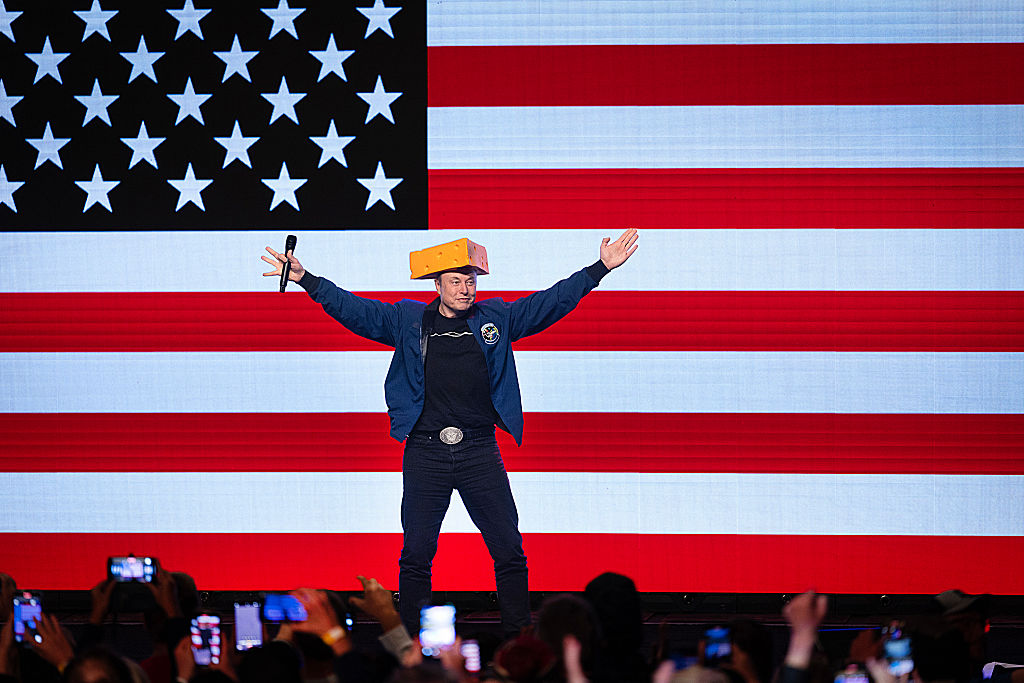
I understand why political noncombatants delete social media apps like X as part of their New Year’s resolutions. But if you consider yourself a progressive political activist and believe you are virtuous for only ever logging in to Bluesky and starving the orange baby gangster and his British poodle of attention, then you are not just delusional. You are a coward.
We young millennials are slowly reaching the age where we have amassed enough professional and social capital to wield influence and power. Your thirties and forties are the sweet spot when you are still young enough to have energy but old enough to know what to do with it. We are not a large enough generation to make the difference boomers make in voting, even if growing older means we are more likely than we once were to turn out to vote. Yet we are starting to win political power, even against the odds, as with Zohran Mamdani. (Britain’s first millennial prime minister, Rishi Sunak, was so dull that his relatively young age barely attracted any attention.) It is exactly at this fragile moment that many of us are choosing to opt out of social media. We shouldn’t.
Since Elon Musk bought and transformed Twitter almost four years ago, thousands of experienced activists, academics and commentators exited X for principled reasons and to find their peace. These were people and media organisations with immense influence and reach. Their now-dormant accounts often have millions of followers (eg, the Guardian: ten million followers). What’s more important is that they had institutional memory of how political change happens, how it was communicated, and how it could be misrepresented, in the decades before young millennials like myself started tuning in to the daily news. But those who withdrew didn’t want to deal with the bile-throwing mobs unleashed by X, so they left us millennials, and now zoomers, without any back-up.
The internet is not a fantasy. It is a real place, real life. X remains a public square. Bluesky, by contrast, is where the teachers’ pets meet after class to study.

Do you think Athenian assemblies were pleasant? You, who fancy yourself a democrat who would fight and die for your values, believe you could have put up with the stench of the sweaty bodies, the brute violence of the hecklers, the steely bigotry of the Athenian psyche, to perform your patriarchy-given right to vote?
The progressives who left X in droves performed a voluntary ostracism. The orange baby gangster and his British poodle probably couldn’t believe their luck. Within a couple of years, the right was fully proficient in manufacturing artificial outrage and forcing the government to respond. The playbook was simple: first, you get something trending on X and ideally get the spiritual teenager who owns it to notice it. Then the next day, the exhausted, underpaid, dopamine addicts who staff Westminster’s newsrooms would pick your pet project from the trending topics and splash it on their front pages. The government minister doing the morning rounds the following day would be forced to answer to the story, thus forcing the government to rush into creating policy on something that is unlikely to be the most important problem facing the country that day. This is how the government has been forced to spend billions of pounds on enquiries and consultations and waste precious resources like time and attention on issues that alt-right anon accounts on X are very interested in – like the Motability scheme or local councils cleaning up British flags littering random public spaces – but which in the grand scheme of things are not going to move the dial on the country’s stagnant growth.
There are two reasons I wish all the progressives who defensively left X hadn’t done so, as other social media platforms with equal reach do not exist. For one, they would have witnessed how gut-wrenching it feels when an ideologically fanatical faction hijacks the government’s attention, as the liberals did occasionally during the previous era of Twitter to obsess on identity topics that did little to improve the material circumstances of most people. The second reason is that, despite their blind spots and capitulation to a very loud and censorious minority of activists with symptoms of untreated mental distress during the 2010s, they still have institutional experience and historical knowledge that’s incomparable to whatever young millennials like myself who stayed online and on X may have had time to develop and fight with.
This self-protective, self-diminishing attitude goes back to a deficit in the broader British left’s ability to motivate and engage people, especially when it comes to mentoring the young, and modelling behaviour for them. I have written before that the left needs a Dominic Cummings figure, not in the “manic guru who swears a lot” sense, but in the sense of people with experience and knowledge (regardless of how you rate him) who put in time to mentor and encourage younger people to campaign. It is no secret that the campaign group “Looking for Growth” is Dominic Cummings’s brainchild (he mentioned in a podcast with Chris Williamson in August 2024 that his “start-up party” won’t be a party straight away, but a campaigning group and that he was interviewing young people to take his vision forward; a few months later LfG was born). Meanwhile, left and liberal people of Cummings’s age and with comparable professional backgrounds, despite their proclaimed communitarian values, seem either to lack the ambition to achieve the kind of reach Cummings and LfG have achieved, or the appetite and openness to the amount and kind of social contact this kind of political engagement entails.
Our progressive mentors are above all that. Instead of picking talented young people and training them to flood the zone, and opening up their calendar to anyone who is interested in improving their country, and not just their kicked puppy faction, they retreat within their echo chambers and revamp humble initiatives with the same people they have been having pints with since university. They are not narcissists, they will say in their defence, so of course they do not seek the infamy that someone like Cummings or the cringe LfG kids seek.
But in reality, we on the left and centre are the worst narcissists of all. We continue to take ourselves very seriously. Our personal reputations, that is, not our moral mission to change our country for the better. We continue to worship the legacy media, even when they abandon us when we most need them by failing to preserve their own relevance or high standards. Labour MPs and progressive commentators go down badly on social media not just because the algorithm is cooked, but also because they refused to upgrade and adapt and are too cowardly to speak with their chest. They still expect to parrot the party line without flinching and receive a high five from their intern when they get back to the green room. Our think tanks and campaign groups won’t even create TikTok accounts. Our brightest and best thinkers still write words that could convince a dead man to stand up and vote if only he’d find them in the obscure journals they publish for an audience that could fit in a pub.
If in 2026 your moral mission is to save social democracy, then you have to do what’s best for it. The zoomers and Gen-A kids trawling the web do not appreciate that talking alone into a camera phone feels cringe to us; that status in progressive circles takes decades to build and one bad viral moment to diminish; that we can still remember, and miss, our phone-free childhoods. Subconsciously, however, they can sense we are abdicating responsibility, and like the greedy boomers who voted to increase our student fees and chop the working-age benefits they got to enjoy, they know that when we were their age, we arrived on the internet to find an unstoppably prolific army of alternative progressive writers from Mark Fisher to Noam Chomsky. We may not have the immediate financial incentive and backing of astroturfed right-wingers, but I believe us when we claim that money should never be the most important thing and that the collective interest should come first. Now it’s time to prove it.
[Further reading: Why Labour needs Owen Jones]
Content from our partners



Related



Join the debate
Subscribe here to comment