
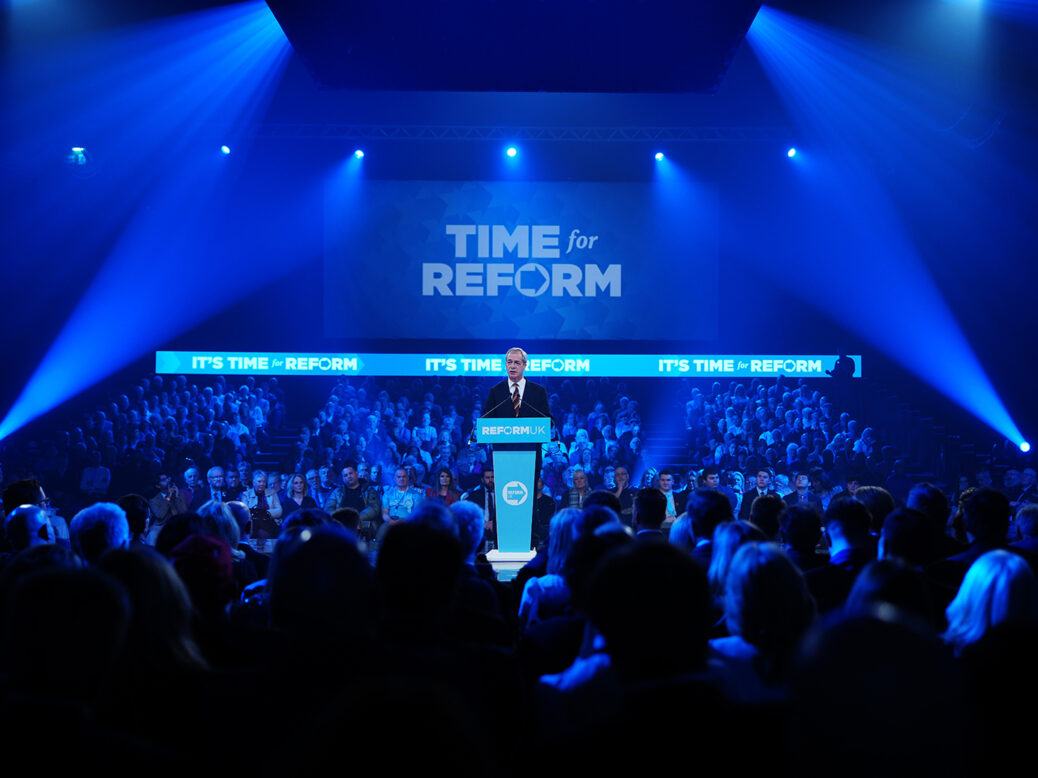
“When is the Hitler Youth article out then?” The London Students for Reform boys are anxious that I will misrepresent them. We are at the pub, after Reform’s NEC rally in Birmingham. They bounced up and down at my request to talk to them. The public-school boy among them, the social secretary, took my number and brought the group to the location I sent. They now look trapped around my table. I wanted to talk to them because they were less intimidating than the rest of the crowd, who were mostly pensioners, as you would expect for a political rally held on a Monday at 3pm. Nigel Farage had told them it was time to end working from home. They applauded.
One of the committee members went to the same university as me, Queen Mary. He is 18. The other three are 19. They hate how left-wing their universities are. I am curious how their classmates react to them. They are not far right or racist, they tell me – they just want a safe space to speak their mind. The guy from my alma mater tells me that on his first day, he saw a girl wearing a “Stop racist Reform” T-shirt. There is desperation in his voice; he is worried I won’t believe he’s got it bad, but I am aware of my privilege. When I was at Queen Mary, I enjoyed BNOC status because I was an immigrant, female, socialist. Check, check, check. I was the societies officer, responsible for encouraging student participation in the student union, and I laughed when the Conservative society disbanded because they couldn’t get enough members. I thought the “Never kissed a Tory” stickers were hilarious, but I couldn’t wear one in good conscience.
Keir Starmer, jealous of Farage’s popularity, did his best to piss on the big rally chips by teasing party and country about whether he would stay or go. Reform made the best of it, nonetheless. If the media would rather obsess over a potential new prime minister than come to Birmingham to marvel at the party’s ability to put bums on seats, for £10 a pop Reform would make the news for journalists. Every 15 minutes, Jeremy Kyle announced breaking news to his 2,500-strong audience: it was 4.07 pm, Starmer was still Prime Minister, and Jeremy Kyle’s still got it.
We watch a video of the Reform leader walking around Clacton in January, by the sea with his dog, wearing his signature flat cap, Barbour-core shooting jacket and wellies. He is drenched in sepia tones, and John Lewis Christmas ad music is playing in the background. He speaks of love and loss. Is he about to sell us life insurance? Britain, he tells us, is being run by people who hate it. Young people are yearning for identity. We need to refocus on family, community and country. The arena-rock video edits that follow remind me of playing Mortal Kombat with my brother. It makes sense; every single person I meet working for them is a guy.

There is an interview island a few feet away from the main stage, where Kyle interviews seven of Reform’s eight MPs in a row. They want people from traditional trades to join, but until then, the front row could be an afternoon’s programming on GB News or TalkTV. Notable by his absence is Matthew Goodwin, the academic-turned-Substacker, GB News host, and the Reform candidate for Gorton and Denton. Omitting him from the lineup is a sensible choice, given the circumstances – not of his by-election campaign, but his loftier ambitions. His self-regard and obvious desire to succeed Farage could rub people the wrong way. He’d be too jealous watching Jenrick get the loudest applause anyway.
There is a pleasant bonhomie to all the interviews. Past guests of The Jeremy Kyle Show watching him softball his colleagues would be green with envy. The once-ruthless TV host gently encourages Richard Tice to show the audience his homework. “Tell us, Richard, when the elections come, will Reform be ready to govern?” Tice reassures the class. “We are fired up and ready, people should trust us.”
Sarah Pochin looks wounded when she first climbs on the stage. “Where’s my usual kiss and cuddle?” she asks when Kyle greets her with words only. He obliges. Their microphones pick up the lip-smacking. She tells us how she “spent her whole night with Nigel” when she won her by-election, but drops the baby talk when they turn to violence against women and girls. Pochin is suddenly dead serious. “Would you guarantee you would do something instantly about the grooming gangs if Reform were elected?” “Instantly,” she answers simply. She lets our imagination fill the gaps.
They all make an effort to crack a joke, even those not known for it. Tice complains to Kyle: “You told my sweetheart to dump me.” He is referring to his partner, the right-wing commentator and Dubai resident Isabel Oakeshott, who is a regular on Kyle’s TalkTV show. I try to imagine a mainstream presenter advising Yvette Cooper to dump Ed Balls on air. And these people wonder why their ratings are tanking.
Lee Anderson is on Team Kyle, however. A man of Richard’s age – what is he waiting for not getting married to his lady? He is punching, too. The two of them sound so relaxed, just a couple of lads laughing at each other’s jokes. There is little substance to Kyle’s questions beyond mild titillation. He asks Anderson to repeat the best nicknames he’s ever coined for the embattled Labour cabinet. “Rachel from accounts” is the favourite – Reform isn’t fussy about its feminism.
Jenrick’s pre-prepared joke is to congratulate himself on not being late for his interview with Kyle, unlike his defection. He looks amazing. He never fully leans back in his chair, and delivers a speech with his upper body. There is no party that could organise an event like this, he says with certainty. If the Tories organised an event like this, how many people do you think would show up? His new colleagues do not flinch when he throws his former shadow cabinet members under the bus. Kyle asks, “How could they possibly not agree that Britain is broken?” Jenrick picks the least charitable answer. “They don’t walk the same streets we do.”
One theme dominates the event: isn’t it amazing that they got such a huge crowd together? No other politician could achieve what their Nigel does. They’re not quite right: in 2017, you’d think Jesus was about to walk on water when Jeremy Corbyn led a Labour rally. At his peak, Corbyn led a party with twice as many members as Reform today. The main difference was the demographic diversity. In Corbyn’s crowd, you found the full spectrum of class and identity, and it was undeniably youthful. Sure, maybe you did not have masses of the visible white working class we have come to caricature, but they were there. I worked for a Yorkshire MP; they were hard to miss. At the Reform rally, the few young people I see are mostly the young white boys from the student wing. Kyle cringed when using the word “momentum” to describe his new party’s strength because it reminded him of Corbyn, but I felt that fine quality was lacking from the event. Only Farage had it. He is going places.
We welcome the leader on stage with fireworks and heavy bass. He is wearing a red-and-gold tie – the colours of Gryffindor, the good guys, the ones who win against all odds. He speaks for 25 minutes, sometimes on the podium, sometimes walking around the stage. No notes. Eat your heart out, David Cameron.
His first policy point is about the NHS. It is suffering because of the population explosion, so much so that we are now offshoring and outsourcing it, video-calling doctors on a beach in Malaysia. He is warm and comfortable. He doesn’t lose his nerve when he calls Rachel Reeves the prime minister, rather than the chancellor. People in the crowd shout to correct him. We all know what he meant. What’s the big deal? He will end DEI, he declares in fluent X. The British acronym is EDI. The welfare budget will have to be cut; he knows not everybody will like it. Mild anxiety is no excuse for not working. He has mild anxiety after a night out, though, he admits, to a lesser extent than the night before. Drinking takes the edge off, it’s common sense.
He has no time for the experts who claim crime is down – to hell it is! He mentions that some people have stopped paying council tax because they believe there should be no taxation without representation. He couldn’t possibly support that, of course, but he understands the imperative. He winks. Later, a journalist will ask him about some Reform councils’ failure to cut council tax, as many thought his party promised. He said he never promised to cut council tax, but to cut waste. It is a fact that many Reform candidates run on a platform to lower council tax, but it has always been Farage’s gift to individualise and manoeuvre around policy positions.
I do not know how long this laissez-faire attitude to details will last, but Labour and Tory politicians could only dream of such tongue-releasing leniency. Andrew Rosindell MP said the thing he loves the most about defecting to Reform is that he is finally free to speak his mind. With the Tories, everything he said needed approval first. He is describing the freedom of being in a party that has never governed. An amateur freestyling in his bedroom isn’t freer than a professional on stage. He’s just playing to an empty room.
The big announcement of the rally is that they have just opened applications for parliamentary candidates. The fee is £250. Farage is no oracle, but he can see how an economic meltdown could occur and trigger an election. “Andy Burnham may not be scared of the bond markets, but they are scared of him.” Rosindell is right about one thing: other MPs could only dream of the freedom to speak this casually. Farage repeatedly warns that the next Labour leader will be from the “hard left”. There is hardly anyone like that left in the party but, regardless, I hope the next Labour leader follows Farage’s example and lets their tongue fly. We were told this rally would set out Farage’s economic vision. Call it what it is – boomerslop.
[Further reading: How Keir Starmer survives]
Content from our partners


Related


Join the debate
Subscribe here to comment