
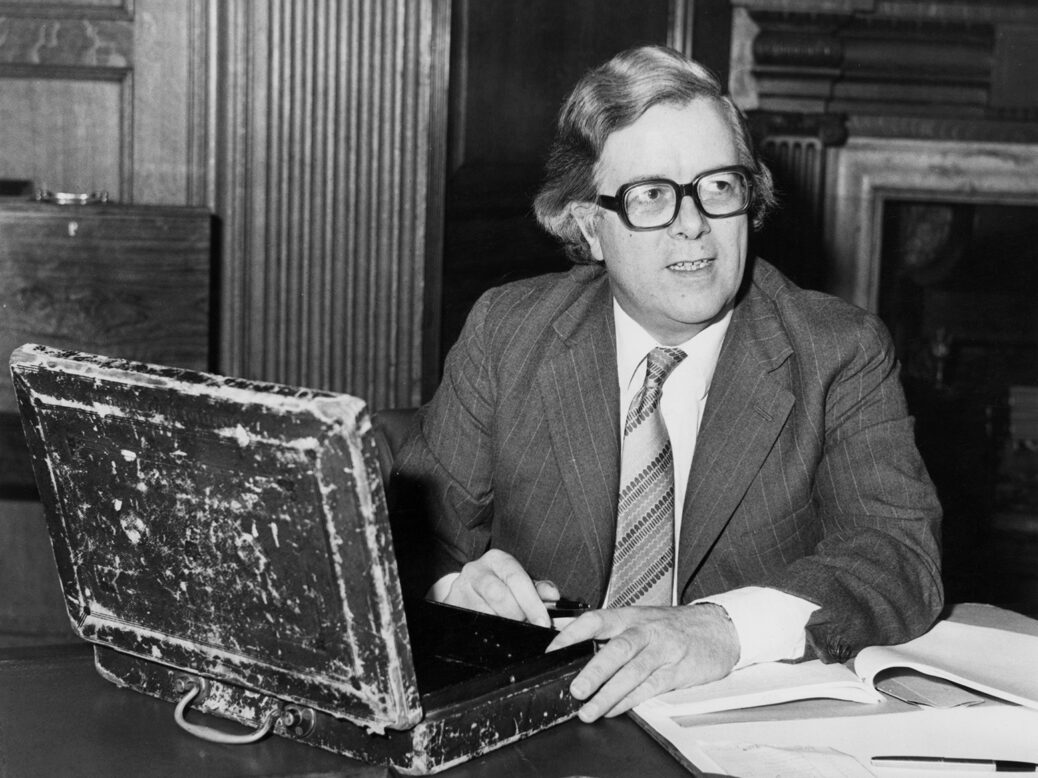
In the spring of 1981, amid terrible economic news, Margaret Thatcher’s chancellor, Geoffrey Howe, delivered a Budget that raised taxes and cut spending – to widespread contempt from both left and right. In the New Statesman, the journalist Peter Kellner asked: “Howe will he wriggle out of this one?”
Among some of the wetter Tory backbenchers, wistful discussion after the third brandy is apt to turn to dreams of a palace revolution.
The scene is 10 Downing Street, the time next winter. The economy, so the story runs, is still nosediving. Two-and-a-half years of Thatcherism and three Howe budgets have manifestly failed. The next election is just two years away, and if steps aren’t taken immediately to reflate the economy and cut unemployment, the Tories will be destroyed at the polling stations. But to reflate would be to jettison the keystone of the Government’s financial strategy.
That is what Lord Carrington, Willie Whitelaw, Lord Thorneycroft and Edward du Cann have come to see Margaret Thatcher about. They have entered Number Ten separately, by the side entrance, through the Cabinet Office. They hope they have not been seen – by the press or, more importantly, by Sir Geoffrey Howe. The Carrington quartet have some harsh things to tell the PM. They have, to be precise, an ultimatum: change course – or we resign.

For Mrs Thatcher to have to admit she had been wrong all along – comprehensively, disastrously wrong – would be unthinkable. But to suffer the resignations of her most successful cabinet minister, her deputy leader, her Party chairman, and the chairman of the Tory backbenchers would be unthinkable too. She has no alternative. She resigns.
That dream, it must be emphasised, is seen even by its most avid exponents as more a fantasy than a prediction. But following this week’s budget it has suddenly become a great deal more plausible. Sir Geoffrey Howe has given the economy a further fearful kick downhill, and the Conservative Party a boot towards electoral oblivion.
Tuesday’s budget speech was constructed on two central deceptions. The first concerns the degree of deflation on offer; the second concerns its effect. In the first case Howe was deceiving the public; in the second he was deceiving himself.
The deceit that Howe perpetrated on his audience was that the economy is being deflated by just 3½ billion. He said:
“I must tell the House that this year’s Budget-making exercise has started from the basis of a forecast for the PSBR public borrowing in 1981-82 of no less than £14 billion . . . Taking everything into account, I have concluded that it would be right to provide for a PSBR of some £10½ billion . . . That leaves a net sum of around £3½ billion to be secured in this Budget.”
£14 billion is a false figure; or, rather, it has been so defined as to render it seriously misleading. Howe told the Commons that it
“incorporates the spending plans for next year that have already been announced – but it is otherwise based on unchanged tax rates and unchanged allowances.”
From this it can be shown that Howe’s calculation is defective on two counts. First, he is excluding the spending cuts and national insurance increases announced last November. These involved £1 billion each, to take effect in the year starting next month. Taking the November package and the Budget package together, the degree of deflation about to strike the economy rises from £3½ to £5½ billion. This factor raises Howe’s “starting point” from £14 to £16 billion.
The second component of Howe’s dodgy calculation takes the figure even higher than that. By speaking of “unchanged tax rates and unchanged allowances” he is altering the rules of the game. The Medium Term Financial Strategy unveiled twelve months ago said that:
Revenue is projected on the conventional assumption of constant indexed tax rates at . . . 1980-81 levels.
In other words, the strategy assumed that the Government would spend the £2½ billion it would take to increase income tax allowances next year in line with inflation. Against this, the strategy also assumed that the Government would raise the extra £1 billion needed to keep excise duties up with inflation.
The net effect of these two bits of indexation would have added £1½ billion to the government’s borrowing. That is the figure Howe would have needed to add to his “starting point” figure if he had employed the indexing assumption contained in last year’s strategy rather than the unchanged taxes assumption deployed on Tuesday afternoon.
Adding £1½ billion to £16 billion brings the total to £17½ billion as the true starting point for analysing what is happening to the economy. £17½ billion is the figure the government would have to borrow in 1981-82 if it had announced no policy changes for taxes or public spending, other than those specified a year ago – no extra spending cuts, no national insurance increase, but with this week bringing in inflation-linked tax allowances and excise duties.
Bringing public borrowing down to £10½ billion, as the Government now proposes, therefore means a deflation of no less than £7 billion – twice the deflation figure Sir Geoffrey trotted out on Tuesday.
We are almost done with the public borrowing numbers game, but not quite. We now know that a continuation of the tax and spending policies announced last year would have landed the government with £17½ billion to borrow in 1981-82. That is nothing like what was originally expected.
Last year’s projection for the PSBR in 1981-82 was £7½ billion at today’s prices. The intention of the Government’s financial strategy was gradually to reduce public borrowing – but the effect of the weapons used has been to increase it. The gap between what was expected then, and what, on the Treasury’s own calculations, would happen now on last year’s policies shows how far the strategy has veered off course. That gap is an astonishing £10 billion – the difference between £7½ and £17½ billion.
The error-factor is now approaching five per cent of gross domestic product: mismanagement of a sort not easy to parallel even in our Treasury’s chequered experience.
How could the strategy go so wrong? Almost half the £10 billion is explained by the direct effects of the recession. In a fit of manic optimism the government reckoned that unemployment in 1981-2 would average 1.8 million, a figure that has now been raised to a fresh projection of 2.5 million. The payment of unemployment benefit, added to the loss of income and indirect taxes, increases government borrowing by £6,000 every time an extra worker joined the dole queue. Altogether, getting the unemployment sums wrong by 700,000 will cost about £4 billion.
Indirect effects of the recession have added a further £3 billion to the Government’s spending plans: in extra aid to the loss-making nationalised industries, smaller profits from the profit-earners, and a variety of industry and employment aid schemes.
Higher-than-expected interest rates, together with the borrowing cost of meeting last year’s overspending, have added a further £1½ billion to the cost of servicing the government’s debts. And £1 billion is explained by the ingenuity with which oil companies have found ways to avoid paying as much in North Sea oil taxes as they were originally expected.
Finally, some hundreds of millions is explained by straightforward overspending by Government departments, most notably defence.
Now Sir Geoffrey has decided to claw back more than two-thirds of that £10 billion gap. If his first deception was played on his audience – by deliberately concealing the extent to which last year’s strategy went awry – his second deception has been played on himself. He seems to truly believe that this year’s measures will revive the economy.
As the chart above shows, the recession has been very uneven in its impact so far. Consumer spending has remained at, or slightly above, its yearly 1979 level, while industrial output, company profits, and investment in new plant and stockbuilding have all declined sharply.
– As I predicted four months ago (The coming U-turn – and why it will hurt – NS 7 November) the government has sought to switch resources from consumption to investment, by raising taxes and lowering interest rates. What is stunning about this week’s measures, though, is that by clobbering consumption so viciously, any hopes for generating growth through industrial investment, stockbuilding, and extra exports are certain to be dashed.
It’s the case, of course, that adequate profits, moderate interest rates and a realistic exchange rate are all prerequisites for raising output in our present economy. However, you also need a customer at the end of the line to buy what you make. After the most deflationary year of post-war economic management, how does Sir Geoffrey square that circle?
First, the Treasury’s forecast is that consumer expenditure will dip only slightly later this year – bounding back up in the first half of 1982 to reach record levels. This is despite unemployment rising towards three million, and the large tax increases on those still in work. The Treasury evidently assumes that most people will cut back on their savings – despite growing evidence that the fear of unemployment is a potent factor encouraging people to save more.
Second, the Treasury expects the recent massive run down in stocks to come to a halt, and stockbuilding to resume by the end of this year.
The turn-round in stocks alone is expected to contribute four per cent to Britain’s gross domestic product by the first half of next year. Without it, unemployment will be nearer four million than three million by the middle of next year. And if that sounds as if I’m just carping, remember that last spring’s forecast of today’s stockbuilding was over optimistic to the tune of three per cent of GDP.
But, the government will say, we are bringing interest rates down, and money supply really is under control – so business confidence should recover. They said that last year too.
And, the government will continue undaunted, public spending is now tamed and the nationalised industries are on the road to recovery. They said that last year, too. Indeed, on nationalised industries, the Treasury and Civil Service Committee of MPs said specifically that last year’s expected two-year turnaround in the fortunes of the nationalised industries – worth £2 billion a year to the government after three years – was unrealistic. They were dead right. Yet the government now has the effrontery to predict an identical turnaround over the next three years.
That Sir Geoffrey’s strategy will fail disastrously – even in the eccentric terms by which the government defines its own objectives – can no longer be in doubt to anyone outside the Treasury or Cabinet; or to many inside either of those battered institutions. That palace revolution may not be so fanciful after all. The only thing is: next winter will be too late.
[Further reading: From the archive: After thalidomide]
Content from our partners


Related

This article appears in the 13 Nov 2025 issue of the New Statesman, What Keir won't hear
Join the debate
Subscribe here to comment