
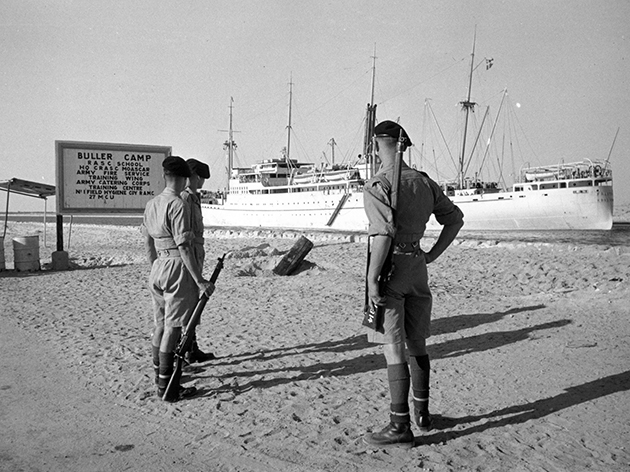
The Suez Crisis of 1956 confirmed the UK’s loss of superpower status and undermined Anthony Eden’s premiership. Three decades later, the historian Peter Hennessy wrote a short “oral history” of the political class’s response to its humiliation.
Ben Pimlott, biographer and editor of Hugh Dalton, produced an appealing metaphor the other day to mark the appearance of the third and last volume of his Daltonian trilogy. Compiling an oral archive by taking a tape-recorder to those who knew Dalton or worked with him was like talking to one’s footnotes, he wrote. That image returned to me again and again last month as I travelled the country with my BBC Radio producer, Mark Laity, talking to the survivors of Suez.
My “footnotes”, ranged in age from mid-sixties to mid-eighties, were impressive people – former Cabinet ministers, chiefs of staff, permanent secretaries, private secretaries and military commanders or planners. Most had never spoken publicly about Suez before. Only the release of the Suez papers at the Public Record Office on 2 January had loosened their tongues. Sir Richard Powell, Permanent Secretary at the Ministry of Defence in 1956, told me: “I very strongly feel that if you take a pledge of confidence, you should observe that confidence throughout your life and it’s only because the documents have now been published and they’re in the public domain that I would feel able to go beyond that.”
As Sir Richard said of the Suez affair in A Canal Too Far on BBC Radio 3 last Saturday: “All officials were doubters, they all felt doubt and hesitation… that would be typical of them, to have doubts but to carry out instructions.” For some it was a matter of outrage rather than doubt or hesitation. But none of them was tempted in the intervening years to “do a Ponting” and tell all which, in its way, is a remarkable tribute to the ethos of the old administrative clan.

The most difficult moment for those in the know must have been fairly shortly after the event when Sir Anthony Eden denied British collusion with Israel before the attack on Egypt (the Israeli assault provided the cover-story, the need to separate the combatants, used to justify the Anglo-French invasion). During his last appearance in the House of Commons on 20 December 1956, Eden said, under questioning: “There were no plans to get together to attack Egypt… there was no foreknowledge that Israel would attack Egypt.”
Sir Donald Logan, private secretary to Selwyn Lloyd, the Foreign Secretary, was the only man from the British side to attend both meetings at Sèvres in the Paris suburbs where the agreement to collude was concluded with the French and the Israelis. He was in the officials’ box in the chamber of the Commons when Eden denied foreknowledge. I asked him how he reacted.
Logan: I felt that at that moment his attempt to justify his intervention to separate the forces simply exploded.
Hennessy: Did you feel at all that you should have done what Clive Ponting in another generation did?
Logan: In those days civil servants were not expected to betray their ministers and I certainly did not feel this, no.
Hennessy: You don’t regard lying to the House of Commons as a cardinal sin on the part of an elected politician?
Logan: Whatever I may think, it is, I think, for ministers to decide their own conduct in the House of
Commons and for the House of Commons and the public to judge ministers on their performance. I think the idea that a civil servant should get up and say “The Minister is not telling you the truth” any time that this is likely to happen is a recipe for chaos and certainly for disloyalty.
The Logan line was taken, with minor variations, by the other officials to whom I talked who knew of what had transpired at Sèvres before the Israelis struck on 29 October, after which you did not need a training in British intelligence to put two and two together. Would today’s Whitehall generation see it that way? Most but not all would be my guess.
However, two of the public servants I interviewed for A Canal Too Far did indicate they had considered their positions in 1956 – Lord Gladwyn, the Ambassador to Paris, and Lord Sherfield, Ambassador to Washington. Eden and the Foreign Secretary, Selwyn Lloyd, travelled to Paris to consult with their French opposite numbers, Mollet and Pineau, on 16 October. Lord Gladwyn met them at their airport. In the car Eden told him he was not to be allowed into the meeting. “I was furious and said this was a most extraordinary thing to happen but I couldn’t do anything about it.”
What he did was to write a furious letter to Lloyd which turned up in Eden’s Downing Street files released at the Public Record Office last month. He considered his position but stayed on as resignation “wouldn’t have done any good for anybody”. Lord Sherfield, like Lord Gladwyn, was told nothing. If he had known and had been instructed to mislead Eisenhower and Dulles “I don’t think I could have been a party to the deception”.
One story I was hoping could be confirmed couldn’t. It’s this. A group of senior Foreign Office diplomats, kept out of the story on Eden’s instructions, knew something nasty was afoot, didn’t know what to do about it and sought the advice of a senior, respected privy counsellor, Lord Attlee (who, naturally, didn’t know anything either). They met him at his flat in the Temple. “You’re civil servants”, the old PM is alleged to have said in his briskest Major Attlee style, “Go away and do as you’re told.”
Does anybody know if it’s true?
[Further reading: Where to from Aldermaston?]
Content from our partners



Related
This article appears in the 08 Apr 2026 issue of the New Statesman, The Fall
Join the debate
Subscribe here to comment