
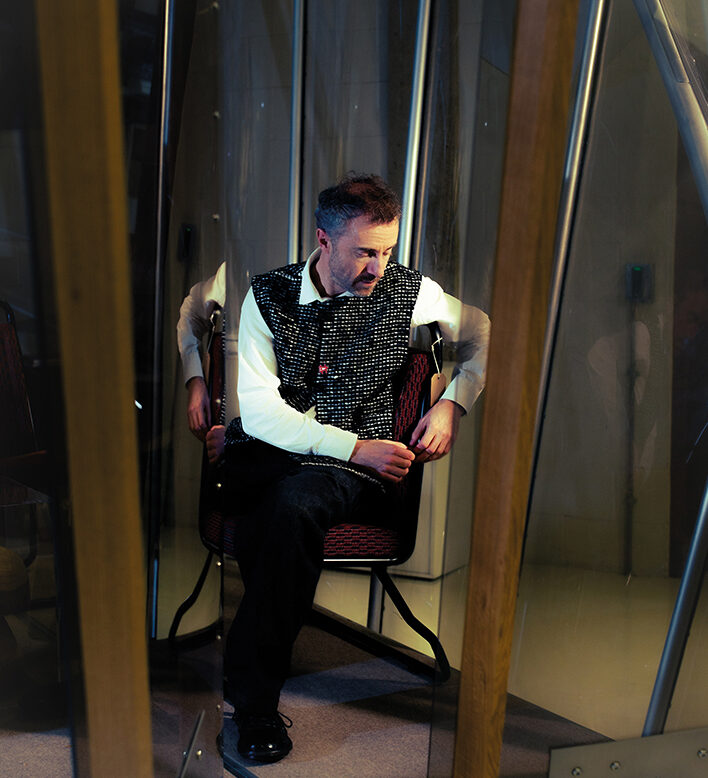
Thomas Heatherwick seemed nervous. He tried to follow my gaze as I glanced at the clutter of curios on his desk behind him: an antique solid-wood thermometer; a mug commanding “Keep calm and prioritise door distance”; an ornately engraved shovel; something resembling a giant bamboo dumpling steamer.
He fiddled with a cue card of statistics he’d handwritten for himself in felt-tip, pawing it around the round tabletop in his study. Far from the sleek, angular minimalism you might expect in an architecture practice, this was a low-lit nook: against one wall was a flamingo-pink sofa, and the air was steamy with mismatched pots of mint tea. Heatherwick fidgeted with his shirt collar, tucking it in to the neckline of the embroidered black-and-white tabard he wore on top. Ten years ago, GQ declared him Britain’s 34th-best-dressed man, praising his “fantastic curls”. Silvering now, they give him the air of pixie elder.
For a star designer of global fame – over the years Heatherwick has been compared with Leonardo da Vinci, Michelangelo and, most lavishly of all, the Wizard of Oz – he seemed curiously anxious to please. “I’m a partial introvert!” he said at one point, lurching back in his chair and holding his hands up in surrender. “I have every urge to just keep my head down.”
That “partial” is telling. In recent years, he has provoked the architecture profession en masse, accusing it of being indoctrinated in a “cult” of modernism that has unleashed “soulless” buildings across the world. He casts Le Corbusier, the early-20th-century brutalist pioneer, as the “god of boring”. “His urban ideas were catastrophic, and incredibly influential,” Heatherwick told me. He’s more of a Gaudí guy. These comments are all part of his campaign against identikit office blocks and bland housing that ignore the human need for “fascination”. And that, according to scientific studies collated in a ironically corporate-looking booklet he handed me, make us unhappy and ill.

He dreams of a streetscape beyond “flat glass, flat aluminium, with silicone sealant”. “How many more big glass fronts with some leather sofas and a marble reception desk and an artwork on the wall?” he lamented. “And the same door handles, the same hinges, the same glass – what does that offer? It is killing a piece of that street.”
Heatherwick wants to do for this “junk” architecture what Jamie Oliver did for school dinners – for ordinary passers-by to “rebel against the Turkey Twizzlerification of our streets”, as he put it in his 2023 book-cum-manifesto, Humanise. But any such uprising would simply bounce like a blue bottle off his own blockbuster commercial ventures, such as Vessel in Manhattan’s Hudson Yards – a kind of upturned pinecone, which temporarily closed for suicide-proofing following four deaths – commissioned by the property magnate Stephen Ross. Or, closer to home, Google HQ in King’s Cross, a “landscraper”, longer than the Shard is tall, like a giant high-rise that slumped down to sleep beside the train tracks. Is Heatherwick’s quest for public-service design reconcilable with his own projects for billionaires and corporates?
“Jamie Oliver ran high-end restaurants, but he’s used his platform to shine a light on something we’ve all experienced,” he replied. Plus, his studio doesn’t “do rich people’s homes”.
“I’m trying to use my platform to shine a light that the challenge is the 99 per cent of projects, not the opera houses and art museums. Yes, my studio has done an art museum; yes, it’s doing an opera house. But I’m not even really talking about my studio’s projects. The whole point is the public bit we all share.”
In this industry of heavily scaffolded egos, the backlash against Heatherwick was inevitable. Catherine Slessor, a trained architect and ex-editor of the Architectural Review, has described him as a populist trading in “dumbed-down arguments” and “chippy, chummy scorn for ‘experts’”. It doesn’t help that he isn’t actually an architect, and swaps professional jargon for cutesy neologisms like “blandemic”, “Quimby – quality in my backyard” and “Jimfy – joy in my frontyard”. You can even buy black T-shirts with “Stop Thomas Heatherwick” in white Helvetica lettering from one particular mid-century estate agent for 20 quid. He hasn’t bought one himself.
“It’s perceived as shallow to talk about the outsides of buildings,” he sighed. “There will always be resistance to anything – it would be strange if there wasn’t – but there’s also been people who are judging my work, and they’re not actually listening.”
Heatherwick has entered the architecture culture war: a bitter and class-inflected conflict of taste. On one side, the traditionalist fixation with neo-Georgian kitsch, epitomised by King Charles’s toy-townish Poundbury in Dorset and the naff Tory “build beautiful” agenda. On the other, the dogmatic Yimby instinct for building high-density postwar-style housing all over the greenbelt, upheld generally by young progressive ex-boyfriends with Ernő Goldfinger-themed tote bags.
In 2024, when she was housing secretary, Angela Rayner offended the traditionalist tribe by removing the “beauty” requirement from national planning policy, calling it “too subjective”. Heatherwick thinks this was a good decision. “I’m very wary of using the word ‘beauty’, because immediately when you use it, certainly the building design industry throws its hands up with an, ‘Ah! That’s subjective! That probably means you just want to build old-fashioned buildings!’ And it misses the very valid criticism of places not being cared about.”
Instead, he says policymakers should insert the need for “necessary visual complexity” and the avoidance of “harmful boring” into planning law. “That provokes all sorts of people, but actually you can work with it. I’m not arguing for any [particular] style, but I’m trying to argue that our brains need places that aren’t boring… These style wars need to be pushed aside and we need to see it as a public health conversation.”
The battlefield of this war is the cut-and-paste swathes of newbuild housing churned out by England’s mass housebuilders – tiny-windowed adjuncts of bin sheds, tarmac and grids of garden fences; they’re often derided by critics as “Noddy boxes”.
“We do need millions of boxes. They are boxes,” said Heatherwick. “But one thing that the Victorians did – forget the style – is they built many, many boxes with characterful details, and they weren’t out of expensive materials. They were using just plaster, render on the outside of them, but they were humanising details. Obviously we don’t need to copy Victorian details, but they were boxes.”

Photo by Pictures/Universal Images Group via Getty Images
When we met, Heatherwick seemed more frustrated with politicians than architects. He feared the government’s target to build 1.5 million homes and 12 new towns could compound Britain’s creeping visual blah.
“One of the key things that we have [in the UK], arguably stronger than anywhere else in the world, is phenomenal creative talent,” he said. “It’s a story we’re not telling because, in general, politicians don’t come from that world and aren’t culturally confident to talk about that. And it’s not manifesting in our new towns, and not manifesting in the confidence to deploy it if we’re building new towns. So people like me go to everywhere else in the world.”
Heatherwick commissioned his own poll which found that only 4 per cent of current residents of postwar new towns described them as “nice”. He would “love to help in how to set things up so that we can make joyful new towns. One of their important qualities is that they must be places that give joy.”
He hasn’t had much luck. Rayner came to visit his studio before Labour won power. But when we met he had spoken to neither the current Housing Secretary, Steve Reed, nor to the Culture Secretary, Lisa Nandy. The housing minister, Matthew Pennycook, was “unavailable” for a radio programme Heatherwick made recently about soulless buildings.
It wasn’t always so. Heatherwick will forever have a place in the British public imagination as a sort of court designer to his vanity-project-mad London mayoral patron, Boris Johnson. This marriage of mayhem became associated with pricey, unrealistic visions: the Routemaster revival buses – a sweet idea, had Transport for London allowed their windows to open and the budget to pay conductors – and the garden bridge that never was.
But to Heatherwick – who also designed the copper-petalled 2012 Olympic cauldron – that was a more confident time for design in the UK. The opening ceremony, with its roller-skating nurses and papier-mâché Empire Windrush, is often mourned as a last glimpse of the liberal British dream.
“The Olympics are great forcers, they force deadlines and some necessarily bulldozing of pettiness to allow something to happen. But they also force storytelling,” he said. “Politics and culture come together, and the 2012 Olympics was a rare moment when we saw a country come together.”
There is far too little of this mythmaking today, in his view. “It feels like a time when we really need to tell the story going forward of Britain, and what we stand for and where we’re going, and I’ve been to a couple of other countries that do have a national story, and at the moment, we’re lacking that.”
Like where? “I went to Riyadh; there was a story of national renewal and moving away from oil.” He must’ve noticed my eyebrows migrating upwards. Surely the Line – a 170km linear city Saudi Arabia has planned – is the very meridian of soulless urban architecture. “We only get the story about the crazy projects,” he insisted, praising the crown theocracy’s everyday building of hospitals and schools. “We are failing to create that story here, which is odd.”
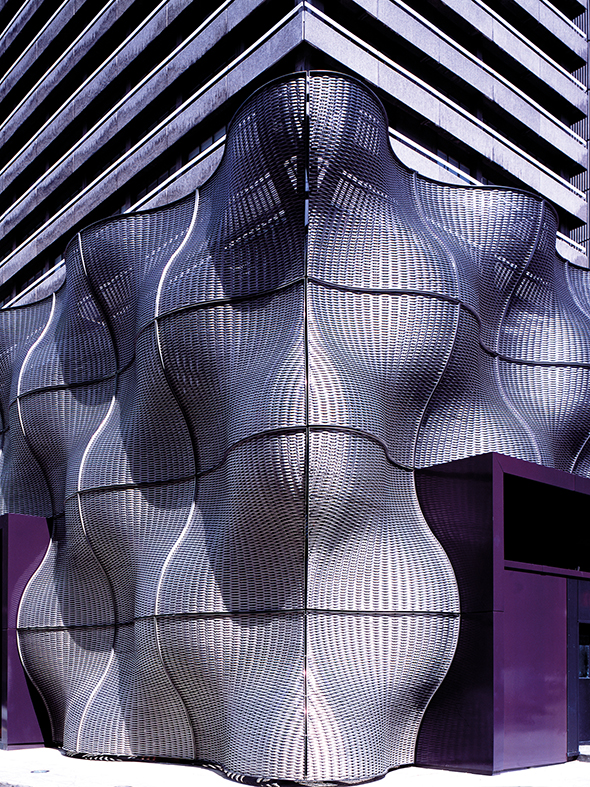
“The Boilersuit” facade, outside Guy’s Hospital in central London, 2007.
Photo by View Pictures/Universal Images Group via Getty Images
Thomas Heatherwick was a child of bohemia: born to a jewellery designer mother, who made her own beads, and a pianist father, who did charity work in east London; grandson to a communist poet and great-grandson to the founder of London fashion brand Jaeger. His creative upbringing and private schooling (including at a Steiner school in Hertfordshire) perhaps bred in him the magnetic mix of English eccentric and establishment operator that persuades investors to part with their cash.
The result can be extraordinary: the Maggie’s cancer-care centre in Leeds, a haven of swooshing timber interiors, lush rooftop foliage and light; Little Island, a park resembling a crop of lily pads floating over the Hudson River; the puffball “Seed Cathedral” of fibre-optic fuzz for the 2010 World Expo in Shanghai.
Skittering around the immense studio atrium below his office, Heatherwick showed as much enthusiasm for the birch and plastic pavilion he built as a 21-year-old design student as for his model of the planned 12-chimneyed Birmingham City football stadium. (It was described by one rival Aston Villa fan as looking “like Willy Wonka designed a power plant” – surely a compliment to Heatherwick, whose aesthetic is one of industrial-scale whimsy.)
Opposite the waiting area of overlapping Persian rugs and the Downton Abbey staircase of his Routemaster, some stylish dressers from an architecture firm gathered for photos. One of the first to sign up to his “Humanise” movement for more characterful buildings. Heatherwick hopes to win the industry round to this cause, and to build some of it himself. “I hope we will get chances to do more housing and more public projects, and it’s not about making projects look like my studio’s projects, it’s not about making them be covered in trees, or be curvy, or traditional, or more square,” he said. “It’s about: how do we make places which are more respectful of the public?”
This fixation on the public realm concerns some critics. B of the Bang, a giant asterisk of 180 steel spikes commissioned by Manchester City Council to commemorate the 2002 Commonwealth Games, began dropping its large needles. It resulted in an out-of-court settlement with Heatherwick’s studio and the core of the sculpture being sold for scrap. Blue Carpet, a once azure, rug-like stretch of rippling pavement in Newcastle, has faded to grey.
“We’ve worked on more than 300 different projects, so it’s inevitable that there are challenges on one or two or three,” Heatherwick said. “Blue Carpet was my first ever public project. So I learned a lot of lessons about maintenance – it’s all very well inventing a new paving material, but the council depot has to be all stocked up, and you’re subject to the whims of different leaders.” He is, however, now speaking to the council about renovating it. “I have my fingers crossed.”
Perhaps this is the tragedy of Thomas Heatherwick. A man who can tempt Diane von Furstenberg to pull together $260m to build a dreamy park on stilts off the edge of a New York City dock, but has to cross his fingers for Newcastle City Council to replace some paving slabs. A global superstar, never quite embraced at home. British cynicism, it seems, blocks like no planning authority can.
[Further reading: The new world war]
Content from our partners



Related
This article appears in the 18 Mar 2026 issue of the New Statesman, The new world war
Join the debate
Subscribe here to commentCan’t recall the last time I had to Google so many references in one article. Some hyperlinks would have been helpful.