
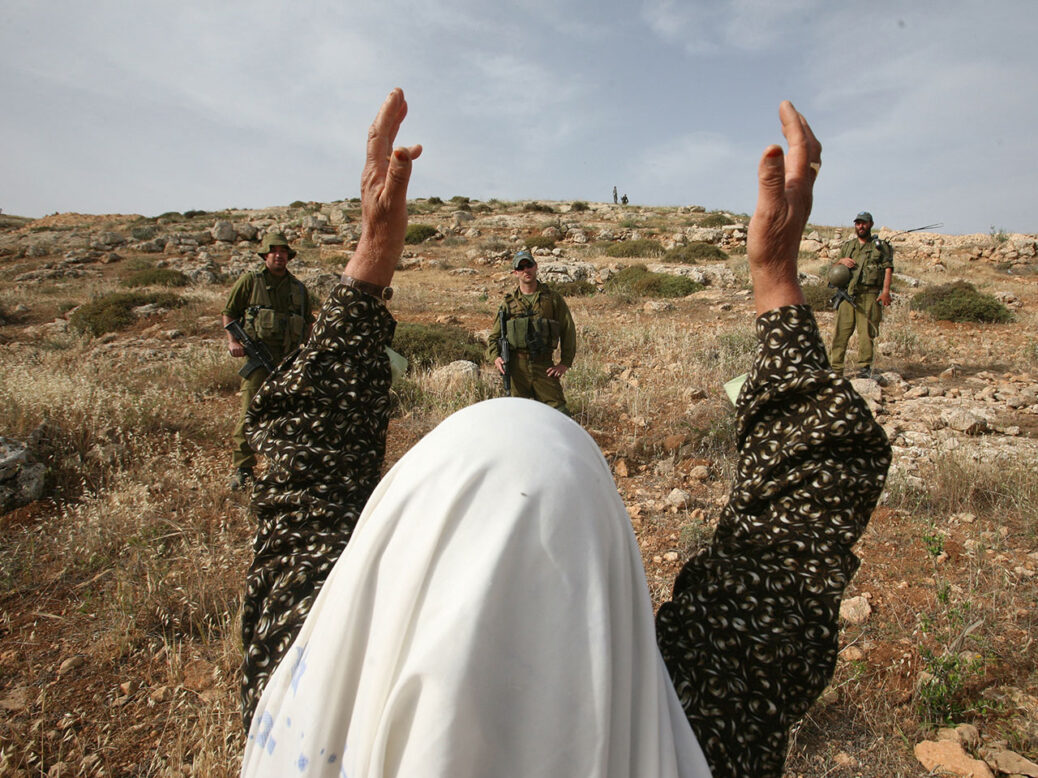
At their closest points, Gaza and the West Bank are just 21 miles apart. Their current form of occupation may be markedly different: people in Gaza are killed at aid sites and are made to suffer widespread starvation, while those in the West Bank carry out hunger strikes in solidarity. But the fates of the two regions, both Palestinian, cannot be disintricated. At the end of July, I spoke with Hassan Mleihat, a Bedouin solicitor and the director of the Al-Baidar Organisation for the Defence of the Rights of Bedouin and Targeted Villages. The Palestinian Bedouins are an indigenous Palestinian minority now mostly residing in the West Bank, an internally displaced people among another. Like many in the West Bank, Mleihat believes that after it has completed its war in Gaza, the Israeli military will come to destroy the West Bank. This is the essence of settler colonialism: a “structure, not an event”, as the late historian Patrick Wolfe, a key figure in the field of settler colonial studies, once put it. So long as the occupation persists, the Israeli military and settlers will feel legitimised and emboldened in their oppression of the Palestinian people, in their mission of total annexation of the West Bank and Gaza Strip.
As the writer Deborah Levy once said of Marguerite Duras’s novels, the purpose of language is to “nail a catastrophe to the page”. How do you nail to the page a catastrophe like this, the intensification of atrocities by settlers against Palestinians in the West Bank while the world’s gaze is turned on Gaza? You might start with the bare statistics. Since 7 October 2023, an average of four incidents of settler violence have occurred every day in the West Bank. Since 7 October, more than 1,000 Palestinians living there have been killed. This is the essence of Mleihat’s work for Al-Baidar. His days are now consumed by efforts to catalogue the violence going on in the West Bank – heading off in his car, morning or night, as soon as news reaches him of settler attacks against Bedouins, in order to transmute the catastrophe into language, then transmit it to the world via report. Such acts of witness are their own form of non-violent resistance.
Another way to nail the catastrophe to the page is to speak of it with particularity. The occupying forces seek to speak of the Palestinians as one homogenous group – as no nation is – addressing them as less than human, as “human animals”, as Israel’s former minister of defence Yoav Gallant declared on 9 October 2023. In response, it is our duty to recognise Palestinians as diverse and contoured peoples with a range of discrete histories and ties to the land. In order for their culture to be safeguarded and able to flourish again in the future, it must be protected from ethnic cleansing.
The Palestinian Bedouins are a group particularly vulnerable to settler violence and displacement in the occupied West Bank as the majority live in villages considered illegal by Israeli authorities. The construction of Israeli settlements in the West Bank since the beginning of the occupation in 1967 is widely considered illegal under international law. Thirty-eight Palestinian Bedouin communities were forcibly displaced in the first half of 2025 alone, their villages attacked repeatedly by settlers trying to burn down their homes and property. In the case of the Arab al-Kaabneh Bedouin Community this July, settlers were accused of slaughtering 117 sheep; as one of its main means of income, sheep-herding is vital to the community’s survival. But the Palestinian Bedouins’ familiarity with being threatened and uprooted from their land has a far longer history, Mleihat told me.

Our interview was delayed an hour because Mleihat’s translator, Saed Hawari, was driving back from Bethlehem to Ramallah, where both men live, and there are multiple military checkpoints on that road now. After 7 October, Israeli authorities increased restrictions on Palestinian movement within the West Bank. In 2023, the UN recorded 645 blockades in the region; now there are close to 900, including at least 119 “iron gates” that circumvent Palestinian communities’ routes to major roads and limit their access in and out of cities. “Can you imagine?” Hawari asked, when we spoke over Zoom, the two men in a plain office, chain-smoking their way through an impressive number of cigarettes, the three of us drinking coffee from paper cups. “Now we live like this,” he went on, “like we are in jail, our cities and villages in jails.” For the rest of our time together, Mleihat spoke with a rapid urgency about the plight of the Bedouins in Arabic, and Hawari would translate his speech into a more hesitant English.
Mleihat described the Bedouins as a kind people who value simplicity. This is what he loves about them: they do not seek out a prodigal lifestyle. The Palestinian Bedouins are a semi-nomadic, semi-pastoralist people, for centuries indigenous to the Naqab Desert (Negev, in Hebrew) in what is now southern Israel. For thousands of years there have been Bedouin tribes inhabiting desert regions across North Africa and the Middle East. Their name comes from the Arabic badawī , meaning desert-dweller.
Multiple modern states have attempted to sedentarise the Palestinian Bedouins. In the 19th century, the Ottoman empire, which then controlled Palestine, introduced new land laws to control their movements, but they mostly resisted such governance and restrictions. After the fall of the Ottoman empire at the end of the First World War, the era of British rule began in 1920, consolidating Palestine for the first time into a single unit. The Mandate for Palestine declared itself to be responsible “for placing the country under such political, administrative and economic conditions as will secure the establishment of the Jewish national home”, in line with the Balfour Declaration issued by the British government in 1917, as well as to safeguard “the civil and religious rights of all the inhabitants of Palestine, irrespective of race and religion”.
By 1942, the British had changed their tune. The Mandate instituted the “Bedouin Control Ordinance”, which afforded the administration “special powers of control of nomadic or semi-nomadic tribes with the object of persuading them towards a more settled way of life”, indicating that these tribes’ movements could be controlled and their communities displaced by British authorities.
Moreover, if a member of one of these tribes committed an offence and the district commissioner could not discover who it was, they could legally “investigate, arrest, control and punish the whole tribe”. The British Palestine Mandate, in its treatment of the Bedouin and Palestinians more widely, set a precedent for oppression and dehumanisation of indigenous peoples that the State of Israel in 1948 would then continue.
On the eve of the Nakba – the “catastrophe” experienced by Palestinians after the state of Israel was created – around 90,000 Bedouin lived in the Naqab. Only 13,000 remained in the desert after the 1948 war, the rest becoming refugees in neighbouring countries. Those who stayed were evicted by the Israelis from their ancestral lands and forced to relocate into concentrated, enclosed areas that became known as the Siyag, and barred from entry to their previous homes that were redesignated as Israeli land. Back in 1948 certain Jewish settlers in the region protested against the military’s attempt to cleanse the Bedouins from the area, the political scientist Mansour Nasasra writes in The Naqab Bedouins. Relations between Palestinians and settlers have not always looked as they do now.
By 1965, Israel had begun an operation of enforced urbanisation against the Bedouins, approving sites for permanent settlements that would force them to leave behind their traditional agricultural ways of life, and focusing their communities into townships which soon became overcrowded, and had high unemployment rates.
Mleihat was brought up in the West Bank, not the Naqab. Under the Oslo Accords, a pair of interim agreements in 1993 and 1995 that were intended to be a stepping stone in the Palestinian-Israeli peace process, the West Bank was split into three areas. Area A would be controlled entirely by the newly established Palestinian Authority, including Bethlehem, Ramallah, Nablus and Jenin, places to which Israeli citizens are forbidden entry. Area B would operate under joint Israeli-Palestinian security control. Area C, the remaining 60 per cent of the West Bank, including most of its natural resources, was intended to be managed solely by Israel, before being gradually transferred back to Palestinian jurisdiction.
This has not happened: Palestinians and Palestinian Bedouins, the majority of whom live in Area C, are unable to build homes without permits, and 95 per cent of Palestinian requests for building permits in Area C are rejected. This is why the Bedouins’ situation is so incredibly precarious now, Mleihat told me – more so than it has ever been.
Near the end of our conversation, the men asked me if I had heard of “E1”. This is the Israeli plan to build 3,500 new houses, exclusively for Jewish settlers, in a contiguous line through Area C from Jerusalem to the Central West Bank, where many of the Bedouins live. The proposal was initiated in the 1990s and put on ice until recently. The plan for the settlements’ construction was approved by Israel’s government on 20 August, with the support of the US State Department. “This is how you kill the Palestinian state de facto,” said the Israeli finance minister, Bezalel Smotrich, in July. When completed, the E1 plan will divide the West Bank in two, making a two-state solution for Israel and Palestine more difficult to achieve than ever.
This is why the Palestinian Bedouins’ survival is so fundamentally tied to Palestine’s future: if they stop resisting evictions, the chances of their country enduring after the war grow slimmer. “For a colonised people,” Frantz Fanon wrote, “the most essential value, because the most concrete, is first and foremost the land: the land which will bring them bread and, above all, dignity.”
In his work for Al-Baidar, Hassan Mleihat records every new Israeli outpost, every new Israeli infringement of international law, not just to nail down the catastrophe in language, but out of hope that it might trigger the international community into acting to prevent the final stage of catastrophe, and to restore to the Palestinians their land and dignity.
[See more: Letter from Gaza]
Content from our partners


Related


This article appears in the 27 Aug 2025 issue of the New Statesman, The Gentle Parent Trap
Join the debate
Subscribe here to comment