
Donald Trump appears, belatedly, to be reaching the conclusion that Vladimir Putin cannot be entirely trusted. “We get a lot of bullshit thrown at us by Putin, if you want to know the truth,” he remarked during a cabinet meeting last week (8 July). “He’s very nice to us all the time, but it turns out to be meaningless.”
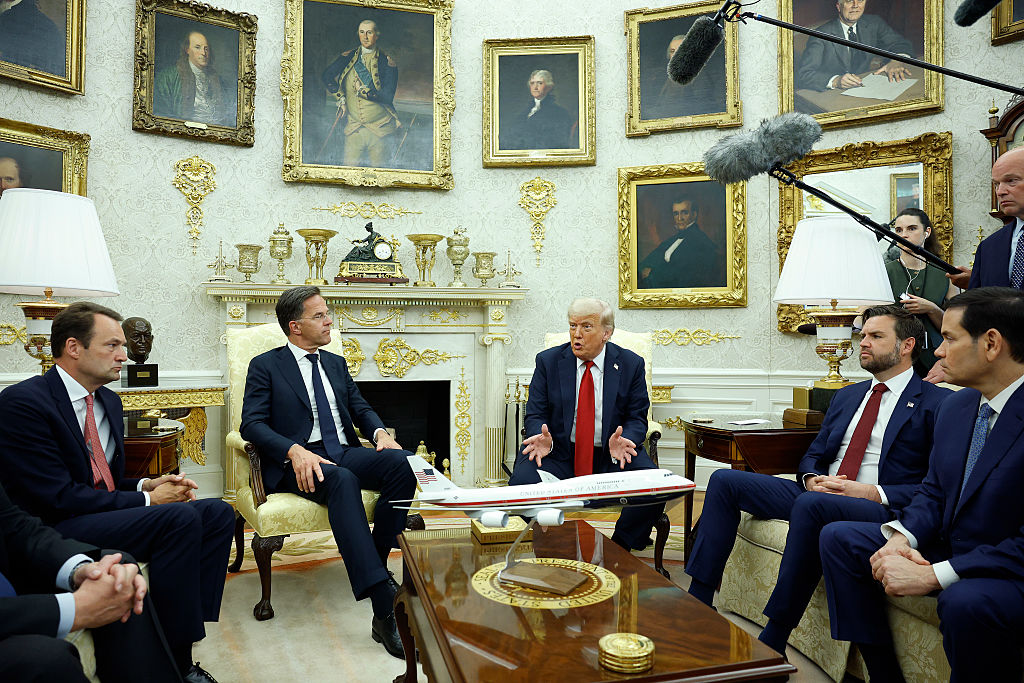
He expanded on that theme during a meeting with Nato secretary-general Mark Rutte in the Oval Office on 14 July, where the US president was expected to deliver a “major announcement” on Russia. After speaking to Putin on the phone, he said, “I always hang up and say, well that was a nice phone call, and then missiles are launched into Kyiv or some other city, and I say, ‘strange.’ And after that happens three or four times, you say, ‘the talk doesn’t mean anything.’”
Even the first lady, Melania Trump, had noted the discrepancy between his “lovely” phone conversations with Putin and the devastating war he is waging against Ukraine. “I go home, I tell the first lady, ‘You know, I spoke to Vladimir today, we had a wonderful conversation,’” Trump recounted. “She said, ‘Oh, really? Another city was just hit.’”
Since returning to power in January – whereupon he had promised to end the war within 24 hours – Trump had believed a peace deal with Putin was within reach “about four times,” he opined, “but it just keeps going on and on and on.”

With this pattern so clearly established and Putin so demonstrably uninterested in serious peace talks, there was growing anticipation in Washington that Trump was about to signal a radically new approach. Perhaps the major announcement would turn out to be an unequivocal declaration of support for Ukraine and a commitment to pass the bipartisan sanctions package that is currently gathering momentum in the senate and would impose a 500 percent tariff on countries that buy Russian oil and uranium (such as China and India). Fool Trump four times, one might think, and, to quote George W. Bush, “you can’t get fooled again.”
To be fair, Trump did announce that Ukraine would now receive the air defence systems and other crucial weaponry that Volodymyr Zelensky has repeatedly requested – and which his own administration had previously suspended – which is unequivocally good news for Kyiv. Although he was characteristically vague on the details of what, exactly, would be sent. “Everything. It’s Patriots [the US-made missile defence system]. It’s all of them,” Trump said as Rutte nodded along encouragingly. The one detail he did want to stress was that the US would not be paying for them. Instead, they would be sending the weapons to Nato, where “rich” European countries would apparently foot the bill, and then send the weapons on to Ukraine.
“This is really big,” Rutte interjected, demonstrating, once again, his fluency in Trumpian rhetoric and his apparent comfort with public acts of self-abasement in an attempt to secure the US president’s support for European security. (During their previous meeting, Rutte referred to Trump as “Daddy.”) “This is Europeans stepping up.” If he was Putin, Rutte suggested, he would now be left with little choice but to take these negotiations “more seriously.”
Alas, this is an unlikely outcome. Far from offering a stirring invocation of the need for Ukraine to prevail and Washington’s unending commitment to standing with Europe against Russian aggression, Trump repeatedly distanced himself from the war. “This is a Biden war. This is a Democrat war,” he said. “Not a Republican or Trump war.” “This is not Trump’s war,” he stressed again as he answered reporters’ questions. “We’re here to get it finished and stopped.” Twice, he pointed out, “they’re not Americans dying,” noting that he and “JD [Vance]” have a “problem” with the war, which they had both campaigned on a promise to bring to an expedited end. “There are no winners here,” Trump concluded, as though he was surveying a bad real estate deal. “This is a loser.” His comments did not exactly signal robust support.
As for the senate’s sanctions package, which is being touted in DC as a “sledgehammer” that will enable Trump to end the conflict, the president himself sounded noncommittal, offering only that it was “good that they’re doing it.” Instead, he promised to impose “very severe tariffs if we don’t have a deal in 50 days.” Those tariffs would be set “at about 100 percent,” Trump said, calling them “secondary tariffs” but offering no further details as to what this meant. (Secondary sanctions are generally imposed on third countries trading with a targeted nation, so this could mean imposing 100 percent tariffs on US imports from countries that trade with Russia, but it is not clear.) Asked how much further he was prepared to go if Putin continued to escalate his attacks on Ukraine, which has been subjected in recent weeks to the heaviest aerial bombardment since the start of the war as the Russian military, Trump responded: “Don’t ask me a question like that.”
For all the dramatic billing, the problem with Trump’s latest strategy is that it is essentially the same strategy that he has already tried. He is threatening Putin with very serious consequences if he doesn’t end the war, while signalling that he, personally, and the US in general, has no real interest in that war beyond ensuring that “we get it finished.” Agreeing to continue supplying Ukraine with the weapons it needs to defend itself, or at least to sell those weapons to Nato, is better than the alternative for Kyiv and allows the Ukrainian military to keep fighting, but it is not the same as committing meaningful funds and political capital to ensure Ukraine’s survival against the Russian onslaught and bolster European security. Trump has the votes to pass a massive new military aid package in congress immediately if he so desires. Evidently, he does not.
There is no doubt that Trump’s tone on Putin has decidedly soured in recent days. Perhaps he is genuinely reconsidering his previously admiring assessment of the Russian president, and a more consequential policy shift will eventually follow. But for now, he is choosing to respond to Putin’s habitual obfuscation and clear track record of stringing him along by giving him another chance – this time another 50 days – to mend his ways, and warning that this time is really serious about getting tough.
Perhaps the fifth time will turn out to be the charm, and Putin will now be persuaded to enter serious negotiations and call an end to his assault. But it is more likely that he will interpret Trump’s announcement as giving him another 50 days to bombard Ukraine and grind forward on the battlefield, where he believes the Russian military has the upper hand, albeit at a glacial pace and tremendous cost. Tellingly, the Russian stock market rose after Trump’s announcement. Moscow, it seems, was bracing for much worse.
[See also: Putin’s endgame]
Content from our partners



Related
Join the debate
Subscribe here to comment