
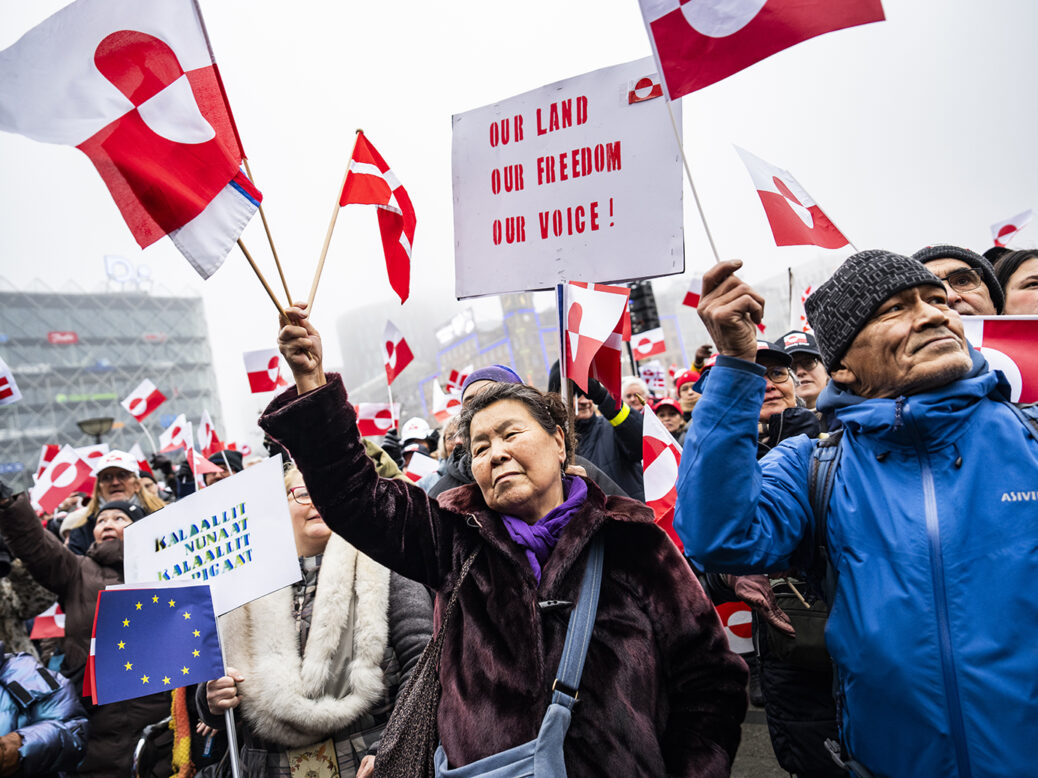
When Donald Trump first made known his desire to “buy” Greenland in 2019, the reaction inside the Kingdom of Denmark was one of hilarity. When he revived the idea early in his second term, that hilarity turned to incredulity. In the face of trade tariffs and threats of military action, it has turned to fear and raw anger.
For decades, relations between Greenland and its sovereign Denmark have been strained. But they have surely never been stronger than they are right now. That much was clear at protests which took place on Saturday (17 January) in the Greenlandic capital, Nuuk, and in the Danish cities of Copenhagen (my home town), Aarhus, Aalborg and Odense. Billboards in Denmark have been taken over by satirical takedowns of Trump and a humiliating naked effigy of the president was jeered as it was carried through Copenhagen streets. Surprisingly, the solidarity expressed in Denmark appears to be mutual. That stems in part from the repeated Danish commitment to a postwar principle of self-determination that Trump is trying to ignore: that Greenlanders must decide their own fate, including a path to full independence if so desired.
Nordic politics, characterised normally by consensus and respect, is experiencing something entirely unprecedented in the indignation being felt towards Trump’s aggression and callousness. A regular sight in Copenhagen this past week was a version of the distinctive red Maga baseball cap bearing the modified phrase: “Make America go away”. The Danish comedian Huxi Bach was asked to comment on the saga by the New York Times, which shared the satirical video he made as a response. Maja Elm, a 17-year-old “ordinary Greenlandic girl” living in the Danish capital, became famous overnight for a 17-second TikTok video in which she challenges Trump to “meet me in the ring alone” for “a fight to the death”. The tone is humorous and the language is crude. But there is a kernel of honesty in the message: neither Greenlanders nor Danes are prepared to take Trump’s threats lying down.
Greenland’s journey from a colonial subject to self-governing nation within the Danish realm has been slow and juddering. Even now, historic mistreatments and discrimination meted out by Copenhagen (such as the recent discovery of a forced birth control campaign against Greenlanders) have to be reckoned with. But we have learned this past fortnight that the ties between the nations run deeper than many believed – while the functional aspects of their relationship have proved pivotal. It is chilling to consider what would be happening in Greenland right now, without its proxy Nato membership, via Denmark.

Never one to be distracted by details of legality and sovereignty, Trump apparently assumed Greenlanders would jump at the chance to become Americans. Whether or not he’s been convinced otherwise by stark polling and huge public displays of opposition – a quarter of Nuuk’s population is thought to have attended the rally in the city on Saturday – he is unlikely to let such expressions of popular will stand in his way.
The delusion that Greenlanders would naturally want to become Americans is not confined to Trump. Nor is it particularly new. His administration’s America First doctrine taps into something far deeper that could be termed America Best – a sincere chauvinism, held by Americans of many political persuasions, that most citizens of the world would really like to share their nationality. It has long been a trope in Hollywood and popular culture, and has proved a particularly useful fantasy for the Maga movement as it struggles to preside over a country riven with internal divisions and burdened by a colossal national debt.
To many millions around the world, US citizenship may well be an aspiration. But the most basic facts about Greenlandic society have thrown into sharp relief the curiously American assumption that everyone, deep down, really wants an American passport. Plenty don’t – and with good reason. The 56,000-plus inhabitants of the world’s largest island might ultimately prefer to be living in an independent country free from colonial legacy of any sort. But for the time being, the choice between the American Dream and a Danish reality is clear.
This should come as no surprise. Greenland has gaps in its social infrastructure that Denmark doesn’t. But Greenlandic healthcare is entirely free and so is education to university level. Greenlanders are entitled to 11 months of paid parental leave and a minimum five weeks’ paid holiday. There is a meaningful social safety net to catch those who stumble and there is no chance of being executed for a crime you did not commit. Greenlanders can vote for lawmakers from a range of parties, with whom they can be in direct contact, who will not get away with serious misconduct and who will likely live a life approximate to their own.
That life can be tough. It comes with all the meteorological and economic challenges of living on an island lying mostly inside the Arctic Circle. But there exists still in Greenland a version of that noble idea, pervasive in the wider Nordic region, that life should be about something more than the acquisition and spending of wealth and that nature is both sacred and wise. Greenland might not reap the benefits of the Nordic social model that it could and should. But it is a country with a soul, a conscience, a binding unity and a belief in justice both personal and planetary.
When I moved to Copenhagen from London in 2015, I took up a place at a state-funded Danish language school with other immigrants from around the world. I shared classes with American exchange students and even some expatriate professionals. They were intelligent, articulate, well-travelled and savvy. But still, they saw the Nordic model of high tax, high welfare and high trust in government as quaint; something they admired in principle but ultimately considered naive and unworkable.
No doubt those same Americans, a decade older, are mostly horrified at what has come to pass in their country. But if they still consider the Nordic model so naive, perhaps they should ask themselves why the population of a remote, inhospitable and economically disadvantaged island would prefer that model rather than join the world’s biggest economy.
Nor, in the age of Ice killers on American streets, is the US’s claim to lead the free world so convincing. As in the other Nordic countries, Denmark’s democracy actually functions for its people. Voter engagement is far higher than in the US, election campaigns are never meaningfully skewed by money, and the electorate gets real choice: political parties can be formed and elected to parliament in a matter of months. Proportional representation and the coalition system mean they frequently are.
Across the Nordic region, this system has consistently returned to government parties who believe in the high tax, high welfare model. The Nordic countries have the world’s freest press, least corrupt institutions and happiest populations. None of these societies are faultless. But they collectively represent, in democratic terms, the best of the postwar European project and a fundamental ideological diversion from the American reality of every man for himself. In its bid to stave off Trump-style nationalism, perhaps the European Union should be turning to its northern members to remind itself what European values look like.
[Further reading: Europe must break from America]
Content from our partners


Related


Join the debate
Subscribe here to comment