
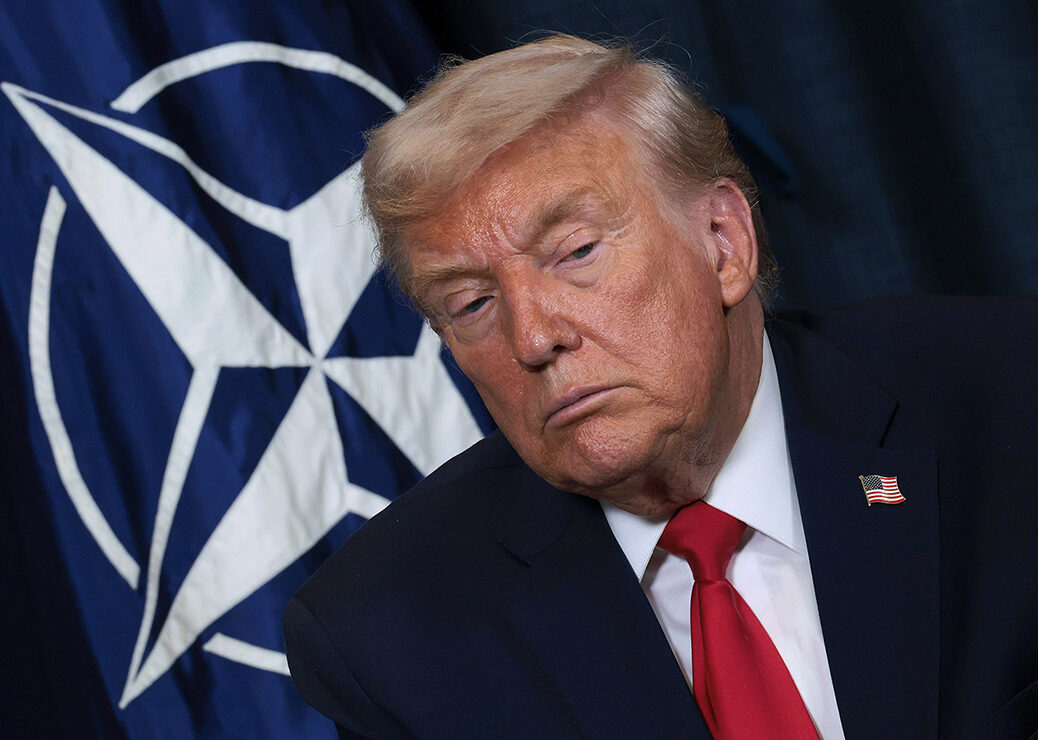
“Daddy” moves in mysterious ways. At least, it must seem that way to the Nato secretary general and Trump-flatterer Mark Rutte, who has spent the Iran war trying to inflate Nato’s stock in the White House by pushing Europe to bundle in behind the Americans. Well, that was futile for a few reasons: European militaries lack the means; the Americans don’t really need the help; and fighting in a war that involves blowing up civilian infrastructure would invite the thump of an international judge’s gavel. Remember the UN Charter is written into Nato’s founding treaty itself. Trump has pulled the alliance into a paradox: its guarantor could become its executioner.
Trump has never had much time for the alliance. Nato matters to him only when it obeys his commands and is party to his whims. The president sees himself as a deal-maker. Deals are short-term transactions, not strategies for continental defence. Take Greenland. “It all began with Greenland,” he said on 6 April. “We want Greenland. [Nato doesn’t] want to give it to us, and I said, ‘Bye-bye!’”
Nato was not built on sentimental postwar American feelings about Parisian boulevards and red London buses, but the need to counter the Red Army, massing on the other side of the Iron Curtain. Now, Trump rhapsodises Vladimir Putin’s strength. And he doesn’t like these effeminate, procedural, miserly Europeans, whose umming and ahing about the difference between defensive and offensive strikes against Iranian targets does not register in this White House.
Even ethnic kinship, which some of Trump’s lieutenants care about, has been sullied in their eyes by mass migration. The next generation of Maga do not have memories of the postwar world that gave Nato its raison d’être – or if they do, it is an object of their resentment, as preserving the US empire is a distraction from the homeland.

Trump is a creature of the century that birthed Nato, sure. His metrics for success are prime-time ratings, the square footage of skyscrapers and the front page of the New York Post. But he is also a thoroughly pre-modern president. He disdains conventions like international law and he cannot understand what they are for. Like a character in some technicolour, Nietzsche-inflected narrative, he is beyond good and evil. Unlike his predecessors, he has waged this war without genuflecting to Thomas Aquinas. In the build-up to this conflict, there was little attempt to frame what was about to happen as a “just war” in Christian terms. On Easter Sunday Trump posted “praise be to Allah” on Truth Social. Recall the frequent comparisons the president makes between himself and Jesus, and this war starts to look like the outcome of a subconscious drive to rebel against meek Christian rules. He probably thinks his comeback in 2024 was more impressive than the son of God’s in AD 33.
There is nothing like Easter to shine some light on this point. Pope Francis died last year on the day of the White House Easter event on the South Lawn. I watched Trump eulogise Peter’s successor as a “good man, worked hard”, before he walked down the stairs, stopped and turned to salute the Easter Bunny. This year, with the Easter Bunny as his witness, and with his staffers’ children sobbing quietly to his front, Trump took the time to muse that Iran was now “not too strong at all”. He has a knack for turning the serious into the surreal. War and chocolate sit on the same continuum. Phrases like “Article 5” are too mundane to hold his attention.
Nor was Nato set up as a vehicle for pillaging. “If I had my choice, what would I like to do? Take the oil,” Trump has said about Iran. Looting other countries makes Europeans feel guilty about their old imperial adventures. Trump, however, combines the morals of an 18th-century privateer with the technology of the US Navy Seals. Catholics confess with an eye to absolution. Trump confesses but doesn’t think he needs forgiveness. He prefers amoral frameworks. “You know, in the old days: to the victor go the spoils,” he has said. That phrase originally described the way an American president would hand out jobs to their friends once they won the White House. Trump has long endorsed that interpretation. Now he is taking it global.
His more intellectual acolytes might criticise international institutions as globalist, or unjustifiable restrictions on nationalist politics, or a way for elites to suppress democracy. Trump sees them simply as fetters on his own will to power. Of course, America often fights wars without Nato. See Iraq and Vietnam. But to Trump, the difference is moot. In his mind, Nato did not pay tribute when called upon this year. Therefore, it deserves to be humiliated, denuded and relegated.
He has spent his second term dismantling the institutions that made up the international system. He has withdrawn the US, to take a few, from the World Health Organisation, the International Law Commission, the European Centre of Excellence for Countering Hybrid Threats, the Global Counterterrorism Forum.
Will Trump leave Nato and break up the alliance? American arms manufacturers might have something to say about that. As might the Pentagon planners who have spent decades integrating the transatlantic militaries into their own. But it might not be necessary. He has already taken apart the assumptions on which it is based. The question for everyone else in the club is what to do about it. Another round of flattery in the Oval Office might not suffice.
[Further reading: Why Trump keeps escalating in Iran]
Content from our partners


Related
This article appears in the 08 Apr 2026 issue of the New Statesman, The Fall
Join the debate
Subscribe here to commentThe Necessary Turbulence: A Post-War Order in Decay
The global experience of the Trump presidency is undeniably painful, but it may be a necessary catalyst. He is the “rude awakening” for a world that has been slumbering under the watch of leaders who have been asleep at the wheel. We do not want the world Trump is building; however, his presence has forced a vital dose of realism upon us. For too long, world leadership has been in denial, content to “muddle through” with minor course corrections to keep the waters calm, even as the current pulled us further away from our true destination.
The Myth of the Special Relationship and the Decay of 1945
The UK’s “Special Relationship” with the USA is a relic of expediency, a Churchillian construct designed to counter a Soviet threat that no longer exists in its 20th-century form. In the wake of World War II, we built a raft of alliances and international laws that were vital for their time. But institutions, like all human creations, require dynamic maintenance to remain relevant.
Without that maintenance, they become hollow:
A Countdown to Renewal
We must now endure the remaining two years and nine months of this presidency. I am counting down the days, not just for a release from the madness, but with faith in the American electorate. I trust that the American people will correct this electoral aberration and restore a leadership that truly “Makes America Great Again” in the eyes of a global community—not through isolation, but through renewed excellence.
Parallel to this, the rest of the world must use this “Trumpian interruption” to construct an alternative world order. We need a system that addresses the problems of today and the challenges of the near future, rather than clinging to the ghosts of 1945. Trump is the storm; our task is to ensure that when it passes, we have finally begun the journey north.