


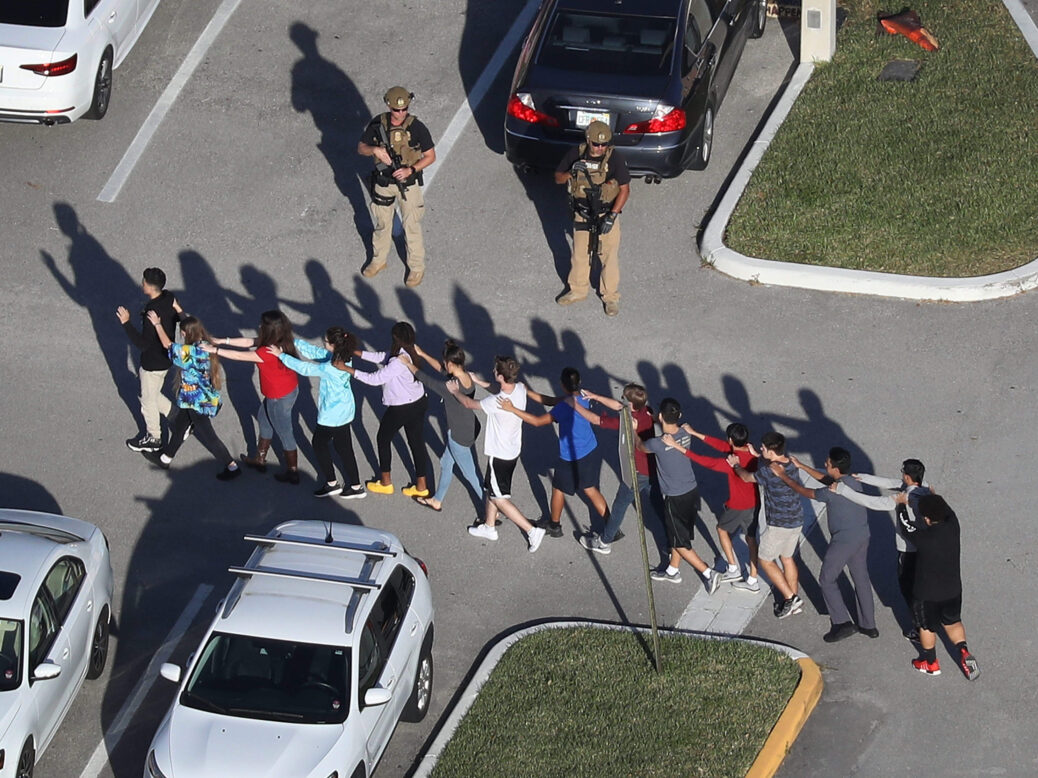
It’s 8:20 am and most of the students have already gone through scanning — a security process mandatory for anyone entering the campus.
A late student arrives. She shows identification and passes her belongings though an x-ray machine, attended by the familiar face of a security guard and school administrator. Bags and other personal belongings float through the machine while the student steps into the metal detector and pauses. There is a green light, and she moves to collects her things from a blue tray.
A computer malfunction or other delay can cause a back-up that cuts into the second period of the school day. The students don’t mind — if they bristle about the scanning, it’s usually because the process is annoying. If there’s a hint of something else, some other grievance over the whole idea of scanning —of going through security — it isn’t often spoken.
Later that day, an announcement crackles over the loudspeaker. A familiar voice declares that the lock-down protocol has been activated. The voice is calm, official. Instinct tells us this is a drill. Teachers and students know the protocol by heart, by rote, as if it were the only sensible thing to do: turn off the lights and turn off the smart-board; lock the door, and take shelter out of sight, in the farthest corner from the door. And then wait. Sometimes for five minutes; but sometimes for hours.
It all depends.
Is it real this time?
When nineteen year old Nikolas Cruz entered the freshman building at Stoneman Douglas High School, he was carrying and AR-15 style semi-automatic rifle. It sprays bullets at high speed — tearing into flesh and shredding organs, tissue, and muscle — three times as fast as the speed of sound. It isn’t just a gun, but an efficient killing machine, designed to quickly and easily inflict maximum damage. If the bullet itself doesn’t hit a vital organ, there are other concerns. The “cavitation effect” is the tendency of these high-velocity bullets to obliterate inches of tissue, muscle, organs, and bones around the wound. The destruction can leave an exit wound the size of an orange.
If Nikolas Cruz were on the other side of my classroom door, I would do anything to protect my students. If I had a gun, I would try to use it. I would use a stapler, a desk, or myself to shield my students from harm. Many teachers have done the same and lost their lives.
But none of that answers the real question: why was Nikolas Cruz on the other side of that door? And why was he in possession of that weapon?
Arming teachers is not an answer to either of those questions.
Teachers are more than just educators. They are often mentors, therapists, counselors, role models, parents, coaches, and cheerleaders, depending on the day. The familiar face of the security guard, the teacher who always has food when you’re hungry — these are the duties of people who work with children. It is not the duty of these people to act as armed guards. It is not the duty of these people to train so that some day they might defend students against another student with a deadly weapon.
If a student has a problem that calls for medical or psychological intervention and support, schools should have the resources to support those students. When school personnel do not have the resources to address the mental-health needs of students, it is not a solution to give them a gun. A gun is not healthcare, or counseling, or therapy. A gun will not eliminate the stigmatisation of mental-health. A gun will not begin to offer necessary support to not only students, but all members of society who struggle to get the mental healthcare they desperately need.
If Nikolas Cruz were on the other side of your classroom door, would you wish you had a gun? Or would you wish that he didn’t? In a perfect world, authorities properly report and investigate potentially dangerous or unstable people. In a perfect world, they get the support they need to be well. In a perfect world, guns designed to kill quickly, easily, and brutally, should have no place outside of the battlefield.
Content from our partners


Related


