
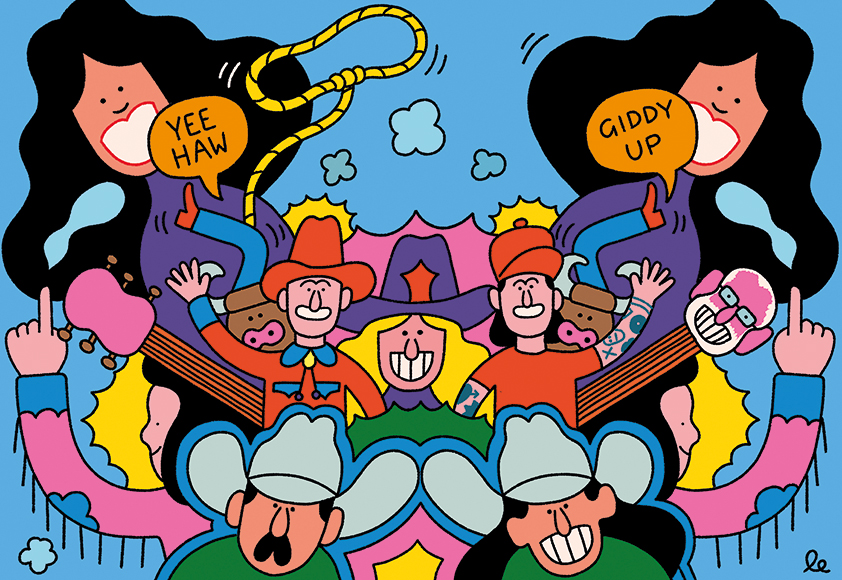
The space around the O2 Arena is windswept in mid-March, and British Americana bands play to sparse crowds on pop-up stages. The 20,000 people who’ve bought tickets to the Country to Country music festival are all at the Ariat cowboy boot stand, and the atmosphere is bordering on tense. “They should really make this place bigger,” says a woman, balancing on one leg to pull on a Kearney Round Toe. Another stands in front of a mirror and looks at her footwear approvingly: “They feel exactly like my other ones!” She takes them to the till.
I smell burning skin and turn to see a “boot-branding station” – making its first appearance at the festival, which is now in its 14th year. The station consists of a leather chair, with a man crouched in front of it like one of those old-fashioned shoe shiners; he rummages with a long metal poker in some hot coals. Thirty shoppers line up to get their brand-new Ariats stamped with his tiny insignia of a Texas longhorn. The man’s hands are coarse, his skin weathered. Where has he brought his trade from? “Canary Wharf,” he tells me, raising a boot over his shoulder. “I could chuck this from here, in fact, and I’d hit it.”
Country to Country takes place every year on the same weekend in March, in three cities at once, with dozens of American artists swapping between venues in London, Belfast and Glasgow at a frantic pace. It feels like a strange dream to see people you’ve never heard of – with names like MacKenzie Carpenter and Bayker Blankenship – playing to vast, hooting audiences who know exactly who they are. Country is now the fifth-largest genre in the UK music market. An old-school British Americana promoter tells me: “We used to avoid the C-word in our press releases, and now it sells.”
Women move about in hen-style packs (fringe jacket AND fringe bag, anyone?), while men follow stiffly in leather Stetson hats. Don’t misunderstand me: I adore cowboy tat, and I know very well the kind of dreams it promises to fulfil. When I first came to Country to Country ten years ago, there were just a handful of stalls, and I would finger a bootlace tie with a silver eagle on it, convinced it had the talismanic power to turn me into a free spirit.

But in 2026, the demand for cowboy tat is off the charts, and the Boot and the Fringe are as commercially powerful as they were in the 1950s: synecdoches for something wild and wonderful that no one quite wants to pin down. In a dim glass unit off Peninsula Square, renamed Yellowstone Yard for the weekend, punters lie prone on tables getting country tattoos. Paramount+ is a partner this year, its big screens everywhere – you can film yourself with your friends against a Yellowstone backdrop, making pistol signs with your hands.
The festival has become a convention, a safe space where people can wear clothes they wouldn’t wear anywhere else. But there are trucker hats now, which didn’t use to be there, representing the rise of “bro country”: a radio-friendly subgenre known for songs about tailgate parties, the Fourth of July and various other things that mean nothing to the British. A mother and daughter from Kent tell me, over chicken fillets, that it all took off when Luke Combs got big on TikTok during the pandemic. You can hear his new album on headphones in a caravan parked near the hog roast stall.
“Not liberal enough for liberals, not conservative enough for conservatives,” was how Combs described himself, when forced to, on a podcast last month. Like most contemporary country artists, he is doomed to keep silent on politics for the sake of his career. What these artists believe, what they actually stand for, used to hang around them like a mysterious gas; it was part of the music’s exotic appeal, like the random call-outs to Jesus you sometimes hear from the main stage at Country to Country, and which a UK audience – so respectful but so profane – never quite knows how to respond to.
In recent years, there have been some more overt expressions of political feeling, such as Jason Aldean’s “Try That in a Small Town” – an unpleasant number with a vigilante flavour, widely suspected to be a response to Black Lives Matter. Aldean hasn’t played Country to Country since 2015, though. Everyone I speak to claims to be of the old guard, fans of the more traditional stuff – like Amber, with her tattoos and saloon dress, who tells me she found her way to Brad Paisley from heavy metal.
I’ve been here for hours and haven’t seen any music, so I head into the arena, where a recording of Zac Brown Band’s “Chicken Fried” is playing to get people in the mood. “A cold beer on a Friday night/A pair of jeans that fit just right…” – this is music that evokes the most ordinary things in life, the soundtrack of a Friday night in North Greenwich.
Whispering Bob Harris takes the stage to introduce the first act. He still presents BBC Radio 2’s Country Show, and at nearly 80 he is the same as he always was: his general approach being to recall a musical event of the past, say how long ago it was, and point out that he was there when it happened. He introduces Noeline Hofmann – she’s in full West Coast revival garb – a Canadian who spent time working on a cattle ranch in Manitoba. Hofmann is followed by my favourite rising star of the weekend, Waylon Wyatt (named for country), a raw-voiced manchild in double denim who plays luxuriantly gloomy modern Arkansas folk with a rock band. He was born in 2006.
In a pub on that chilly strip of bars that runs up the edge of the dome but outside the concert space, something quietly transgressive is going on: a one-man line-dance show run by Brandon Burke, who was born in the Ozark Mountains and is, in his own words, “a Dolly Parton lover and a big ol’ gay”. Thin and wiry, with a steady twitch of the eye and a tricorn hat rather than a Stetson, Burke looks like the kind of guy who runs bars in Key West – the town Americans go to to get away from America.
He came out at the age of 35, “after years of praying to God to change me: then went man-hunting”. And he has his own take on the dance form invented with the principal aim of allowing men to dance without touching each other. Drink focuses the mind, and by the end of Burke’s increasingly complicated hour-long line-dancing set, there are 42 people moving in the tiny space. He beats his haunch with his hand and calls his steps: “Stomp clap, stomp ASS, stomp clap, stomp ASS. Don’t be embarrassed, baby!”
Behind me, rolling a pint around his mouth, is Mark, a mechanic from Fort Worth, Texas. Mark likes Pink Floyd. But gradually, over the past few years, with the rise of “bro”, “post-bro”, and all those forms of country that slowly pulled it into the world of pop and onto his radio, he has been able to admit that growing up, he liked country music – he just couldn’t say that at the time. It was probably the same for everyone who came to Country to Country for the first time this year.
I ask Mark what he makes of the British people’s clothes. He looks down at his plaid shirt and his old Ariat boots. “I wear these for work. This is what you wear in Fort Worth on a Tuesday. Everyone here, I can tell their boots are new. They’ve just got them, and they’ve spent $200 on them. It’s wild.”
[Further reading: Len Deighton was a revolutionary]
Content from our partners



Related
This article appears in the 18 Mar 2026 issue of the New Statesman, The new world war
Join the debate
Subscribe here to comment