
Labour is at war over the Treasury
As tensions rise, the Starmer-Reeves relationship will be tested as never before.

In his letter to cabinet ministers at the start of this year, Keir Starmer wrote: “Increasingly, politics is no longer built around a traditional left-right axis. It is instead being reimagined around a disruptor – disrupted axis.” That claim was viewed by some in Labour with scepticism but Nigel Farage appears determined to prove it. In the Reform leader’s ideological universe there is now room for Arthur Scargill and public ownership as well as Margaret Thatcher and the City of London. Incoherent? Perhaps, but similar contradictions didn’t stop Donald Trump from winning two elections. Labour strategists question whether Reform will be able to maintain its populist turn. “At the end of these local elections thecaty’ll have picked up a lot of former Tory councils,” ...
America’s crisis is the UK’s opportunity
Keir Starmer should open our doors to the best and the brightest fleeing Donald Trump.

It was predictable enough that the election of Donald Trump would come to define Keir Starmer’s premiership. Whether it be his imposition of tariffs or his abandonment of Ukraine, the US president has been hugely consequential for the UK and created immense challenges for the Prime Minister. At least for the moment, Trump appears to have been charmed by Starmer. If this helps us to avoid the worst on tariffs or security cooperation, the Prime Minister will have done the country a service, although a more than nagging doubt must remain that any favour granted by Trump merely gives him leverage to exploit later. Tactical successes should not be begrudged, but nor should they get in the way of strategic clarity. ...
Why the Scottish trans movement lost
Through its dogmatism, the SNP alienated even those sympathetic to trans rights.

It was impossible to miss the explosion of joy and relief from campaigners that greeted the UK Supreme Court’s verdict that the legal definition of a woman is based on biological sex. “Yaaaaaaaaaaaaaaaaaaaaaaaaaaaaas,” tweeted For Women Scotland, the group that had challenged the Scottish government on the issue. There were tears, hugs and champagne. This ruling had been a long time coming, and followed years of abuse and threats towards those who stuck their necks above the parapets and refused to pull them in. The UK’s highest court left no room for confusion in its finding. “The definition of sex in the Equality Act 2010 makes clear that the concept of sex is binary, a person is either a woman or a ...
JD Vance doesn’t understand the Suez Crisis
The Vice President is flattering British conservatives by appealing to their deepest imperial fantasies.

Despite becoming the mouthpiece for the Trump administration’s unprecedented hostility towards their European allies, vice-president JD Vance has made himself popular in one corner of Europe by whispering the magic words that make every British conservative of certain persuasion simply melt: “You were right over Suez.” Even though Vance’s recent admission that “the British and the French were certainly right in their disagreements with Eisenhower about the Suez Canal” was just a throwaway line in a longer interview which focused on the need for Europe to be more independent of the US, it struck a nerve with a portion of the British right who have been waiting to hear this for years. The Spectator magazine responded with an article celebrating Vance ...
Republicans should take back control from Trump
Congress can prevent further economic harm by stripping the president of his trade powers.
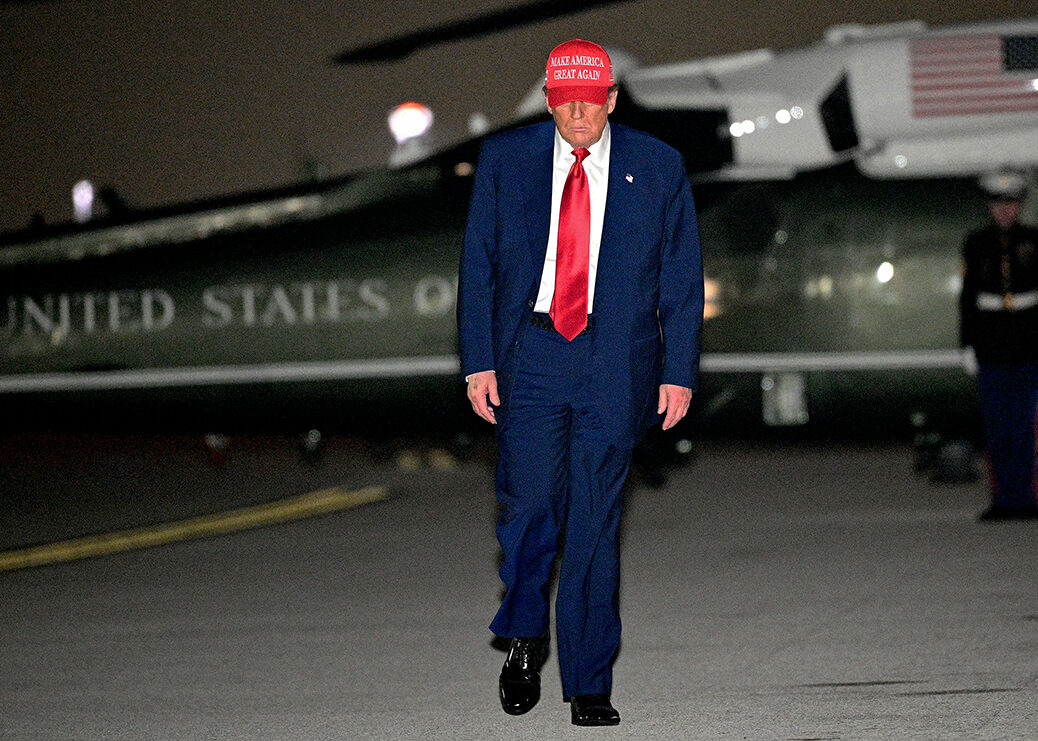
At what point does a legislator – particularly one of the same political party as the government – have to intervene and restrict the powers of the government over trade negotiations? This is the question that Republican members of Congress should currently be asking themselves. Donald Trump may have partially retreated on his “Liberation Day” announcements, but he has still implemented a dramatic increase in tariffs and is doing much damage to the global and US economies. Even if Trump retreats further or succeeds in agreeing bilateral trade deals with some countries, the uncertainty created by his erratic policy approach is destroying business confidence. This is not a good place to be. Congressional Republicans (many of whom, no doubt, are New Statesman ...
Scotland’s public spending timebomb
The country needs a Thatcher or a Blair to provide a dose of fiscal reality.

The names of Graeme Roy and Stephen Boyle won’t ring many, if any, bells with the average Scottish voter. They are, however, two of the most significant and consequential figures in public life. Roy and Boyle are the people’s brain and voice when it comes to keeping watch over the devolved state’s performance, the former as head of the Scottish Fiscal Commission, the latter as Auditor General. Over the past few years, both have produced a series of sharp-toothed reports examining the outcomes of government policy, the domestic and external pressures being brought to bear on the nation, and its prospects. They have done so ruthlessly, banging on dials, scouring the data and issuing ever doomier prognostications. Roy and Boyle have fearlessly ...
The age of five-party politics
Fragmentation leaves Labour facing threats from all sides.

One of the ironies of Brexit is that since leaving the EU, the UK has become a more European country. Tax and spending levels – once likened to the US’s – are beginning to resemble Germany’s. Britain’s “flexible” labour market is undergoing continental-style regulation. And it will soon be the government’s job to make the trains run on time. The UK’s politics, too, has an increasingly European appearance. Two opinion polls published this week – by YouGov and More in Common – feature four parties on between 17 and 24 per cent of the vote: Labour, the Conservatives, Reform and the Liberal Democrats (riding an anti-Trump wave). Throw in the Greens (on between 7 and 9 per cent) and this starts ...
Is Labour ready for recession?
Keir Starmer and Rachel Reeves face their greatest test.

At the beginning of a crisis, actions always trail behind events. In autumn 2007, as the first bank run for 150 years began, Gordon Brown refused to nationalise Northern Rock (fearing it an “Old Labour” remedy). By the following year he had taken the commanding heights of the banking system into public ownership. In early March 2020, as the worst pandemic for a century began, Boris Johnson declared that it was “business as usual” and reacted with libertarian incredulity to calls for a lockdown. A few weeks later he was amassing emergency powers and ordering the UK’s “free-born people” to stay home. Even as a new world comes into being, politicians cling to the old one. They, like us, are creatures of ...