
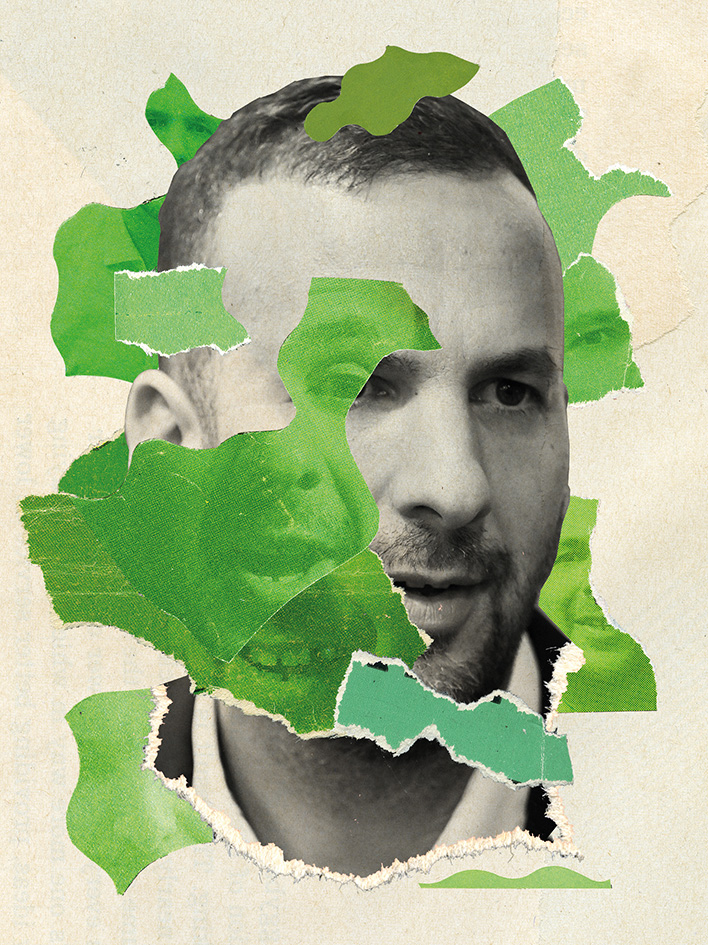
Zack Polanski is standing in the drizzle on a patch of woodland, on the edge of a car park in the quiet village of Forest Row, East Sussex, waiting to be introduced. “I thought there would be about 20 people,” Rachel Millward, the deputy leader of the Green Party, shouts excitedly to the crowd of hundreds that has gathered, on a weekday morning, with less than 24 hours’ notice, to see the Green Party leader.
These are people of all ages, dressed in colourful clothes, excited. “I see people who do yoga together,” Millward declares. “Who sing together! Who dance together!” As co-deputy leader of the Greens, she says, it is her duty to “speak the truth – my truth – and to speak hope”. The crowd looks emotional.
Polanski steps up, picking up the theme. “The thing that people say to me over and over again – it would become repetitive if it wasn’t beautiful – is I’m feeling hope!” The crowd erupts in agreement. “I’m feeling hopeful, too, both as a leader of a political party, but frankly, as someone who lives in this country,” he continues. “It was starting to feel pretty grim. It was starting to feel like the managed decline of the Labour government was just warming the plate to hand that over to Nigel Farage and a Reform government. What I’m here to say today is none of that is inevitable.”
The crowd beams up at him. One woman holds a placard of a Marmite jar that reads “Spread Love, Reject Hate.” “Love that,” Polanski says, pointing at the sign.

When he finishes his speech and steps off the platform from which he addressed the crowd, he is quickly mobbed – that’s the only word for it. The crowd wants selfies, signatures, photos of him with a book they’ve written. His bodyguard bundles him towards a car, but supporters rush alongside him, insisting they must tell him about this project or that idea, handing his advisers documents, pressing plans into their hands. It becomes increasingly urgent, almost aggressive. I am rushed into the car alongside him, the door is slammed shut, and then, finally, there is silence. Yes, it is always like this, Polanski tells me with a smile when I ask.
Zack Polanski has been leader of the Green Party for just seven months, having been elected on an “eco-populist” platform in September last year. At that point, he could walk down the street mostly unrecognised. Now, he goes on visits with a bodyguard, gets stopped by teenagers on the Tube, and hosts club nights where crowds of young people cheer his name. It is strikingly, unmistakeably, reminiscent of the Corbyn mania of 2017.
“My life’s absolutely transformed,” he says, when we sit down on the train back to London together, munching on a bag of popcorn – his lunch, the best vegan option available at East Grinstead station.
The Green Party has been transformed as well. It is enjoying a swell in support, tapping into the national despondency towards Keir Starmer. Membership has grown from 60,000 when Polanski took over, to 226,000. The Greens have surged in the polls, and in February, won their first Westminster by-election. The Polanski recipe is simple enough: “hope”, with a heavy dash of populism. Corbynism has found its heir.
Will the Green moment end as quickly as it began, or is the party now a permanent force to be reckoned with? Polanski is determined to make sure it lasts. He sees the parallels with Labour under Corbyn, the last major surge on the British left. Over the course of our train journey back to London, he tells me about the lessons he is drawing from that project.
He is quick to emphasise the differences too, though. One major difference, of course, is Polanski himself. While Corbyn was the same politician in the 1970s as he is today, ever consistent in his convictions, Polanski is barely recognisable as the man he was even a decade ago. How did he become the left leader he is today, a figurehead so many now look to for an alternative to Starmer’s Labour? Let’s just say he has been on a journey.
Zack Polanski was not born Zack Polanski, but became him. The young boy who grew up in the Jewish community of Salford, Manchester, in the 1980s was called David Paulden. He had a difficult upbringing. He was deeply affected by his parents’ divorce, and as a teenager was bullied at school for being Jewish and gay.
He changed his name aged 18, choosing the Jewish family name that had been dropped when the Polanskis arrived in Britain, fleeing pogroms in eastern Europe in the early 20th century, and “Zack” for the Jewish character in Goodnight Mister Tom, a children’s novel set during the Second World War. “Growing up as a practising Jew, having a bar mitzvah, there’s lots of joy and community to that,” he tells me. “There’s also an immense amount of pain, an immense amount of resilience of the Jewish community and situations we’ve faced.” He was reclaiming his identity, recognising “the determination and pride in the face of unimaginable circumstances” that generations of persecuted Jews have faced.
He had another reason to change his name: it was a symbolic rejection of the stepfather with whom he shared a first name. When he was growing up, people referred to them as “Big David” and “Little David”. “I didn’t want to be a little version of this man that I really didn’t get on with,” he says.
Drama at school had been a refuge of sorts, so the new Zack Polanski attended acting school in Georgia, US, and then returned to study drama at Aberystwyth from 2003 to 2006. He moved to London after graduating, working in community theatre, the gig economy, and, yes, hypnotherapy. He marched against Iraq, but freely admits he was almost entirely unpolitical until his thirties. It was theatre that began to politicise him.
He was working in a school of drama known as the “Theatre of the Oppressed”, a tradition that grew out of 1970s Brazil and which is popular among activists. He was, he says, “meeting with people who were facing injustice” and then playing them on stage. Yet Polanski’s first foray into politics wasn’t radical at all, but curiously, even subversively unpopular. In 2015, Zack Polanski joined the Lib Dems.
There is a video of Polanski, in a chintzy suit, like a children’s magician, sporting a goatee, on stage at Liberal Democrat autumn conference in 2015. He is a new member, he proudly declares, a rare recruit at the end of the party’s time in coalition, fondly quoting “Nick” and urging his fellow travellers to “feel proud” of the party’s time in government. At one point he even bursts into song. “Listen baby!” he booms out as he sways beside a gospel choir singing “Lib Dem fightback”, declaring that the qualities “Nick” is urging them to display are “qualities we eat for breakfast”.
Just as voters were deserting the Lib Dems, after five years of austerity and a broken promise over tuition fees, Polanski chose to join. He did not just become a member, but a candidate, and twice stood unsuccessfully as a Lib Dem candidate, for Camden Council and for the London Assembly. A 2015 article from the website Liberal Democrat Voice describes him as “ambitious, but with a true liberal soul”.
Labour has used clips of that conference appearance to tap into an idea that Polanski is inauthentic, inconsistent in his principles, or more focused on having a political career than on the party he represents. “I totally accept it is a very unusual journey into politics,” he tells me. He became a Lib Dem because the party wanted to change the first-past-the-post voting system – an issue that came up time and again at Theatre of the Oppressed workshops. “Once I understood that the voting system was the thing that was stopping people changing the system or getting the outcome they wanted, it felt to me, and still does, in many ways, that the voting system was the thing that really needed changing.” The “thing that shifted” wasn’t his view, but that the Liberal Democrats were, he believed, “the only party that were famous for talking about proportional representation when no one else was interested”. He only realised later that the Greens had the same policy.
In 2015, the same year Polanski joined the Lib Dems, Jeremy Corbyn was elected leader of the Labour Party, making similar arguments and riding a similarly hopeful, youth-backed wave that Polanski does today.
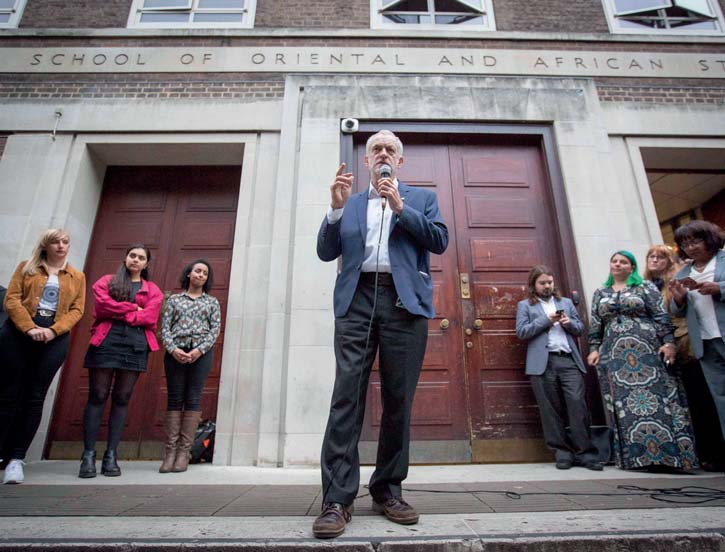
One summer’s evening in 2016, Corbyn held a hastily arranged rally with hundreds of his supporters in London, as Labour MPs prepared to mount a leadership challenge against him. Addressing the crowd on the pavement outside Soas University, Corbyn declared he would fight on, continuing to champion his anti-austerity, left-populist politics. “What about Europe, Jeremy? Where were you when we needed you?” a lone heckler called out from the crowd. It was Polanski, then a Lib Dem and council candidate.
When Labour had its populist left moment, Polanski was heckling from the sidelines. Does he look back now and think he should have been a part of the Corbyn project? “I think if I knew what I knew now – you can only do the best with the information you have at the time – then, yes, I would have supported Jeremy Corbyn at that time,” he says. “I was lost in the propaganda.”
When Corbyn was opposition leader in 2018, Polanski, who had by then moved to the Greens, tweeted that as “a pro-European Jew” he had “two reasons I couldn’t vote for Labour under Jeremy Corbyn”. Polanski now regrets this remark. “I’ve apologised to Jeremy privately about that,” he tells me.
In fact, he now believes complaints of anti-Semitism were weaponised to damage Corbyn. “I say this now as a Jewish party leader where there’s constant accusations of anti-Semitism [towards me],” he says. “I take anti-Semitism really seriously, and so where there is anti-Semitism that needs to be dealt with robustly. [But] I’ve undoubtedly seen lots and lots of examples, particularly reported in the press, where it’s very clearly criticism of the Israeli government and the ongoing genocide in Gaza, and isn’t anti-Semitism.”
Polanski says Corbyn could have handled the situation better than he did, but it’s not his job to “relitigate history”. He says he feels some guilt for being, as he puts it, “another voice that, I think, was being unfair at that time. When I see a man who’s been an anti-racist campaigner most of his life, and I just don’t think it passes the smell test to believe that he’s an anti-Semite…” It is a profound change of position on a fundamental question for British Jews and British progressives.
The Polanski who sits opposite me today champions arguments he once rejected, on anti-Semitism under Corbyn, on the economy, on his party allegiances. The chintzy suit and the goatee of his Lib Dem years are gone. He is remade into the leader of a young, vibrant, left-populist movement. He is a creature of social media and the left-online ecosystem. He fuels the Green movement with an alternative approach to campaigning, hosting his own podcast and club nights, drawing on the inspiration of Zohran Mamdani in New York and yes, Corbyn, the man he once heckled and fundamentally objected to.
This transformation will be hard for many to comprehend. His changes of heart, his time as an actor, even his changes of name, are leveraged as ammunition against him, to argue that Polanski is slippery, inauthentic. It is a criticism he robustly rejects.
“I used to have a sense of shame or guilt,” he says, about his past political beliefs, such as believing “the lie that a national economy was anything like a household income”. Now he embraces it. He says he understands that “if you’ve not had a political background, and you hear a story that sounds plausible, you easily buy into that story”. He wants “people to go on that same journey” that he has been on. “I don’t want people who already agree with me just to vote Green. I want to speak to all of those people out there who might hear me or the Green Party say something right now and think, ‘Oh, I like the idea, but it’s not possible.’ My job between now and the general election is to demonstrate to people that there’s been a lot spent on propaganda to make people think that things aren’t possible, that things can’t be different. And actually things can be different.”
This is my first time meeting Polanski, someone I previously knew only from his social media videos, podcasts, interviews, and endless conversations with his opponents and colleagues about what he represents, who he really is, what his strategy is. In person, he is gentle, even a little nervous, despite the regularity with which he now gives interviews. Before we begin, I hear him giving his co-deputy, Rachel Millward, advice about speaking to the media, telling her it’s important to be kind to herself, that journalists can spring the most random questions from nowhere, that she and he need to remember that they are only human, they can only do their best.
On the day of our interview, he has been “on” all morning, giving TV interviews, visiting a food bank, then addressing the crowd in Forest Row. When I suggest a pause so he can catch his breath before we speak, he seems taken aback. He says he thought a journalist might want to pounce while he was tired. Again and again in our conversation, evidence of his deep distrust of the media emerges.
I tell him what everyone wants me to ask him: who is he outside of work, and does he even have a life outside politics any more? “The political answer is that I do have a full and fulfilling and recreational life outside politics,” he says, smiling. “The honest answer is that politics is pretty much everything.” He works “six and a half days a week”, insisting on an evening off a week, which he spends with his boyfriend, Richie, a palliative care physiotherapist, with whom he lives in Hackney, east London.
To relax, Polanski tries to “get a film in a week”, even sometimes late at night, after arriving home after midnight. He and Richie are trying to watch a film from every country in the world, in alphabetical order. They have done Iran and Italy; Japan is next. He always carries a book with him, but “crap reality TV is absolutely my escape as well”. He loves RuPaul’s Drag Race and The Traitors. When he has an evening or a weekend off, he goes clubbing, which he says has been one of his favourite activities, long before he became Green leader. It’s “one of the best ways of getting any stress out of your system and just having a great time. Last week, I went to Hastings for a couple of days during the Easter break and had two days off and did lots of dancing.”
These are his small ways of coping with quite how much his life has changed in the past seven months. He has found aspects of the transition tough, describing the sudden press intrusion, particularly “some of the media coming for my family” as “quite traumatic”.
“You know, they drove Diana to her death. We’ve seen the way that Harry and Meghan have been treated. I’m not comparing myself to the royal family, but I think politicians’ views and policies, and indeed their own personal decisions should all be fair game to be scrutinised in a fair and transparent way. But as soon as you’re stepping into family members, it feels pretty vile.” He says he is now “determined to push for media reform”.
He says it has been “disgusting” when he has been asked “because I’m Jewish, what my mother might think about some of my views”. I get the sense that he is speaking with such feeling now because, just days earlier, social media was awash with allegations that his mother was once a cam girl. “I really love my mum,” he says of that situation, with a sad smile. “She means the world to me, and I’m really proud of her. Her life and her work, I don’t believe, is of public interest.”
He is braced for the media scrutiny only to get worse before a general election, but he says he has “taken a breath and come to terms with it”. That’s a sad advantage of having been bullied at school, he says: “When some of the media constantly talk about the gap in my teeth, for instance, you recognise the bullies for who they are.”
He intends to be extremely clear, going into the next election, that he is up for scrutiny, but his family isn’t. He worries that such scrutiny puts off ordinary people from entering politics. “We shouldn’t be surprised if the politicians that we get are people who knew they wanted to be a politician from 15 years old, who planned their whole life to be a politician, probably became a special adviser to another politician, never lived a life experience, never made a mistake or [did] anything wrong”. In Polanski’s view, this is the reason we elect “robots rather than human beings”.
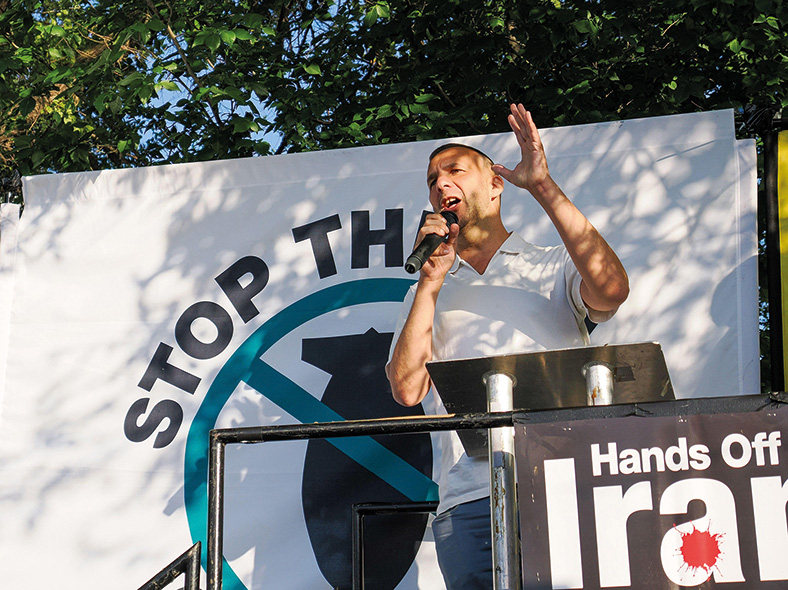
Stagecraft: Polanski speaks against Israel’s bombing of Iran, June 2025. Photo by Leo Bild/Alamy Live News
There is one mistake from his past that continues to haunt him. In 2013, while working as a hypnotherapist on London’s Harley Street, Polanski gave a Sun reporter hypnosis he claimed could increase her breast size. The BBC has reported that, contrary to Polanski’s initial claims that he immediately disavowed the practice after the session, he had said in an interview several days afterwards “the evidence is growing” that the technique worked. Labour insiders describe the incident as misogynistic and “just downright weird” – further ammunition for the argument that there is something to be mistrusted about the hope merchant, that he is in fact “selling snake oil”.
Polanski has a stock answer on it today: he simply apologises and argues he was misrepresented by the Sun. His team does not hesitate to admit how embarrassing the incident is, although it says privately that it believes it’s “baked in” to public perceptions of him. Labour isn’t so sure. Polling from More in Common indicates voters are half as likely to support Polanski when they are informed of the hypnosis incident. Labour believes it could harm him in a general election.
Polanski, for his part, argues that society should show “forgiveness and compassion” about people’s past mistakes, “as long as they’re saying the right things now”. That extends to Nigel Farage. He finds the Reform leader’s alleged anti-Semitic remarks from his youth “pretty vile”, but says he has “been consistent, though, in saying, ‘I’m a lot more concerned about what he’s saying and doing now.’ I don’t think it’s always helpful to just keep raking over someone’s childhood.”
Farage and Polanski would likely object to being spoken of in the same breath, but they are facing similar challenges. Both have turbocharged their movements by focusing on party membership: Farage had a ticker on his website to track the Reform membership figures, while Polanski posts video updates about Green membership numbers every few days to his social media. Both are experiencing poll surges and have inflicted bruising by-election defeats on the Labour Party. Now they are facing the increased scrutiny and expectations that come with such growth.
The Greens are having to expand and professionalise at pace, vetting candidates, hiring staff and rapidly establishing a ground presence the party is lacking in some places, as a historically small party. Polanski is all too aware, he tells me, that “huge rallies, the people turning up and the excitement doesn’t necessarily win an election”. Green insiders recognise that only a sharp, sudden ramp-up in door-knocking and data-gathering will turn the poll surge into something that lasts.
The team around Polanski is a mixture of long-serving Green staffers, a friend from his theatre days who now writes his speeches, and veterans of the Corbyn project and the wider left. As they look to build on and sustain Polanski’s winning streak, they are learning from the Corbyn era. Polanski says the main difference between his and the Corbyn project is that he is blissfully unencumbered by Labour factionalism, whereas Corbyn “had an entire party, or most of the party, trying to pull him down and destroy him”.
The Greens are also finding that they can dip into the “Reform-curious” voter pool in a way that Labour struggled to, once Brexit began to divide the electoral coalition that was starting to build under Corbyn. Polanski, who still holds to a pro-European line and criticises Corbyn’s more equivocal stance on the EU, is finding he is competing with Farage for voters. One of his advisers says that Labour’s tragedy, when they talk of their party being the best option to stop Reform, is that “they don’t realise that people want to stop Labour”.
Polanski has learned another big lesson from Corbyn, he tells me, and he picks his words carefully. There’s a risk that “actual cases of anti-Semitism don’t go challenged” on the left, he says, “because we’re fighting back against the weaponisation of criticism of the Israeli government.” His aim is “to make sure that [the Greens] push back against false allegations of anti-Semitism, but also make sure that actual anti-Semitism is also being dealt with”. At least six Green Party candidates in the local elections have been accused of making or sharing anti-Semitic comments online; including that “ramming a synagogue isn’t anti-Semitism. It’s revenge.” Some of the comments have been deleted but none of the individuals have been disavowed by the party.
He says the idea that his party would “vote for the only Jewish leader in the country with a mandate of 84 per cent and they’re anti-Semitic, again, just doesn’t pass the sniff test”. But “anti-Semitism exists in society, so it can and will exist in political parties, too”.
At the Green Party’s spring conference, party members proposed a motion declaring “Zionism is racism”. It was quashed, but is due to return to be debated in the autumn. Denying the legitimacy of support for an Israeli state is thought by many to be a form anti-Semitism in and of itself. When I ask Polanski about it, he is careful to hedge his response, neither disavowing a motion that many Jews condemned as offensive nor endorsing it. “The way our members can vote on policy is a really important democratic principle. I also think the motion is a distraction” from what is going on in Gaza, he tells me.
Polanski has been on a journey – that word, again – since his Jewish upbringing in Manchester. Growing up, he says, support for Israel was taken as a given. He has changed his mind since finding Jewish socialist groups that criticise the IDF and Israel. Polanski’s position today as a Jewish man who is firmly anti-Israel, and his rejection of the idea that as a Jewish man he couldn’t vote for Corbyn, must be painful to some other Jewish people in Britain, I suggest. He cites polling released in November 2025 showing a nine-percentage-point increase in British Jews voting for the Green Party between the 2024 general election and June 2025. This shows that the assumption “that all Jewish people are also Zionists” is “clearly not true”, he says. (Although data consistently shows that a majority of British Jews identify as Zionists.) Jewish people come up to him “all the time”, he says, to tell him “how important it’s been for them to have a Jewish person in public life who is challenging Zionism and challenging this Israeli government. That’s felt really important to me.”
Polanski is still learning. In November last year, he suffered his first serious blip as Green leader, when he was interviewed by Alastair Campbell and Rory Stewart on their podcast, The Rest Is Politics. Stewart was “horrified” as Polanski confused the debt and the deficit, incorrectly named the top rate of income tax, and inaccurately estimated the amount the UK spends on servicing its debt annually. He appeared to suggest that the UK finances its deficits solely from the Bank of England, rather than from markets around the world in the form of bonds. “We don’t actually owe that money,” he added, claiming incorrectly “we’re spending that money back to ourselves”. He told Stewart they were “operating under different paradigms”. Polanski had been influenced by modern monetary theory (MMT) – a controversial but coherent economics framework – but seemed to have a superficial understanding of the bold theory he was expounding, exposing gaps where his economic knowledge should be.
Insiders say that Polanski, and the Greens as an institution, have learned from the episode. “He can afford to make a mistake like that, a few years out from a general election,” one says. “He can maybe even afford a couple more. Far better to expose gaps now and fill them in than during a campaign.” A Green insider suggests the issue was with staffing – that at that time, he only had one person working for him, and he wasn’t briefed ahead of the interview the way another politician would be. They suggested that, actually, most politicians would be unable to answer questions on a policy without being briefed.
Polanski went away for a few months and listened to economists, including the Nobel Prize-winner Joseph Stiglitz. When he delivered a major keynote speech for the New Economics Foundation in March, he was no longer a proponent of MMT. Instead, he made a more careful case for borrowing to invest, taking up some of the bolder policies Rachel Reeves has considered, such as equalising capital gains tax. This raises questions about where Polanski will land on future policy questions; whether he will condemn the “propaganda” of much of mainstream economics and call for a “paradigm shift”, or arrive somewhere closer to a soft-left Labour positions.
That party policy is voted on by party members is another major challenge to Polanski’s credibility. Privately, his advisers say he will have to overhaul the system. He tells me the process will need to change not because the policies members pass are embarrassing him, but because “when the world is moving and changing so fast, and we’re under so much scrutiny to be able to answer a question even if we don’t have policy, that we do need to adapt the system”. He “would be supportive of people bringing forth proposals as how we can make sure that our process is even more democratic”, he says, but “I don’t think it should be up to the leadership to decide. I think it should be a kind of grassroots movement of the party to decide what the future looks like.”
But with the influx of more than 100,000 new members since Polanski became leader, the factionalism that the Green Party congratulates itself for avoiding could yet emerge. The party resembles a more traditionally left-populist movement. His overtures to Corbyn over the course of our interview seem to be opening the door for the former Labour leader to join the Greens, should he wish to. As Polanski’s activist base, and indeed his own instincts, pull him in one direction, and the scrutiny of people like Stewart and Campbell in another, it is still unclear where Polanski will land on many policy questions.
He would say he is listening, and learning. Regarding his podcast, Bold Politics, I say, it is striking that he spends most of his time listening. The show isn’t really about him, but about whoever he’s speaking to. He looks slightly stunned, again. “Thank you. That means a lot. The first review that came out on it was from the Times. They said that I wasn’t a leader because I was listening and I was still developing my ideas.” It was “actually a very helpful intervention” and a “key moment” for him in the first few weeks of his leadership, “because it clarified for me the different model of leadership that I hope I’m putting across and really want to put across, which is not being at the front and everyone saying, follow me, but actually being a member of this party, being a citizen of this country and being within the community.” That doesn’t mean he doesn’t put in his own ideas – he chooses the guests, and the questions – but he is also “willing enough to listen to people [in a way that] also guides your future thinking, future ideas, and the way you hold those conversations”.
I put to him an idea that a Labour aide put to me: that Polanski is an actor for whom “charismatic left-populist leader” is just his latest part. He sees this as “a desperate attack, because, actually, the best actors are incredibly authentic communicators. I think there’s often a myth that acting is about lying, but actually most successful actors will say that acting is about the authentic communication of a truth under a given circumstance. The scenario is the thing that changes. The authentic emotion is [what] remains consistent.
“I’m not surprised that Labour, who very often do play these corporate briefcases that are emotionally stagnant, that very often feel like robotic automatons that are reading out rehearsed lines, would point at Green Party politicians and say, ‘That’s playing a role,’ as opposed to, ‘Those are human beings that people recognise.’”
But Polanski isn’t finished changing yet. “In the quieter moments, I always think: how can I improve as a leader and a human being?” he says. “I have gaps in my knowledge and gaps in my skillset that I’m still looking to work on. And I really hope on the last day of me being leader, that I still have an element of imposter syndrome, because I never want to feel like I’m the perfect finished model.”
Unlike Corbyn, for good and ill, he has shown a willingness to change, and even embraced it as a virtue. For Polanski, acting is not lying. The stage is set. Corbynism has found its heir.
[Further reading: Keir Starmer is all alone]
Content from our partners

Related
This article appears in the 22 Apr 2026 issue of the New Statesman, All alone
Join the debate
Subscribe here to commentFrom what I gather from this excellent interview, part of Polanski’s political plan seems to involve hoovering up stray Corbynista votes and creating some of that excitement that parts of the left felt in that heady 2017 summer at Glastonbury, when Corbyn told an adoring crowd that politics should be about “what we dream, what we want”. Polanski is aiming to build a populist anti-Reform alliance built around the idea that the “establishment” is not only lying to us about who is to blame for all our current woes, but also about what is possible. He’s saying that wishful thinking could come true if we wish it hard enough, a message tailor-made for youthful idealists. As I have learned from talking to my son, it is difficult for an old fart and former leftist like me to temper the idealism of adolescence.
“watch a film from every country in the world, in alphabetical order. They have done Iran and Italy; Japan is next.”
Have Zack & Richie realised there’s a country missing from that sequence ?
How ironic by them, given the context of how assiduously Ailbhe has documented all the self-lacerating contortions in her piece.