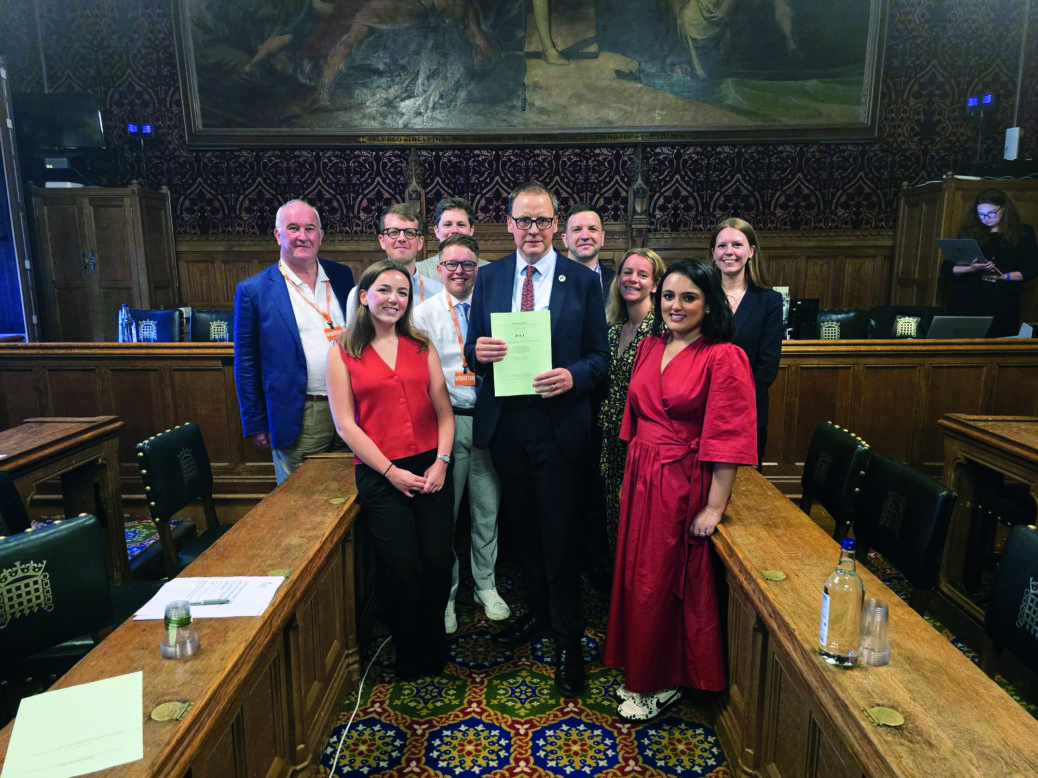
The Rare Cancers Act’s enshrinement into law in March 2026 has been described as a transformative moment by its supporters. The story of the bill’s passage to royal assent also offers a revealing glimpse into how backbench initiative, charity campaigning, quiet ministerial cooperation and a useful dose of parliamentary naivety can converge to produce legislation in an area long neglected by policy.
The act seeks to improve coordination, accelerate access to clinical trials and create national leadership for an area of cancer that often struggles for attention and financing. It also commits the government to review orphan-drug regulation and encourages improved data-sharing, with the aim of making it easier to match patients with research opportunities.
Its sponsor, Scott Arthur, a member of Labour’s 2024 intake, was sitting in his office only two months after arriving in parliament when he first learned he’d been drawn in the 2024-26 private members’ bill ballot. “My phone was suddenly pinging with emails and messages from lobbying groups asking to meet me so they could talk about their fantastic ideas,” recalls the MP for Edinburgh South West.
With limited time to decide, he was weighing competing causes while still getting up to speed with the mechanics of parliament. The lottery, held at the start of a parliamentary session, randomly selects a small number of MPs to get priority time to introduce their own legislation. Most backbenchers will never have such an opportunity. For Arthur, it had arrived in a matter of weeks.

His relative inexperience, he believes, was a mixed blessing. He had not expected to be elected and had done little preparation for legislative procedure. Yet that lack of familiarity also made him less deferential. When party whips presented him with a list of government-backed proposals – the usual route for successful private members’ bills – he declined. “I think that naivety helped me say ‘no’,” he reveals. Many private members’ bills that reach royal assent, Arthur notes, are effectively government measures leveraging backbench time. This one, although shaped in consultation with ministers, retained its independent origins.
The final decision, he says, came through a combination of chance and personal history. Sitting in the café at his local Tesco, Arthur opened an email from somebody involved in the brain tumour advocacy efforts led by his Commons colleague Siobhain McDonagh, outlining how she had lost her father to glioblastoma, an aggressive and often fatal brain tumour. The story sounded familiar. When he returned home, Arthur asked his wife whether it was the same condition that had killed her father a few years earlier. It was. “It felt like the decision was taken out of my hands, like fate was starting to get involved,” he says.
The initial idea was narrower – focused specifically on glioblastoma and building on work already under way by McDonagh and her team. But parliamentary clerks advised that any bill’s scope would only become more limited during passage, not widen. Starting with a single tumour type risked reducing its reach. The concept expanded to brain tumours and then, ultimately, to rare cancers more broadly. What began as a niche proposal became something capable of uniting multiple disease communities under a single legislative umbrella.
That shift proved decisive. Rare cancers collectively account for around 47 per cent of all cancer diagnoses in the UK and more than 55 per cent of cancer deaths, yet they receive only a fraction of research funding and clinical trial activity. By broadening the scope, Arthur and his collaborators could build a coalition spanning numerous charities and patient groups. “The coalition around the bill didn’t really exist,” he says. “But once we got under way, we were approached by Cancer52 and a number of other groups, who were quickly placed right at the core of our efforts.” Alongside Cancer52, organisations including Pancreatic Cancer UK, Brain Tumour Research and The Brain Tumour Charity helped shape the early messaging and broaden support across multiple rare cancer communities.
What followed was a period of quiet but intensive negotiation. While the coalition provided momentum, translating that into legislation required sustained engagement with officials at the Department of Health and Social Care. Arthur describes a cycle of weekly discussions: proposals refined with charities, fed back to civil servants, then reworked again. The aim was to produce a proposal ambitious enough to matter but narrow enough to survive the procedural constraints of a private members’ bill.
That balancing act shaped the legislation’s final form. Each party recognised that pushing too far risked losing government support altogether. For charities used to campaigning in maximalist terms, the process demanded pragmatism. The shared objective became securing a foothold in law rather than an all-encompassing reform.
The breadth of the coalition proved critical in those discussions. With dozens of organisations – including large research charities and smaller condition-specific groups – aligned behind the same ask, officials were confronted with a unified voice rather than competing demands. That unity, Arthur suggests, helped shift the tone of engagement from scepticism to collaboration. By the time legal drafting began, the bill had evolved from a set of campaign priorities into a measure the department was prepared to support.
Despite his earlier eschewing of whip guidance, government backing and involvement proved essential. Early meetings with ministers, including Wes Streeting, helped align the bill with broader policy direction. Arthur believes the timing was favourable. Rare cancers, he argues, had moved up the political agenda, and several ministers, the Health Secretary among them, have personal experience of cancer. “I think the government was already heading in this direction,” Arthur says, noting that rare cancers were mentioned in parliament more often in 2025 than in the previous two decades combined. “Our efforts helped accelerate all that.”
The legislative process was not without drama. One of the most precarious moments came during the bill’s third reading in the Commons, when amendments tabled by Christopher Chope MP threatened to derail its passage. This would have forced the measure back through earlier stages, effectively ending its chances. Charities mobilised rapidly, urging supporters to contact MPs. “About 120,000 emails were sent in just a few days,” Arthur recalls. The pressure helped neutralise the threat – and illustrated the breadth of grassroots engagement behind the legislation.
Another moment that crystallised the bill’s significance for Arthur came in the House of Lords, where it was steered through its final stages by Baroness Elliott of Whitburn Bay.
Separated from campaigners due to a seating mix-up, Arthur sat alone in the gallery during the third reading. Listening to peers recount personal experiences of rare cancers – contributions that helped smooth the bill’s passage in the upper chamber – he found the occasion unexpectedly emotional. “Just sitting there, thinking about everything that had happened, it was incredibly moving,” the MP says. The scene underscored how far the campaign had travelled from its origins in a single email.
Arthur often summarises the act’s ambition with a simple image: a patient diagnosed with a rare cancer accessing a clinical trial through the single click of a button. “For people with these diagnoses, they’re often desperate,” he says, citing a constituent whose family raised half a million pounds to access treatment abroad. More trials, clearer pathways and better data sharing, he argues, should make the need for patients to find answers outside the system unnecessary.
Central to the legislation is the creation of a national specialty lead for rare cancers – a figure intended to oversee strategy, identify opportunities and ensure resources are used effectively across the research system. Arthur points to past frustrations, including the £40m committed to brain tumour research in the wake of Tessa Jowell’s death from glioblastoma. Eight years on, only a fraction of that funding had been allocated, highlighting the lack of coordination this role is designed to address. The new lead, he hopes, will be outward-facing and collaborative, working with charities and clinicians. “Somebody who’s got an open door,” he says, rather than “someone sitting in a cubicle somewhere with an Excel spreadsheet”.
Despite royal assent being secured on 5 March, Arthur insists the work is far from over. He intends to remain engaged, liaising with charities and officials to monitor progress. “It’s tempting to move on,” he admits, “but it’s been such a big part of my life now, I feel I have little choice but to stay involved.” What has struck him most, he says, is the response from patients and families. He recalls a recent exchange with someone affected by neuroendocrine cancer, surprised to learn the legislation existed at all.
“I’m really looking forward to the first time hearing from someone for whom the act has made a tangible difference to their life,” he says.
The Rare Cancers Act is not intending to revolutionise cancer policy overnight. But its passage demonstrates what can happen when parliamentary opportunity meets organised advocacy and personal motivation. A backbench MP, a coalition of charities and a receptive policy environment combined to deliver legislation where, statistically, success was unlikely.
For Arthur, the experience remains “absolutely incredible”. Whether its legacy matches that sense of possibility will depend on what follows. But, at the very least, rare cancers have now secured a place on the legislative map.
Content from our partners



Related