
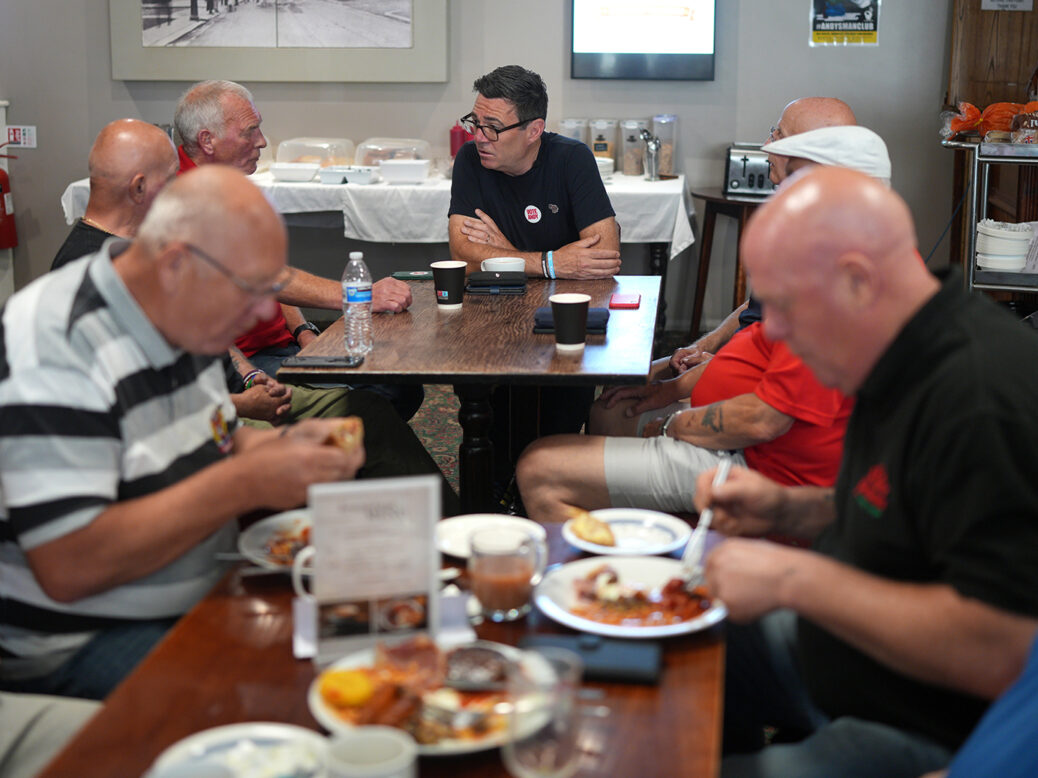
Much has been written over the past few weeks about what Manchesterism is or is not, and what sort of prime minister Andy Burnham would be if he is elected leader of the Labour Party. At the root of the discussion is another question: what would the economic project of a Burnham government look like?
Burnham himself has talked frequently and in broad terms about ending 40 years of neoliberalism, taking utilities back into public ownership and de-centralising power so that metro mayors and councils have far more control over their regions. But he has yet to set out a clear programme for how this would be achieved. Into that space has stepped a number of intellectuals from the worlds of politics and policy, jostling to get their ideas heard by the man who could be the next occupant of No 10.
One of those thinkers is Mathew Lawrence, the founder of Common Wealth and a vocal proponent of “Manchesterism”. In a piece for the New Statesman, published shortly after the local elections, Lawrence argued: “Manchesterism works. Public control of essentials reduces the cost of provision by eliminating the privatisation premium and lowering coordination frictions, which in turn reduces the fiscal transfers required to make essentials accessible – progressively deflating the upward pressure on public spending that currently exposes the country to the harsh judgement of bond markets.”
Alongside the US-based academic Alex Williams, Lawrence has co-authored a paper on Manchesterism which is set to be released by the soft-left parliamentary group Mainstream in the coming weeks. His relationship to Burnham’s team is an informal one. The partnership between the two teams was formed after Burnham referred to Common Wealth’s work on the Privatisation Premium in a speech to the Centre for Cities in March. “Rebuilding public provision is not the alternative to fiscal prudence. It is fiscal prudence,” Burnham said, directly quoting the think tank’s paper.

In the past few weeks, Lawrence has begun working closely with Mark McVitie, the director of the Labour Growth Group of MPs. Earlier this year, McVitie published his own paper, “An Honest Day”, which makes the case for a new political-economic settlement that lowers the cost of essentials, decentralises power, reforms taxation to favour work over passive gains and rebuilds state capacity to deliver national projects and economic growth. The paper was co-authored by McVitie with Chris Curtis, the parliamentary chair of the Labour Growth Group, who has backed Wes Streeting. LGG is not necessarily the obvious political home for Burnham’s economic vision. The MP adherents of Manchesterism mostly hail from the soft left of the party, while LGG mainly represents MPs from Labour’s moderate wing or the new right. (In a message to members earlier this week, McVitie announced that the group would be winding down but encouraged “anyone who believes in the group’s potential to put themselves forward” to take on running it).
But in their discussions, both Lawrence and McVitie found their ideas shared economic common ground. In an op-ed for the New Statesman, published on Tuesday (2 June), McVitie and Lawrence argued that their diagnoses are the same: “Britain pays too much for the basics because the state has lost control of the foundations ordinary life and enterprise depend on. Housing, energy, water, transport, care and local infrastructure have become too expensive, too fragile and too extractive.”
The pair’s argument for a cross-Labour consensus has been met with praise from within the party. A senior Labour MP and LGG member told me: “For those of us who have been cautious about Manchesterism, this makes it look more like a credible governing programme.” They added: “If Andy can turn his critique of Westminster into a political project that allows him to pursue ambitious supply side reform then he might have cracked it.”
Lawrence and McVitie’s suggestions are not the only ideas swirling around Burnham. The Tribune group of MPs has also been suggesting policy ideas intended to send Labour in a new direction. Several are now involved in Burnham’s Makerfield campaign. In a pamphlet of essays, Tribune made the case for higher taxes on wealth, increased borrowing to fund investment and more action to ease the cost-of-living crisis. The group’s pamphlet also called for the government to re-examine its fiscal rules (which Burnham has ruled out doing). In the forward to the essays, two Tribune members, Yuan Yang and Louise Haigh wrote: “Britain’s economic settlement is no longer delivering what it once promised… And confidence that politics can improve people’s lives has been eroded.”
For now, Burnham’s focus is on fighting the by-election. With a little over two weeks to go before voters’ head to the polls, the Manchester mayor and his team are firing on all cylinders to get out the Labour vote. But should he succeed in Makerfield, and set his sights once again on No 10, Burnham will need to outline a coherent programme of delivery. When he does, he will have an abundance of visions to choose from.
[Further reading: Andy Burnham’s door-knock to Downing Street]
Content from our partners



Related


Join the debate
Subscribe here to comment