
“We are the voice for the voiceless” said a banner tied to the railings on Marsham Street in central London. The text was superimposed over an AI generated image of a dog, a cat and a horse. Another sign read “taken in the cruelest way by the most evil people run free fur babies in memory of the 41 over the rainbow bridge”. Later, protestors would bring out a more direct banner: “Hang you sadistic scum”.
It was an overcast Friday afternoon and a few metres away from the Home Office, Britain’s new animal rights activists were staging a protest. They had come because of the sentence handed out to Oaveed Rahman, a man who had run what purported to be an animal rescue centre in Billericay, Essex. In reality, his rescue centre was severely mistreating the dogs in his care, the remains of 41 of which were found on his property. Rahman was sentenced to 38 months in prison: the protestors are universally outraged at this, viewing it as far too short. This informed the demonstrators’ key policy demands. They wanted an extension of the minimum sentence for animal abuse, which is currently five years (it was increased from six months by a 2021 act) and, per their petition, “for those who abuse multiple animals, we want separate charges to be required for each animal abused, rather than a single charge”. At present, one protestor told us, there is “no deterrent” for animal cruelty. “They say the prisons are full”, she said with a disbelieving grimace. “All people are getting is a slap on the wrist”, another said.
Tracey, the march organiser, was not local to the incident. She had seen the case on Facebook and decided to get involved, attending every day of the court case bar one. She had initially got involved by warning other posters on Facebook about contempt of court laws when proceedings became active, helped by her background as a former legal secretary.
Despite the horror of the crimes – one attendee showed us their drone footage of mummified dog remains being scooped into bin bags by police officers – there was an odd familiarity between the protestors and the criminals. The guilty man and his girlfriend were referred to by their first names. One ringleader had regularly exchanged Facebook messages with him. “Come round for a barbecue tomorrow, we’ll eat one of the dogs”, she claimed he’d messaged. She’d even offered him £1,000 of her own money to secure the release of two dogs, but after he refused to provide proof of life she rescinded the bid.

All of the 24 people who have shown up on Marsham Street were women. Perhaps not unrelatedly, the event had a rowdiness that evoked the sense of a hen-do-at-a-train-station. Passersby were accosted in a jovial, if slightly intense, manner. One man in shin-high leather boots, leather shorts and a transparent shirt was wolf whistled via megaphone by a group leader, and then instructed to take a leaflet amid his “catwalk”. He smiled, and obliged. Disinterested civil servants walking through the protest on their lunch break were greeted with “keep on ignoring us” over the megaphone, while one man who declined a leaflet was given a wanker sign as he turned his back on the group, to giggles from the attendees.
While Friday’s protest had a keen focus on the specific crime, the demonstration was part of a broader pro-animal movement that has galvanised in the wake of the XL bully ban.
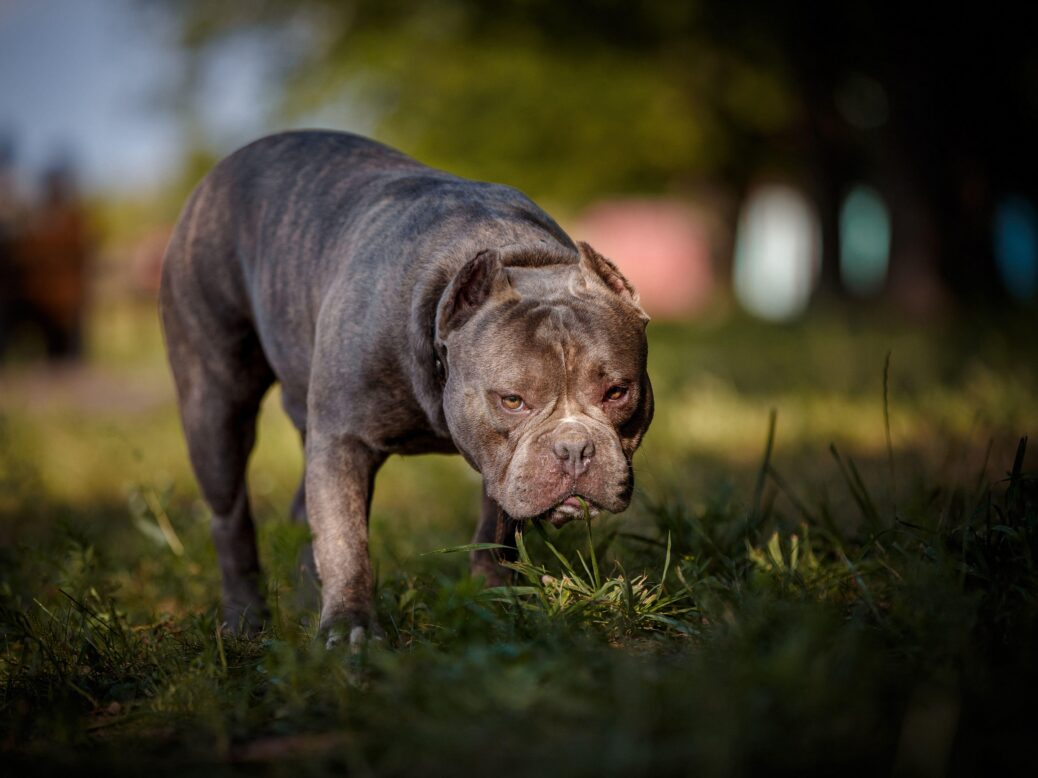
There were eight fatal maulings involving XL bullies in the 12 months preceding the ban, and the crackdown hit owners hard. Alienated by friends and with their dogs rounded up into police-operated kennels, owners waited for a magistrate to decide if their dogs could remain in the community. In years following the ban, the online XL bully support groups became a safe space for the community, and it was in such online spaces that the people here today talked, shared stories and organised.
One dog whose name came up several times was Ghost. An XL bully killed by police in Sheffield, Ghost seems to have become a kind of canine folk martyr, like if William of Norwich was a dog. “The family watched him die”, volunteered one protestor. “He was a kind, warm, lovely dog”. When asked if she knew the dog personally, she said she’d seen pictures on Facebook, maybe a video too. But his legend in this world was such that he felt known to the protestors (out of legend and in Sheffield magistrate court at the end of last year, Ghost’s owner was convicted of owning a dog dangerously out of control, and of malicious communications over social media posts about the officer who had killed her pet).
Another woman told us that it was the deaths of Marshall and Millions that first brought her into this world. The two dogs (either Staffordshire Bull Terriers or XL bullies depending on whether you ask someone sympathetic to the dogs, a dispute which opens into the broader questions about how you define dogs) were shot dead by Police on a canal path after attacking a woman protecting her own dog. Following the shooting, the IOPC cleared the police officers involved and Marshall and Millions’ owner was given a second banning order, running concurrently with one he had already received.
Since then, Marshall and Millions have been elevated to martyrdom. At the march, several protesters were wearing Marshall and Millions T-shirts; Facebook has dozens of groups with names like “Marshall & Millions’ Army” and tens of thousands of members. A children’s book, Marshall & Millions Adventure with Dad, was published by Grosvenor House last year. “I’m not very political”, one woman in a Marshall and Millions shirt told us. “Apart from the Tommy marches” she said, noting approvingly that people brought their dogs on those. “And the pink ladies”, she added.
Cases like those of Ghost and Marshall and Millions inform a view of the police as highly incompetent when it comes to dealing with dogs. Police need to “get some training, learn how to use a catchpole” said one woman. “If you had a Yorkshire terrier next to a corgi, I bet half of coppers wouldn’t know the difference”, said another. There is a general feeling that the police over-police and over-react to some issues (notably those relating to XL bullies) and neglect others, and that those who deserve punishment get off lightly when they face consequences at all. “Look at what happened to poor Lee Rigby” one woman tells us, noting the soldier’s killers are still alive and to her view have a good standard of living behind bars. “But a dog only has to make one mistake” and it can be killed, she notes (another issue of concern for this attendee is laboratory animal testing: “If they want to test drugs, there are enough people [in prison] doing so-called life sentences”).
These views characterised by distrust – or perhaps more accurately by an assessment of profound failure, even collapse – extended out from the police to the state as a whole. It was a particularly notable sentiment because the majority of the women we spoke to work in or are retired from public sector jobs. One noted that not only did police not pursue the case of a local decapitated dog, but it was barely covered in the local paper. Another woman told us she doesn’t trust “the government we’ve got at the moment”, particularly, she says, given the Prime Minister was “head of the CPS when a certain Jim’ll fix it was there”. She thought Larry the cat should be in charge: he’s “the only sensible one going in and out of Downing Street”. Another woman told us she thinks the laws around animal abuse are just “bad”, and that in the country overall things are “getting worse”. She thought the government “is for foreigners”.
To their view, the authorities have failed. Accordingly, the protestors had often taken matters into their own hands. One woman used her spare time to provide free transportation for dogs in pounds across the country, to prevent them being put down. Others told a story of how they used two different forms of surveillance which were almost certainly illegal against two suspected animal abusers, after calls to the police went unanswered.
We asked several protesters why they thought only women had shown up. “It hits women harder” said one; “it’s over 80 per cent men who abuse animals” another attendee volunteered. To the women, abuse of animals is clearly tied very closely to child and domestic abuse, echoing what seems to be a fuzzy overall distinction between vulnerable people and vulnerable animals in the protestors’ worldview. “You have to be seriously broken as an individual to abuse an animal or a child”, as one woman told us. Throughout the protest, the topic of safeguarding women, children and animals came up almost interchangeably.There was a shared feeling of deep injustice and absolute certainty that is common to small protests.
“A society is judged by how it treats the most vulnerable”, we were told over the megaphone, by a protestor who also noted: “Study after study has shown the connection between animal abuse and violence against people”. One woman who was local to the Billericay case said that a number of the dogs sent to the shelter had been sent there by women fleeing domestic violence. Much of the ire of the protestors was reserved for the partner of Rahman, who avoided punishment or a ban on looking after animals. The women treated her not only as complicit in the wider abuse, but seemed, at points, more upset with her actions than Rahman’s.
The short speech included a round of chanting: the protest staple, “what do we want, justice, when do we want it, now”. Yet while they might prefer urgency, the women were clearly prepared for a long fight. “We will not stay silent,” the speaker concluded. “We will carry on this fight until this government wakes up and sees we are a nation of animal lovers”. It was time for the organisers to collect the miniature gravestones from outside Marsham street and pack up their banners before deciding whether to get coffee before or after their march on Westminster. Some of them had met at a protest about the killing of a dog in Brazil in April; in May, some had marked the third anniversary of Marshall and Million’s killing. Whatever animal outrage happened next, they were ready.
[Further reading: Will Henry Nowak’s death lead to a summer of disorder?]
Content from our partners



Related

Join the debate
Subscribe here to comment