
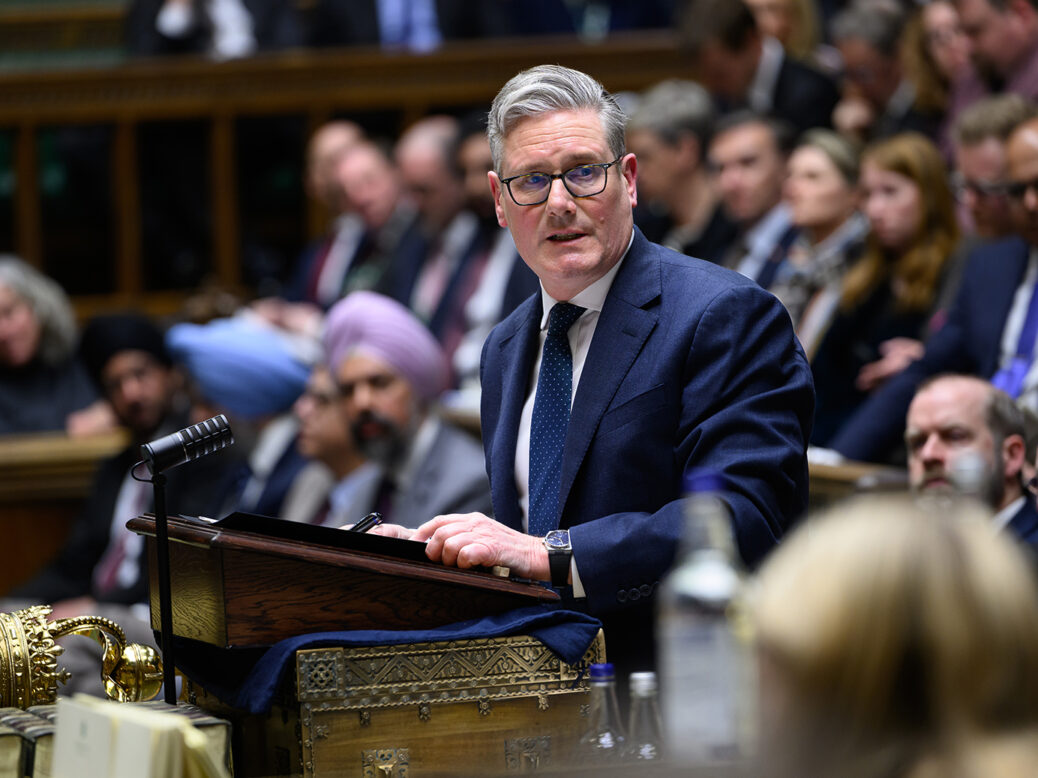
Keir Starmer had a message for the House and the country at PMQs: yesterday, over a thousand Britons returned to the UK from the Middle East on commercial flights from the UAE, with eight more flights scheduled to leave today along with the first charter flight from Oman and two more to come. The government’s top priority amid the volatility and chaos of the conflict with Iran, the Prime Minister stressed repeatedly, is the protection of UK nationals.
Kemi Badenoch did not want to hear it. The leader of the opposition came armed with a narrative: the UK government is not doing enough. It was a point she repeated multiple times, lambasting Starmer for not allowing the RAF to take offensive action against Iran to protect British bases, for the delay in deploying the UK’s sole warship HMS Dragon from Portsmouth to the Middle East, and for the lack of clarity on when and how defence spending will hit 3 per cent of GDP.
In the face of Starmer’s sombre, measured tone outlining the UK’s response and repeating his explanation in the Commons on Monday for his refusal to “join a war unless I was satisfied there was a lawful basis and a viable, thought-through plan”, Badenoch amped up the outrage. First, she accused him of “catching arrows rather than stopping the archer” with regards to Iranian attacks – a line that sounded conjured up from armchair generals on X where the matters of war are discussed as though there are simple solutions.
It did not get better for Badenoch from there. Her weekly refrain at PMQs recently as Starmer deflects her lines of attack is to point out that he isn’t answering the question. Sometimes, this is effective. But today, her dismissal to his detailed account of how the UK government was getting Brits home – “I wasn’t asking about evacuations, I was asking about defence spending” – missed the mark entirely.

“I’m sorry she’s not interested in how people caught in the region will get home,” Starmer responded. “I think for the vast majority of people watching this PMQs, that will be the single most important thing on their minds.”
Put bluntly, Badenoch is out of touch with the country – not only on evacuations (it is the job of any government to protect its citizens abroad) but on the UK response to the US-Israel move to strike Iran in the first place. The Tory line – shared by Reform, which did not get a question at PMQs today – is that the UK should have acquiesced to Donald Trump’s initial request for the US to use UK airbases and should be taking a more active role in this conflict. Leaving aside the issue of international law (which matters more to Starmer than to other world leaders), blindly following America’s lead into another contentious Middle Eastern war may not be in the UK’s security interests. It is certainly not popular: according to YouGov, Brits are opposed to US action in Iran by 49 per cent to 28 per cent, and are split on whether the UK should allow the US to use British bases at all.
Starmer did a good job today of conveying the seriousness of the issue and the steps the government was taking to both protect British bases and citizens and decrease the risk of further escalation. Badenoch, in contrast, came across as too absorbed in the talking points of the pro-Trump online right to grasp the nuances and risks of the situation, or display any empathy with the individuals stranded abroad and their families. Her subsequent attempts to link defence spending with the Chancellor’s Spring Statement (there was no defence plan, she argued, because Rachel Reeves had spent the money on the welfare), and then – astonishingly – with the Gorton and Denton by-election result, similarly portrayed her as more interested in political point-scoring than security. “Moments like this define a leader of the opposition,” the Prime Minister replied, arguing Badenoch had exposed her “utter irrelevance”. Given her performance, you could see his point.
Starmer is at his best when being austere and statesmanlike on matters of foreign policy and security. But PMQs also revealed the heightened risks the Iran conflict has exacerbated. Ed Davey for once chose not to use his questions to attack the US president (beyond a reference to “Trump’s illegal war”), instead focusing on the impact on oil and gas prices and reports that bills could rise by £500 a year. Would the PM provide a “cast-iron guarantee” that he would not let that happen? Starmer promised to keep a close eye on it, but the risks are obvious.
Bringing down the cost of living and energy bills in particular is one of the few achievements the government can point to which voters really care about. Along with getting inflation under control, it is core to the Labour offering. All three are put at risk by the situation in Iran. Remember, it was the energy crisis sparked by Russia’s invasion of Ukraine that forced the Tory party into (further) crisis, with Boris Johnson, Liz Truss and Rishi Sunak all forced to take action on bills at huge expense. Now the Labour government is on the brink of a similar crisis.
Starmer might have had an easy ride deflecting Badenoch at PMQs. He certainly seemed to enjoy the chance to indirectly respond to Trump’s less than favourable comments about him, replying to Tory MP Gareth Bacon’s question on whether the UK’s “dithering response” over Iran had risked the “special relationship” with “Hanging on to President Trump’s latest words is not the special relationship in action.” But all that is theatrics. The importance of evacuations aside, nothing spells trouble for a limping government quite like soaring energy bills.
[Further reading: We cannot afford another failed government]
Content from our partners


Related

Join the debate
Subscribe here to commentI think it’s fair to say Badenoch is not very intelligent given a lot of her recent comments regarding this war
A Prime Minister has 167.5 hours every week to make announcements and only half an hour when he or she is obliged to answer questions in the Commons. So, why is it that only during the PMQs and not at any other time was is possible to talk about flights from the Middle East?