
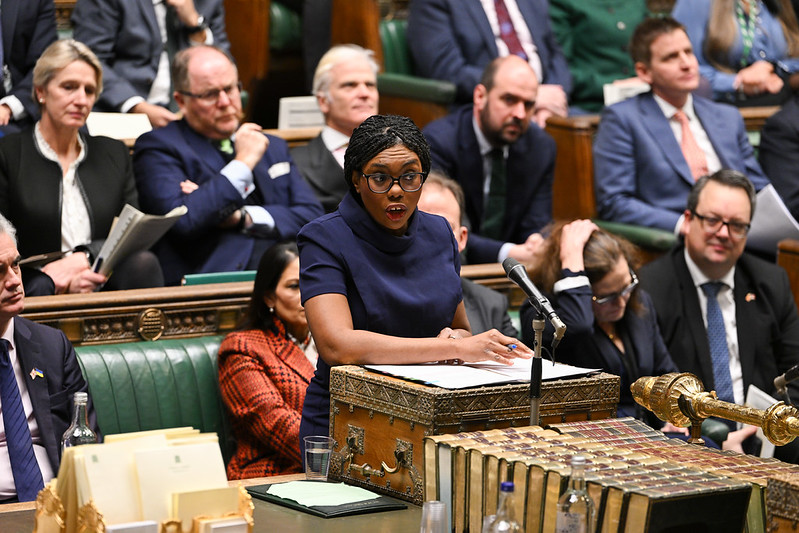
Sometimes when Kemi Badenoch tries a scattergun approach to topics at PMQs, it tanks her momentum and makes her look disorganised and undisciplined. Not today. The leader of the opposition had a singular theme uniting her smorgasbord of attacks against Keir Starmer: U-turns.
She began by welcoming the latest government reverse-ferret on mandatory digital ID, adding with a smile: “I feel like I say that every week”. Then she asked if the Prime Minister agreed with Wes Streeting’s ill-timed comment yesterday that the government’s new year’s resolution should be to “get it right first time”. Starmer responded with the digital ID fudge that “there will be checks, they will be digital and they will be mandatory” and tried to remind the House of the litany of U-turns from the last Conservative government. It derailed Badenoch not one bit. “A lot of waffle, but it’s still a U-turn,” she retorted.
Polls and focus groups show that voters, in general, are not averse to governments changing their minds – what matters is usually that they get to where the public wants them to be. So there is mileage in jettisoning unpopular policies – “scraping the barnacles off the boat”, as the strategy goes.
But as the Delphic Oracle said, nothing in excess. Today’s head-to-head between Starmer and Badenoch demonstrated that there is a limit to how many times the government can change its mind without inflicting damage on itself. Depending on how you count them, the government is up to around 13 major policy U-turns, giving Badenoch ample ammunition. After digital ID, she honed in on Labour’s recent changes of heart on the family farms tax and business rates on pubs – reviving past hits including the winter fuel allowance, the two-child benefit cap, the Waspi women and the grooming gangs inquiry. For an added bit of theatre, she was able to spur Tory MPs to a chorus of “U-turn” after every one. She mentioned the apprehension over reforms to jury trials as a bonus: “I think that’s going to be the next one”.

It left Starmer with very little ground to retreat to. His prepared lines about Monday’s defection of former Conservative minister Nadhim Zahawi to Reform, which he called a “laundry service for disgraced Tory politicians” fell flat, even with a convoluted joke about furniture (don’t bother looking it up, not worth it). Usually, this sleight-of-hand and deflection at least enables the PM to neutralise Badenoch’s attacks and score a draw. But today, the sheer volume of examples at her disposal and the subsequent clarity of her questions threw Starmer’s lack of answers into sharp relief.
One other thing we learnt from this session, if we didn’t know it already: disquiet both on the Labour backbenches but within the Cabinet is undermining the Prime Minister’s authority. This is linked to the U-turns – as Badenoch coolly articulated, the government’s constant veering between policies is putting Labour MPs who publicly support it in an impossible position: “They follow his lead and he hangs them out to dry”. There are only so many humiliations loyal foot soldiers will bear before they start to reconsider their loyalty, as evidenced by the quotes from anonymous ministers detailed in the FT’s latest reporting which Badenoch’s gleefully read out, including that “what’s happening at the moment is extraordinarily bad” and “it’s worth rolling the dice” on a new leader. Starmer’s only answer was to try to throw the accusation of disarray back to the Tories and Reform. Increasingly for Labour MPs, that’s just not good enough.
Indeed, we got a taste of where the next flare-up with Labour faithful is going to come from, with a question from Anneliese Midgley on the Hillsborough Law, which campaigners fear is being watered down. Would Starmer confirm whether the law would impose duties and responsibilities of candour across all parts of the state, including on individuals within the security service? His response was that “we’ve got that balance right” between transparency and national security. Some of his MPs will not be satisfied with that.
There was one glimmer of positivity for the government: as Starmer informed the House, X is reportedly now complying with UK law in relation to the Grok AI bot creating sexualised images of women and children. If Elon Musk has indeed backed down, that’s a relief for a government stuck between the threat of retaliatory sanctions from an aggrieved White House and its own moral and legal position on child sexual abuse material.
Interestingly, the sharpest Reform attack question came not from a friendly Labour backbencher, as it usually does, but from Llinos Medi of Plaid Cymru, who said she had “personal experience of AI images”. Sitting directly in front of Nigel Farage (who was in the chamber for once this week), she accused him of continuing to defend Musk, adding: “Anyone who defends platforms linked to the sexual exploitation of children forfeits any right to give lectures about protecting women and girls.”
It was a gift to Starmer, who called Reform’s position on Grok “disgusting” and their calls to scrap the Online Safety Act “a disgrace”. It is an area where Reform is genuinely vulnerable – unlike, for example, its acceptance of Nadhim Zahawi.
The final moment of drama came from the Conservatives’ Nick Timothy, who raised shocking updates regarding West Midlands Police, which has admitted misleading MPs about the decision to ban Maccabi Tel Aviv fans from an Aston Villa match. Timothy called for a review of “the corruption of our criminal justice system by Islamists”.
Home Secretary Shabana Mahmood is due before MPs later today to update the Commons on whether she has confidence in West Midlands Police chief Craig Guildford, following the astonishing revelation that an AI-generated hallucination of a football match that never happened made its way into the security report.
Timothy’s question, of course, went further. Starmer dodged it with an aside about Timothy’s involvement in the move to strip the government of the right to sack police chiefs when Theresa May was home secretary. But it is a complex and thorny issue for the government, encompassing its approach to law and order, relations with police forces, and tensions in certain communities regarding the war in Gaza and UK foreign policy. Not an easy one for Mahmood to navigate – and, unlike Starmer at PMQs, she will not have the option of deflecting with personal attacks.
[Further reading: The battle for Labour’s leadership has already started]
Content from our partners



Related
Join the debate
Subscribe here to comment