
On Lambeth Palace Road in Central London, a few strides down from Lambeth Bridge, there’s a cafe called 2Love that I frequent. Once I’ve secured my very reasonably priced (£5) Sexy Latte, their signature drink, I sit by the Thames’ boundary wall and look out to the horizon. One building really feels out of place among the three-storey buildings that surround it – a fish out of water, rather like Richard Holden in Basildon – Millbank Tower.
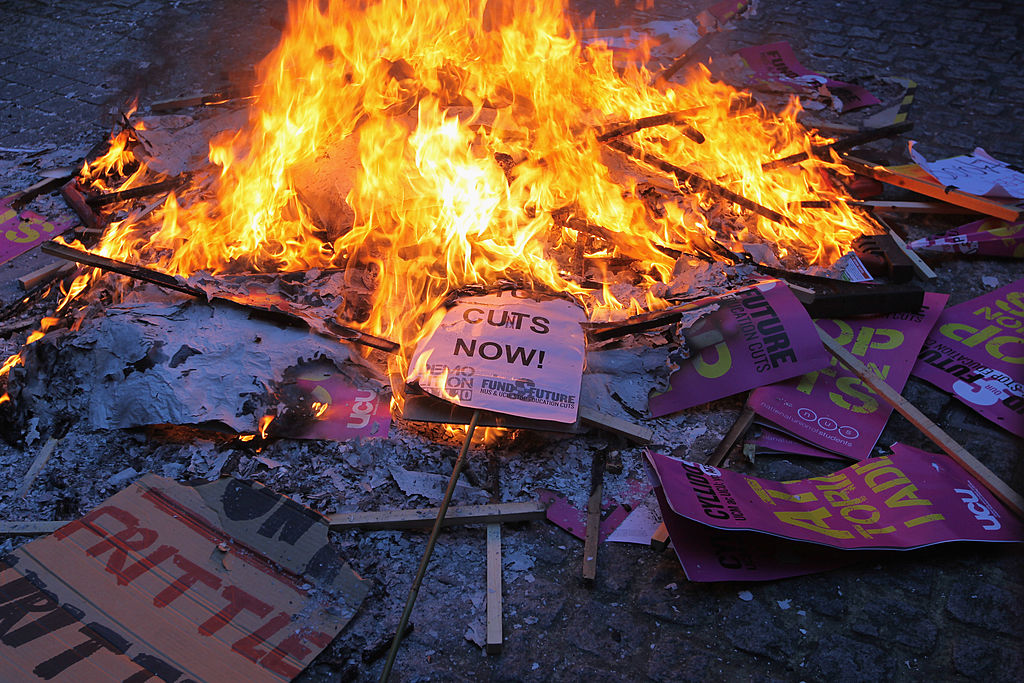
The tower became the epicentre of youth rage 15 years ago because it housed the Conservative Party, and David Cameron’s coalition government had made the decision to raise the tuition fee cap to £9,000. And the Liberal Democrats, who had campaigned explicitly on abolishing fees, marched into government only to vote to triple them. But Millbank hasn’t only housed the Tories, and the student protestors weren’t only angry at Cameron and Clegg. Labour had planned its 1997 landslide in Millbank, too, and those present felt they had been sold a lie in the New Labour vision of university as the great leveller. They were teenagers in 2010. For them, a revolt against New Labour and against the heir to Blair and against the Liberal Democrats, previously the only anti-tuition fee party, meant a revolt against all the politics they had ever known.
Labour, the Conservatives and the Liberal Democrats shared 88 per cent of the vote in 2010; they are now polling at 46 per cent together. The student fee protests were the first mass revolt against the political fiction now approaching its final death. And that fiction wasn’t just a Conservative or Liberal Democrat invention. Blair had re-introduced tuition fees in 1998, framing them as a necessary modernisation rather than a betrayal. But for the teenagers of 2010, that distinction didn’t matter. The illusion evaporated the moment fees were trebled. When the coalition slapped a £9,000 price tag on the promise Blair had made, students saw the scam in real time. The marches, the occupation, the chants, the smashed glass – all of it was a collective rejection of a story that no longer made sense. It wasn’t an overreaction, rather the only rational response to a future that had just been priced out of reach.
The 2010 protests served as a logistical model as well as an emotional one. The patterns of their mobilisation would later define resistance to austerity. Yes, the NUS had planned the usual mediocre choreography: a march, a neat route, a stage at the end. But the scale and spirit were never under their control. The protests multiplied faster than any union could coordinate. Much of the turnout was driven by new, decentralised networks: Facebook events multiplying overnight, BBM broadcasts (Blackberry Messenger mass messages) ricocheting through sixth forms, societies and house shares, students mobilising each other. The October occupation of Millbank certainly wasn’t planned. It was the first glimpse of a new generation capable of assembling itself without establishment permission.

And the state’s reaction was telling. The kettling, the horses, the truncheons, the sheer spectacle of overreaction, didn’t cool the protest; it made a whole tranche of university-age people believe that the political system didn’t have any intention of listening to them. The rose-tinted glasses of the New Labour years had already been clouding over as students defected en masse to the Lib Dems, the only party promising to scrap the unfair fees Labour had introduced. Then Clegg went into coalition and voted to treble them. In the chaos of Millbank, it wasn’t only police boots stamping on those glasses – it was the realisation that Labour had sold the dream, the Lib Dems had sold the escape route, and the Conservatives had locked in the outcome. The idea that higher education was a conveyor belt into social mobility, that a degree was a passport to prosperity, that working-class kids could simply study their way out – all of it lay in shards on the pavement.
And yet 15 years ago today, on the day MPs voted on the fee increase, tens of thousands marched again, this time into central London. Students were kettled for hours in Parliament Square on 9 December 2010 as the vote went through, an actual containment of dissent at the very moment the political establishment priced a generation out of its own future. That was the day the Government confirmed what the students already knew: the decision had been made long before anyone took to the streets.
What struck people at the time wasn’t just the anger, it was the solidarity. Liam, who was in the crowd that day, remembers looking around and realising how unusually broad it was. Students from wealthy families next to students from families who’d never had anyone go to university; elite institutions marching alongside post-92s. “We were graduating into a recession-battered economy,” he said. “And of course we felt betrayed. Why were students being made to pay for a crisis of capitalism, while those responsible were bailed out?” It wasn’t the usual suspects. It wasn’t a left-versus-right caricature. It was a whole generation recognising someone else’s bill had been slipped under their door.
Another protestor, now in her 30s and working in campaign innovation, remembers the day less as a political awakening and more as a moment of collective moral clarity. “It was one of those moments when everyone just stood up and said: this is unfair. £3,000 already felt heavy; tripling it seemed indefensible.” She described the coaches pouring in from every corner of the country, the sheer logistical ambition of it all. And then the turn, when the mood shifted and police kettled teenagers in the freezing cold. “My instinct was just to keep the younger students safe,” she said. “You suddenly felt responsible for everyone around you.” It wasn’t the glass breaking at Millbank that stayed with them; it was the feeling of looking after each other when the state made clear it didn’t intend to.
That day politicised people in lasting ways. It built movements, campaigns, media platforms, union organisers, left-wing infrastructure that still shape British politics now. Even those who left protest behind learned the same lesson: outrage may start a movement, but organising sustains it. And still, the tension lingers: the vote passed, the fees rose and the escalator remains broken. A whole generation of working-class kids had the dream sold to them at one price and delivered at another. And today, our economy lives with the consequences, a missing cohort, a strangled skills pipeline, a productivity crisis we pretend to find mysterious.
When I sit by the river with my coffee, Millbank still looms. It has also been home to the United Nations and countless political consultancies. Tony Benn was even born in it. But if it was the UK’s tallest building in the mid-60s, it looks more awkward now. A reminder that in Britain, these great institutions rarely fall; they just wait for the next generation to realise what they really are.
[Further reading: The economics behind Zack Polanski’s claims]
Content from our partners

Related


Join the debate
Subscribe here to comment