
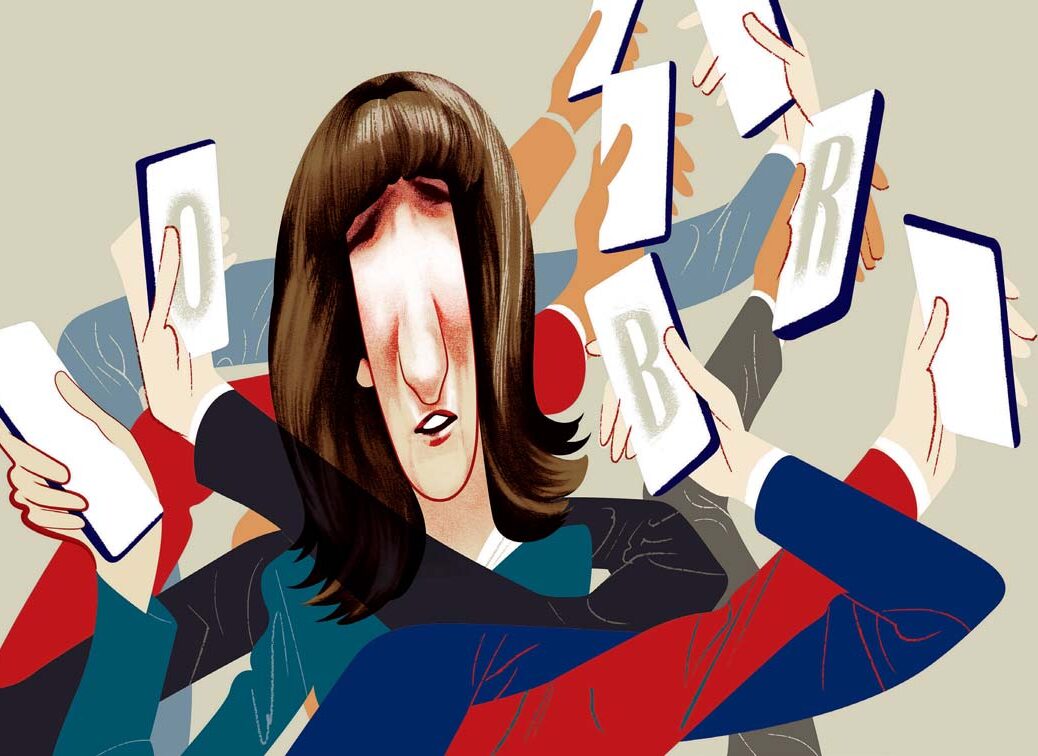
Each year, press officers from institutions such as Oxford University Press (OUP) compete to cheapen the names of their employers by picking a crass neologism as “word of the year”. The hope is that if the OUP sufficiently debases itself by choosing “bovvered” (2006) or “youthquake” (2017) to encapsulate the political and cultural moment, people who use words like that will stop “vibe coding” or “vajazzling” or whatever it is they do instead of reading, and run to the nearest bookshop to stock up on dictionaries. Good luck with that. Anyway: Oxford’s 2025 word of the year is “rage bait”. (A proper university would recognise that this is actually two words.) “Rage bait” means saying or writing things you don’t mean, and which are calculated to be irritating, to provoke a reaction. The person who has done this most successfully in 2025 is Rachel Reeves.
On 4 November, Reeves gave a “scene setter” speech in which she set the scene for higher taxes. It was a speech about realities that had to be understood, about “basic facts” which “no accounting trick” could change. The meaning was made clearer in government briefings: Reeves was looking to fill a hole in the public finances of £20bn to £30bn against the Office for Budget Responsibility’s new, more pessimistic forecasts, and a 2p rise in income tax was “nailed on”. After her speech, a cabinet meeting took place in which ministers were also led to believe that income tax would be raised. This meant breaking both a manifesto commitment and a political taboo that has persisted for half a century (the basic rate was last raised in 1975), but it was presented as inescapable. The forecasts were too grim for anything else.
Ten days later, on 14 November, Reeves changed her mind: a blunt tax hike would not be necessary, thanks to improved forecasts. This raised some eyebrows. It also raised the yields on government debt by ten basis points (or 10 per cent of a Truss-Kwarteng). And it raised a question: what changed, and when?
On the morning of Budget day (26 November), staff at the Office for Budget Responsibility (OBR) arrived for what would be a memorably awful day. Unbeknown to the OBR wonks, from 5.16am onwards a small number of people who had guessed the web address for the latest OBR forecast had been trying to access it. Shortly after the document was uploaded at 11.30am – an hour before Reeves’ speech – someone who had already tried 32 times to access the page refreshed it for the 33rd time, and the full 205-page document appeared. In the Commons, about ten minutes later, Reeves was handed a phone on which she could see that everyone else – including the MPs on the opposition benches, who were themselves staring at the report on their phones – already knew what was in her speech. It was a masterclass in political humiliation, but the OBR’s blunder was merely the starter: the main course was yet to come.

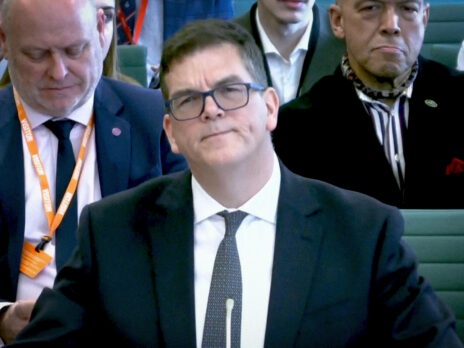
Meg Hillier, the Labour MP and chair of the select committee that scrutinises the work of the Treasury, is not someone who allows detail go unobserved, even if it’s detail her own government would prefer to keep somewhere safer, like the inside of a volcano. Immediately after the Budget, Hillier wrote to the chair of the OBR, Richard Hughes, asking for more information on the timing of the forecasts. His response contained what opposition MPs have claimed was a smoking gun: that the OBR’s productivity downgrade had not made tax rises inevitable – it had been more than covered by higher tax receipts – but also that Reeves had known this from 17 September. Headlines asked if Reeves had “lied” to justify £26bn in tax hikes. Kemi Badenoch began immediately to emit the kind of furious denunciation that she only usually emits for 14 to 16 hours a day. Nigel Farage – yes, the Nigel Farage who declined to investigate his own party after his Reform colleague, Nathan Gill, was sentenced to a decade in prison for taking bribes from the Russians – reported Reeves to the independent ethics adviser.
Keir Starmer’s political week began, on Monday 1 December, in a nursery in London. Infants from nine months to four years old gathered around the Prime Minister. For a moment he felt at peace, and then: “Did ooh misrepresent the OBR pre-measures forecast?” asked a two-year-old girl, thrusting a rattle towards his face. “Did Wachel Weeves mislead the public about the amount of fiscal headwoom provided by tax receipts?” demanded another toddler, chewing furiously on a handful of rusk. The PM, having tried and failed to distract the infants with an excruciatingly awkward rendition of the “six-seven” meme, moved quickly to another room. To his dismay he found it populated by a group even more easily bored than the toddlers, even more prone to tantrums and uncomfortable flatus: the press.
“The Budget,” Starmer declared with a hopeful frown, “was a moment of personal pride for me.” It definitely wasn’t, but what he meant by this was: “The nice part of the Budget, the lifting of the two-child cap on benefits, was a moment for which I would personally like to take credit.” No one in the crowd cared. They had a story to tell: lies! Lies had been told! The tax hikes were a swindle!
The same afternoon the BBC’s political editor, Chris Mason, told the nation: “We were misled,” which is quite the position for the state broadcaster to take. Boris Johnson and Rishi Sunak were asked if they’d lied, but no such judgement was issued. What about Donald Trump, Chris? Is Donald Trump a liar? Or is that one a bit risky?
It didn’t help that Richard Hughes, the head of the OBR, quit on 1 December. You don’t have to be Claudia Winkleman to understand that if someone who has made you look bad doesn’t turn up to breakfast (or, in this case, to give evidence to the Treasury Select Committee), that just makes you look more guilty. Which is unfortunate, because the accusations against Reeves don’t make any sense.
When the press asked Starmer if his Chancellor had lied about the UK economy being in a worse state than it really is, he said there was “no misleading”. What he might have said was this: “Look around you. Look at the roads. Look at the local leisure centre, if it’s still open. Look at the schools, riddled with asbestos and spongy concrete. We’re talking about getting rid of trial by jury to save money. We’re already letting convicted criminals out because we can’t afford to keep them in prison. Our tanks vibrate so badly that soldiers fall out of them covered in puke. We spend more on debt interest in two days than we spend on libraries in a year. On what fucking planet do you think it’s credible to argue that this government has been too downbeat about the state of our finances?”
There was plenty about the Budget that was dishonest, because all budgets contain a bit of subterfuge. Stealth tax is dishonest and everyone hates it. Ten million people are being pushed into new tax brackets; none of them think the government hasn’t raised their taxes. The massive central government efficiency savings used to balance the books will be very hard to achieve, and the headroom created could easily be wiped by an external event, such as the popping of the AI bubble. The fact that all the pain of this Budget is clustered around the next general election suggests it will be deferred yet again when the time comes (perhaps the idea now is to make the next parliament so fiscally unpleasant that no one else even wants to win?). It is a grim, desperate Budget and a wasted opportunity, but every one of the roughly 4,000 choices in it was the Chancellor’s to take; she did not owe the BBC a full explanation on every point.
[Further reading: The OBR is pushing us into a doom loop]
Content from our partners
Related
This article appears in the 04 Dec 2025 issue of the New Statesman, Books of the Year
Join the debate
Subscribe here to comment