
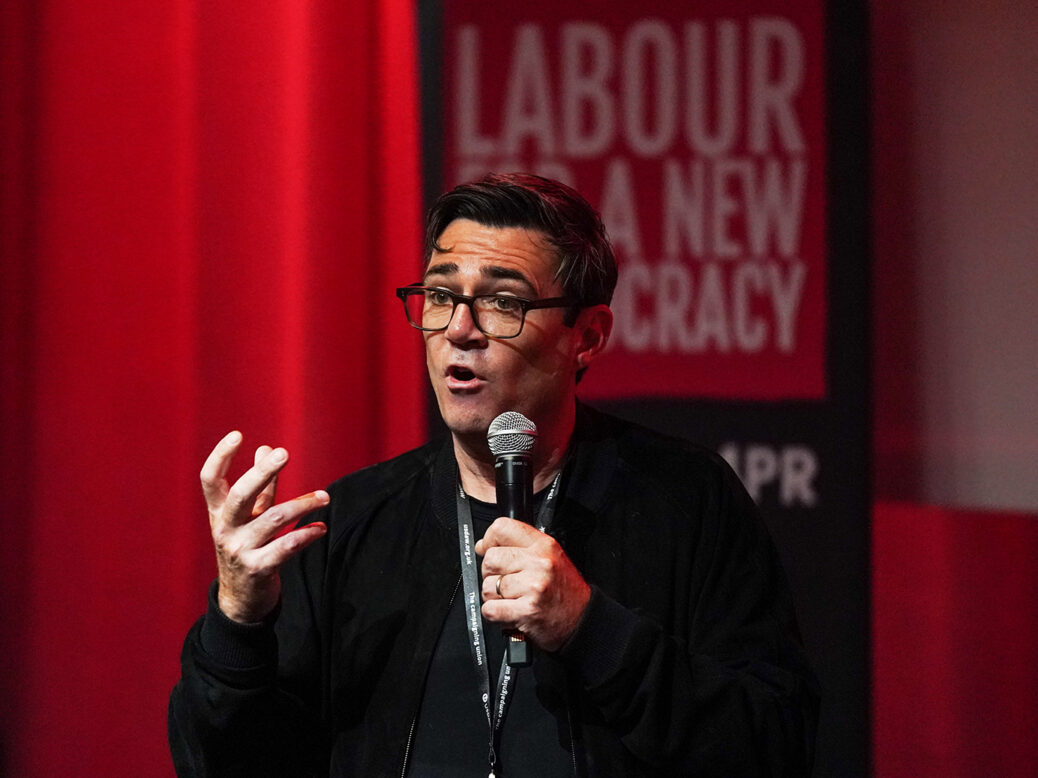
Andy Burnham is that rare thing at Conservative conference: a politician with power. “I’ll probably get a better reception here than I did last week,” he quipped at one of his three fringe appearances after a Labour conference where he often rivalled Nigel Farage as the principal target.
One of Keir Starmer’s mottos as leader has been “country first, party second”. As befits an advocate of “Manchesterism”, Burnham emphasised that he was “place first rather than party first”, citing the support he had attracted from “traditional Conservatives” across three elections.
The mayor was unambiguous about the place he blames for holding the country back: Westminster. “I have to spend part of every single working week in this job remaking the case for devolution to Whitehall,” he complained. “You would think I wouldn’t have to do that anymore after ten years of growth, averaging 3.1 per cent – but sadly, we do.”
Burnham, who praised George Osborne for championing devolution, added: “I think it’s something to do with power. Some don’t like the idea of places like this answering back a bit more forcefully than perhaps we were able to do in the past.”

There are two issues, the mayor said, on which Westminster has singularly failed: social care, “and the ongoing nightmare that presents”, and council tax. “How can it be justified that council tax has not been revalued since 1991?” he asked, noting that northern households pay hundreds of pounds more than those in London and the south-east and citing local government finance as the biggest threat to devolution (Burnam also called for the introduction of a “tourist tax” on visitors to Greater Manchester).
For proof of this crisis just look to Kent. It was here that Reform took office in May, vowing to reduce taxes by cutting costs through an Elon Musk-style “Doge unit”. But as with Musk, it didn’t take long for the party to collide with reality. Diane Morton, Reform’s cabinet member for adult social care, has now said the local authority will raise council tax by 5 per cent – the maximum permitted – after finding that services were already “down to the bare bones”.
The surprise is that anyone should be surprised: figures show that Kent County Council spends 74 per cent of its budget on adult and children’s social care and homelessness. Did Reform believe this was through mere choice? Without change, voter resentment will only grow as the public pay more for less (recall the rage of The Inbetweeners actor James Buckley at being charged for a garden waste collection).
Burnham’s message to Rachel Reeves, ahead of the Budget on 26 November, is that she should be prepared to pick a fight. “It [council tax] does need to be revalued and if that is perceived as a wealth tax by some people in very big, very expensive properties, who will start to pay more, then I’m not going to shy away from saying that is exactly what they should be doing.”
There’s another politician who once made such an argument: Rachel Reeves. “Council tax, based on 1991 valuations, is at the very least long overdue a re-evaluation and revision of existing bands,” she argued in her 2018 pamphlet The Everyday Economy. Will the Chancellor, as has long been rumoured, use her second Budget to announce just this? Without reform, the only certainty is that the rolling crisis in local government will go on, threatening old and new parties alike.
This piece first appeared in the Morning Call newsletter; receive it every morning by subscribing on Substack here
[Further reading: Kemi Badenoch pitches the Tories as the Lib Dems of the right]
Content from our partners

Related

Join the debate
Subscribe here to comment