
Party conferences have their own personalities. These may or may not relate to how well the party is doing in the polls – or even whether it is in Government. The Conservatives’ 2022 conference in the wake of the Liz Truss mini-Budget had a hyper quality, all excitement and chaos and wild speculation. Labour in 2023 was gripped by nervous excitement, a wonderous sense of “we might really be able to do this”, culminating in the image of Keir Starmer being covered in glitter by a protester during his speech, transforming in a cloud of fairy dust before the conference’s eyes into a prime minister in waiting.
Last year, Labour had just won a historic three-figure majority and everyone was miserable. Conference was “a three-day anxiety dream” according to one gloomy delegate. The Tories, meanwhile, had suffered a catastrophic defeat and were buoyant – partly because they had a leadership contest to distract them, partly because Labour had seen its popularity fall so quickly, but mostly because reality hadn’t yet hit them. There was a sense of delusional optimism, the feeling, as one Tory strategist put it, that “while the wife might have left us, she’ll soon realise what she’s missing and be back” (the wife being the electorate, obviously).
Is Labour being similarly delusional this year? As George has outlined, the mood in Liverpool has been remarkably cheerful given the Government’s dire standing in the polls. Some of this is down to the counter-intuitive optimism from critics of Starmer from all factions that he cannot last long and could soon be replaced with whoever their preferred alternative might be. But the cheeriness is also coming from the Government. They think they can turn this around. Why?
The answer has been front and centre of every cabinet speech: Nigel Farage. The Starmer project has found an enemy. Rachel Reeves argued Farage represents the “single greatest threat to our way of life”; David Lammy got a standing ovation for calling Reform’s plan to scrap Indefinite Leave to Remain “what it is: it is racist”; Shabana Mahmood painted her own measures to toughen up migration policy as the only way to halt the path towards “ethnonationalism” and keep out the radical right.

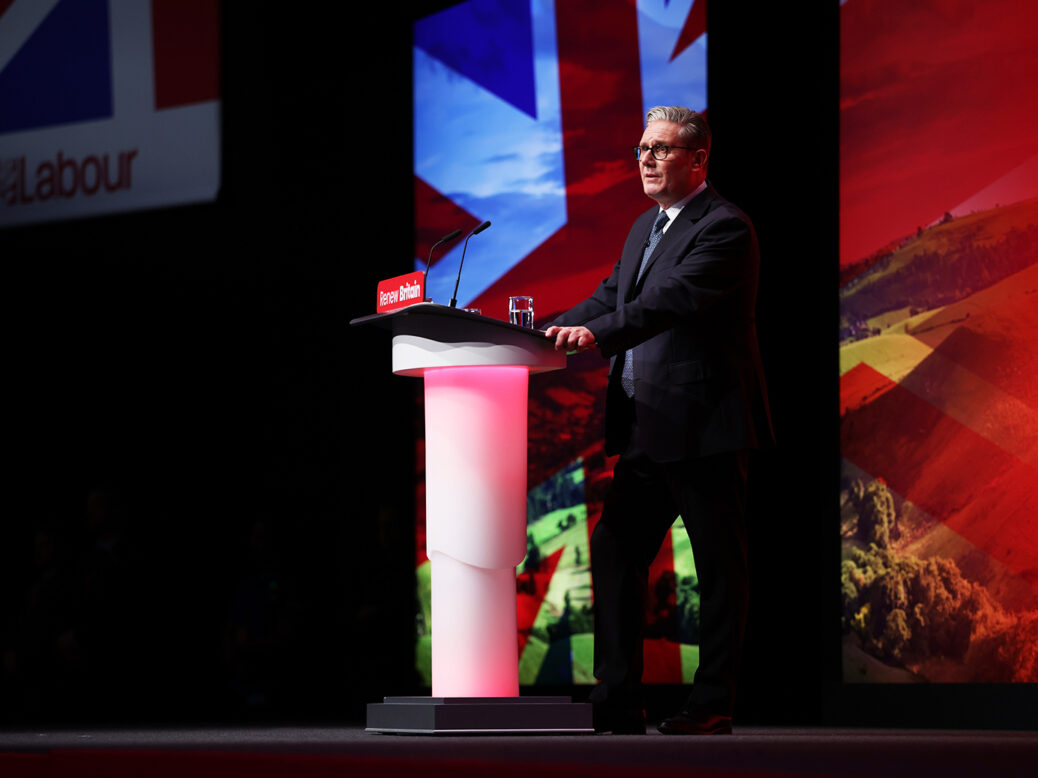
It’s a baton the Prime Minister himself was only too happy to take up in his own speech. “Britain stands at a fork in the road,” he told the packed conference hall. “We can choose decency. Or we can choose division. Renewal or decline. A country, proud of its values, in control of its future, or one that succumbs, against the grain of our history, to the politics of grievance.” This isn’t just rhetoric. After a year of struggling to define what it is the Starmer government is about, fielding criticisms of “lacking a narrative” or having no vision, the rise of Farage from the fringes to the top of the polls has provided an answer.
Labour strategists know that elections to be fought around one big question. Find yourself on the right side of that question, and the electorate will come with you. In 2019 it was “Do you want to get Brexit done?” In 2024 it was “Do you want to kick the Conservatives out?” If the next election – still more than three years away – is framed around getting rid of Starmer, Labour is in trouble. But if turns into a different battle, a question of keeping Nigel Farage and the brand of populism he represents away from No 10 at all costs… Well, that’s a case that is much easier to make.
Helpfully, it’s also a case which unites all the warring factions of the Labour ecosystem, from the soft left to the Blairites, and even the more far left fringes tempted by Zack Polanski and the Greens or whatever becomes of Jeremy Corbyn’s Your Party. Despite Labour seeming more divided than ever back in Westminster, the past few days in Liverpool have felt remarkably free of factional toxicity. That isn’t because Starmer is suddenly widely popular – far from it. But the solidification of Nigel Farage as the enemy has shifted the focus. One delegate described it in the terms of Tolkien’s Lord of the Rings: the coming together of different tribes to take on a force whose victory would change Middle Earth forever.
It has even laid the groundwork for the Budget, in which Rachel Reeves will once again walk an impossible tightrope of trying to keep on top of myriad spending demands without breaking either the manifesto tax pledge or her fiscal rules. There has been precious little in the way of Budget hints over conference this year (maybe an increased tax on gambling, maybe something on VAT). But when Starmer talked about economic growth as the “antidote to division”, you could see the outlines of how November’s financial decisions will be made. Stick with us, stick with the plan, and the resulting economic growth will be the weapon we need to vanquish the treat of Reform – for good.
Is this as delusional as last year’s Tory conference, that saw the once-great party mired in the “denial” stage of grief? It certainly comes with risks. Some veteran Labourites worry that the government walked into a trap bigging up Reform as its main opponent last year, in the hope of crushing the Conservatives for good. Now the Conservatives indeed seem crushed, but the expectation Reform would be an easier rival has proved disastrously short-sighted. Reform has basked in the credibility leant to it by Labour’s laser-like focus: Starmer, with over 400 MPs, is obsessing about a leader who has five. His decision to take the fight to Reform on immigration, outlined in stark terms in Shabana Mahmood’s speech, risks alienating progressive voters on the left to the point where they may not come back, even with the fight framed in terms of “us-or-Farage”. And that’s to say nothing of the economic headwinds, sluggish growth and what happens if the “antidote to division” fails to materialise.
But there is no doubt that this conference has given the government the definition it has been lacking. And that is why the mood is so upbeat. Labour members, delegates, activists and MPs may be frustrated. They may be disappointed. They may even harbour hopes of a change of leadership. But they no longer lack a purpose.
[Further reading: Crying racism only hurts Labour]
Content from our partners



Related

Join the debate
Subscribe here to comment