
He came, he saw, he putted. Donald Trump’s visit to Scotland was the expected whirlwind – a golfing trip during which he fitted in some diplomacy (if that’s the right word with this president) with the leaders of the EU, the UK and Scotland.
Trump clearly enjoyed himself, to the extent that he suggested he could become first minister once he’s done with the US and the rest of the world. That joke raised quite the entertaining vision, as did his description of Scotland as a land of “no crime, no muggings. You don’t have people being hit over the head when they are not looking with a baseball bat, they’re not pushed into a subway.” Not at the five-star Turnberry resort, anyway.
John Swinney had two chances to beard Trump, at a dinner and then at a head-to-head, and spoke to him about whisky tariffs and the ongoing crisis in Gaza. For all Trump’s unpopularity, meeting the leader of the free world is the kind of moment that elevates any first minister. The far left carps, as the far left does, but Swinney was right to take his opportunity. He behaved like a grown up.
That, so far, has been the mark of Swinney’s time in office. These things are relative, but he has been a moderating force, dragging his party back to the centre ground after the leftist administrations of Nicola Sturgeon and Humza Yousaf.

Much of his attention is on fixing the NHS – he has a plan, and we will see whether it bears fruit (it had better). There is also a focus on growing the economy. To many, these are obvious priorities for government activity, but it has not always been like that in Scotland.
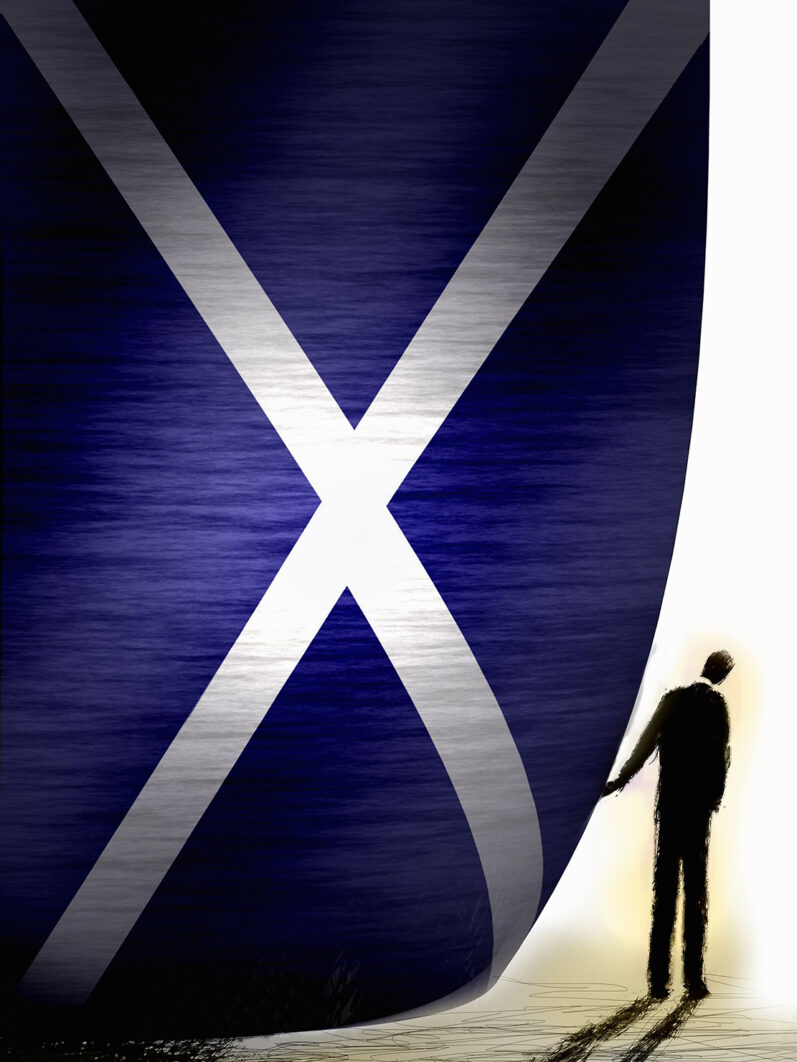
There is a limit to how long any SNP leader can get away with talking about anything other than independence, of course, and the First Minister is as committed to his party’s raison d’etre as the most passionate activist. It is his life’s work, and even his moderation is merely a means of achieving that goal. Whatever an SNP government does, it is always based on what it thinks will best advance the cause of breaking up the UK.
True to form, Swinney has now unveiled the latest strategy for getting to indy. There have been so many of these in recent years that voters are understandably confused about what the offer is. A de facto referendum, 60 per cent backing for separation in the polls over a sustained period, a majority of Scottish seats for the SNP at Westminster – each has been proposed as a route since the turn of the decade. None has lasted.
Swinney has, in effect, returned to 2011. That was when Alex Salmond won a surprise overall majority at Holyrood, providing the legitimacy and momentum that led David Cameron to accede to the 2014 referendum.
The SNP is going back to the future. The First Minister said that, once again, securing a majority in Edinburgh is the way to a second referendum. There are 129 seats at Holyrood, meaning the party would have to win 65 of them. The alleged transformation of Scotland that would come with independence “only happens if we have that referendum and we only get that referendum if a majority of SNP MSPs are elected next May,” Swinney said.
He insists independence will be at the heart of his party’s election campaign, but it’s hard to see his strategy as anything other than kicking the can down the road. That’s certainly how the hardliners are viewing it, lining up to criticize the FM’s approach as weak and defeatist. Alex Neil, a former SNP health secretary and a critic of the administration, said it was “more about trying to save the SNP’s bacon”.
This is probably true, but that does not mean it lacks sense. Swinney has an election to win, which would take the Nats into their third consecutive decade of governance, and he will not do so with alarming promises of constitutional upheaval whatever the outcome. Sturgeon tried that, and it helped do for her.
Voters – or most of them – are not looking at next May as a chance to refight the independence battles. They are worried about the cost of living, the state of the health service, jobs, transport and other policy areas that impact their day to day lives. They are nervous about the international climate, and are seeking security. They are fed up with politicians of all stripes. They are exhausted by the indy permawar, and would appreciate a break from all politics having to be squeezed through that funnel.
Swinney’s mature approach is to understand this, and to attempt to meet the electorate on its preferred terrain. A wise leader knows which fights to pick, and when. This is not the moment for William Wallace and saltire face-paint and screams of “freedom”. It is not the time for “one last push”.
The SNP will not win 65 seats next May. It will be an unprecedentedly divided parliament, with Reform joining its ranks. There will be a minority administration, which will be formed by either the Nats or Labour. Swinney’s independence plan is really an attempt to draw as much of the separatist support to the SNP, away from the Greens and Alba, so maximizing his party’s performance.
For the independence movement, if its members would only accept it, this is a time to regroup, rethink, and play a longer game. The First Minister, at least, seems to see this clearly.
[See more: Maga zealots want to redraft the Civil Rights Act]
Content from our partners

Related
Join the debate
Subscribe here to comment