
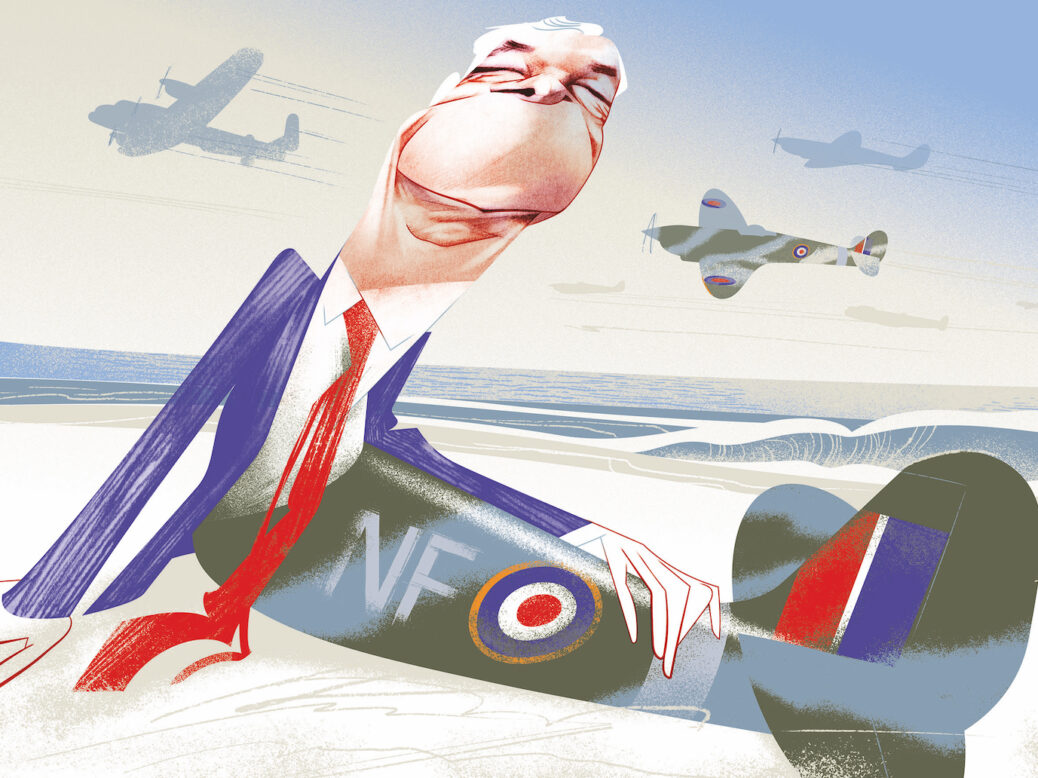
It was unusually cold for August. It was windy. I was staring into the North Sea with around 100,000 attendees, waiting for the Spitfire to whip past. There was a small, uninterested cheer when it did. If there were any serious aviation-heads at the Clacton Air Show, which takes place every August, I did not find them. Instead, what I found was at best collateral enthusiasm: a slew of people sitting on the beach unwrapping sandwiches and staring into the sky, because why not?
Thunderbolts, Red Arrows, Spitfires – a series of Second World War and postwar planes undulated and pirouetted. The sound of the engines was more whirring mosquito than deep roar. I learned that air shows consist of an enormous amount of waiting around, to see occasionally a very small aircraft go past. Another insect sounds above. I think the trick is that this Mustang was flying upside down, but it was just slightly too far away for me to tell.
An announcement blared over the loudspeaker: “We once again remind you that it is prohibited to swim in the water while the planes are overhead.” This seemed sensible to me – some of these planes were older than the present King. “Oh fuck off boring wankers!” a 60ish-year-old man in an entirely powder-blue outfit – it matched his eyes – shouted, at no one in particular. A snaggle-toothed Jack Russell in an Adidas singlet trotted past. It was hard to tell if anyone was having fun.
Clacton might be Britain’s most chronicled town, constantly subject to invading and terribly concerned journalists who visit from London, vox-popping and ventriloquising the plight of the residents. And it stands as rhetorical shorthand for the hard-up seaside resorts of England – the left-behinds; the disaffected white working class; the truculent but impotent populace outside of the capital city. The emergent view of Clacton is that it is a place that has been ravaged by drugs and racism, sickness and cigarettes. This is the coastal town where one in five has never had a job; the spear tip of Britain’s anti-immigration anxiety.

The town’s defenders resort to polite euphemism to describe it: it’s down to earth, it’s unpretentious. Its critics soften the blow: it’s just somewhere modern Britain forgot. Matthew Parris once damned Clacton in 2014 for representing “all-our-yesterdays Britain”. Wherever the world is happening, it is not happening here.
But the heretical secret of Clacton is that the world very much is happening here; the residents have won the argument. Politically, at least, Britain is becoming more, not less, like Clacton. So I was on the beach not watching planes with a bunch of disenfranchised nobodies, as all ten years of poverty dispatches might have you believe, but with the most powerful people in the country. When the BBC wanted to find out if the English still liked Brexit, they sent Question Time to Clacton for a special edition in 2023. The audience no doubt disappointed Fiona Bruce by remaining bullishly favourable to the decision to leave the EU in 2016.
Clacton is the only place to have ever elected a Ukip MP (Douglas Carswell in 2014). In 1969 it played host to an Enoch Powell intervention – that Britain didn’t need those Europeans, that it would be better striking out on its own away from the EEC. This vision was fully realised, with neat symmetry, in 2016 when 70 per cent of the constituency voted to leave the European Union. By 2024, Nigel Farage marshalled all of this – disquiet about immigration, high unemployment, a vague sense of the Conservative Brexit-betrayal – and converted it, finally, into a successful bid for a seat in the House of Commons. And, Clacton’s once-taboo anxiety about asylum seekers is now a matter of mainstream conversation. This doesn’t sound particularly left-behind to me. It will sound even less left-behind if Farage becomes prime minister.
I wandered down the seafront – with its manicured gardens and well-painted iron railings – and detected an attempt to discredit the image of run-down, boarded-up, immiserated townscapes painted by the well-meaning Clacton-chroniclers. It is nice; you could even accuse it of vanity. And I am thinking of the actually impotent millennials waving Palestine flags at Glastonbury; the residents of Henley-on-Thames who just want George Osborne to be in charge; the metropolitan elites languishing pointlessly in expensive London restaurants, as politics happens to them, whether they like it or not; the déclassé journalists hovering around literary festivals, hand-wringing ineffectually about populism. Their guy might be in No 10, but the arguments he has few answers to were forged in Clacton-on-Sea.
When Parris went to Clacton, he observed a post-imperially depressive resort, representative of a Britain “going nowhere”. The future, he said, belonged to places with ambition, not serious economic inactivity. The Tories, he advised, should be thoughtful to the suffering of Clacton’s inhabitants, but less interested in listening to their opinion. There is no viable election strategy in looking for approval from a cohort that “wants to spend its days buying scratch cards and its evenings smoking in pubs”, he concluded.
And where, exactly, has that got them? The Conservative Party is depleted, facing an extinction-level event. Its last hopes lie in a self-styled renegade, the online poster Robert Jenrick – the man who is aping the language of Farage to recoup all the ground lost to Reform UK. The shires – these places “with ambition” – belong to the Liberal Democrats now. Neither Henley-on-Thames nor Cambridge is onside. Clacton is Reform turquoise; will it ever be Tory blue again?
Down-at-heel would be a polite description of Clacton’s high street. I walked past a boarded-up Asda. I witnessed a fight between an old man in fatigues and a pack of furious children. The Moon and Starfish Wetherspoons on the promenade was rundown, even by Wetherspoons’ standards. The shopping mall was empty. In a sports bar a local described his own town as a “shithole”.
And yes, Clacton is populated by a predictable cast and crew, just as all the prodding constituency profiles describe: disability is conspicuous, most people are pretty old, asylum seekers are mentioned with impressive regularity. I spoke to Steve, 67, who thought Farage is a bit too soft. “I love journalists,” he told me, somewhat surprisingly. “Tommy Robinson, especially,” he followed up. Ah, I see. (I suppose I would have been surprised if he said Emily Maitlis.) We watched the Spitfire together, though like everyone else there, Steve was not aggressively enthused by this homage to British wartime greatness. “Did you know the first person to do a loop-the-loop in an airplane was an Essex man?” he asked me as it flew past. No, I did not know that! I am not even sure if it’s right.
On the second day of the air show, Farage dropped by and posed imperiously: staring at the sky as the RAF Red Arrows shot past, patriotic red, white and blue in their wake. This great, noisy nostalgia-fest is backdropped by an offshore wind farm just off the coast, co-owned by the Danish multinational Ørsted and the Bank of Japan. It sits there in the North Sea as a reminder that no matter how much people say Clacton is stuck in the past, the 21st century will impose itself anyway. And this town, beset by post-crash melancholy and serious poverty, is at its helm.
[See also: The wonderful world of Prince Andrew]
Content from our partners


Related


This article appears in the 27 Aug 2025 issue of the New Statesman, The Gentle Parent Trap
Join the debate
Subscribe here to comment