
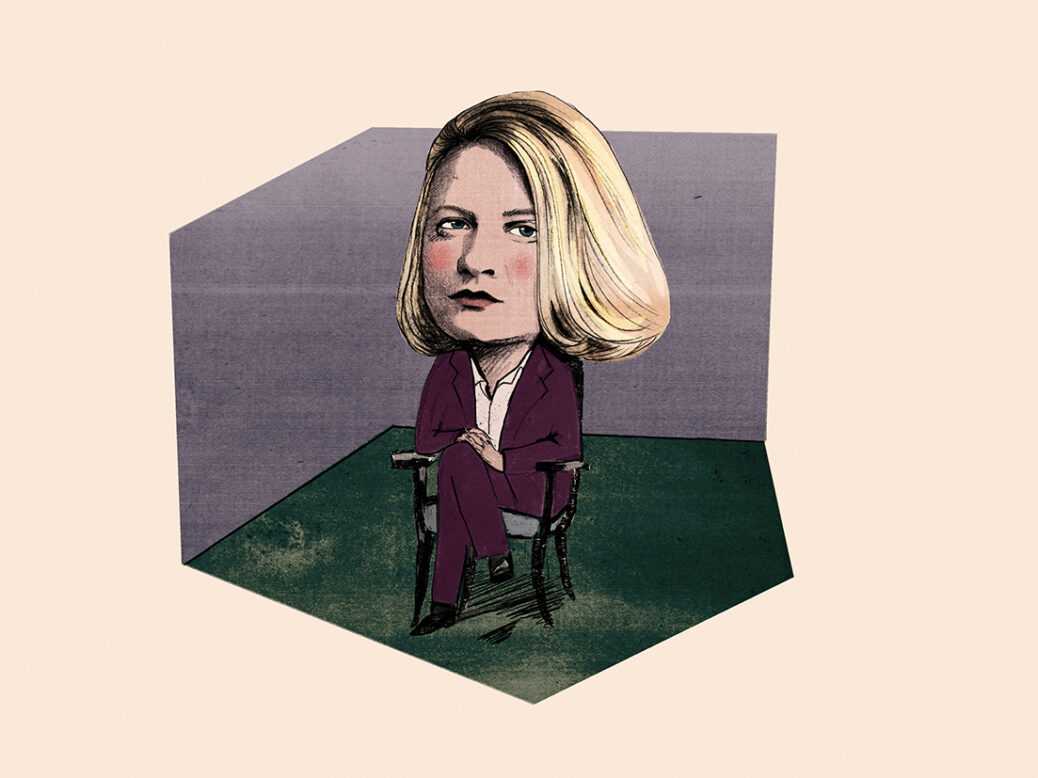
We were on our second glass of wine and Katie Lam was ready to talk about the spiralling fortunes of the Conservative Party. “We’re still less than a year from the biggest electoral defeat in modern British political history. The public’s not ready to forgive us,” she said of the recent spate of polls that show the Tories pushed down into third and even fourth place. “There were some major, major failings – and the public’s very angry, very reasonably.”
The 33-year-old MP for Weald of Kent is about as Conservative as they come. She’s been an adviser to Boris Johnson in No 10 and Suella Braverman in the Home Office. She won her constituency in July with one of the highest on-paper Tory majorities, joining the two-dozen new Conservative MPs entering parliament after an election in which her party lost 250 seats.
It’s been barely a year, but in the think tank conference rooms and Westminster bars where the wounded Tory community can still be sighted, Lam is being whispered about with words like “fiery”, “authentic”, “fearless in debate” and “the real deal”. Ask a Conservative who they think is the one to watch out of the limping new parliamentary cohort and chances are you’ll hear the name Katie Lam.
At the Westwell wine estate in the picture-perfect Kent village of Charing, between Ashford and Maidstone, none of that was on the agenda. In a dark-green dress and trainers well suited to examining vines, Lam was just another local MP, squeezing in a tour of the winery in between two primary school visits and a meeting with parish councillors. After a detailed conversation with the owner about cellar-door relief, post-Brexit equipment import costs, energy prices and R&D funding for viticulture science, we were handed glasses of Westwell’s flagship sparkling vintage. In between digressions on karaoke, Tory WhatsApp groups and why Britain needs to leave the ECHR, I tried to figure out how Lam became the Tories’ rising star.

Lam has undoubtedly entered parliament at a difficult time: she is part of the smallest Tory cohort in modern history. Parliamentary arithmetic has shoved her into the spotlight long before one might expect even Westminster obsessives to know her name. As well as serving as an opposition whip, she holds a shadow Home Office brief. It was in this capacity that she dashed from her office to the Commons chamber on the last Tuesday before the Easter recess to respond to a statement from Jess Phillips on the government’s action on the grooming gangs scandal, clutching a speech hot off the printer.
“It was a mad, mad 48 hours,” she told me. For an opposition response of this nature, “you would normally want a couple of days to write and source and fact-check that… I think we had about an hour and 40 minutes’ notice.” Her speech included harrowing details from the court transcripts of grooming cases; because of Lam, Hansard now contains the quote: “We’re here to fuck all the white girls and fuck the government.”
“I hadn’t said it aloud before I stood up and said it in the chamber, because I literally finished writing it as I sent it to the printer… I didn’t consider it to be a particularly explosive thing to have said.” She paused. “It went down very, very badly in the room.”
But whatever Labour and Liberal Democrat MPs in the mostly empty chamber made of Lam’s intervention, the outside world had other ideas. Her speech was clipped online and has been viewed tens of thousands of times. By the time Lam returned to her desk, she had emails of support from “well over a hundred people, which became well over a thousand people… It’s a useful reminder that the chamber is not the country.”
The daughter of a primary school teacher and a small business owner, Lam has been a Conservative “for as long as I can remember”. It very much does not run in the family: her great-great-grandfather was a socialist politician in Germany who had to flee with his family from the Nazis. It’s the kind of story fit for a high-octane Netflix drama, involving a prison break through a window and a dash across borders to run a resistance radio station. Her grandparents met delivering leaflets for the Labour Party in the 1940s – she has previously joked that she “wouldn’t be here without the Mill Hill Labour Party”.
Yet, somehow, by the time she was “politically sentient” Lam had decided her values were fiercely Conservative. “The first general election I remember was 2001 when I was nine,” she recalled. “I felt very strongly that we should keep the pound. I can’t tell you now exactly why that was, but I know that was what I thought.”
Skirting over the fact that, as political awakenings go, the attempts of William Hague to rescue his party from electoral oblivion is about as relevant as they come for a Conservative MP today, Lam has a CV tailor-made for politics. She ticks both the “state school” and “Oxbridge classics degree” boxes, having studied at Trinity College, Cambridge. She explained that, while her school didn’t offer either Latin or Greek at GCSE, she was so inspired by one of her teachers that she insisted on taking them independently. (“My poor old parents! I went home and I was like: ‘I’m going to need a Greek teacher.’”)
She was both president of the Cambridge Union and chair of the Cambridge University Conservative Association, in between theatrical antics that included a production of Jerry Springer: The Opera, complete with pyrotechnics. Her one regret from Cambridge, she told me, was not doing her dissertation on a comparison between Eminem and Ovid.
She went to work at Goldman Sachs, hoping for a grounding in how business works. Six years in, a chance encounter at the Conservative Party Conference (accompanied by her father, who joined the party in solidarity with his daughter) landed her a job with the Boris Johnson adviser Andrew Griffith in No 10. The 2019 election was called weeks later, Griffith became an MP, and Lam was suddenly deputy Downing Street chief of staff and head of the Prime Minister’s business team. “It’s all worked out in retrospect, but it was not planned,” she insisted.
After her time in No 10, she was chief policy adviser at the advisory firm Portland, answering “quite basic questions like: ‘I deal with both these government departments; how are they talking to one another?’ And the answer is usually: not at all!” A stint at an AI company and a return to government, this time in the Home Office, kept her busy until she was selected for the blue-as-can-be seat of Weald of Kent in 2023. In her spare time, she wrote a number of musicals, one an adaptation of The Railway Children.
On the stifling hot June day we met, Lam was as relaxed discussing what the government can do to support English vineyards – from reforming alcohol duty rates to reversing the national insurance threshold hike that has made it harder for small businesses to hire new staff – as she was admitting her obsession with Abba or enthusing about co-chairing the newly minted all-party parliamentary group for classics. She gave off the vibe of a school prefect from an Enid Blyton novel (indeed, she was head girl at school), turning from bubbly to stern in a flash when asked about the prospects of replacing Kemi Badenoch a leader, which she said would be “inappropriate” to speculate on.
She has the Duracell Bunny energy associated with the shadow justice secretary, Robert Jenrick, whom she backed in the leadership contest. A slickly produced “day in the life” video on Instagram shows her scoffing pizza, riding in a squad car with Kent Police, scaling the 99 steps of All Saints Church in Staplehurst and cuddling her golden retriever Bailey. One almost expects her to burst into song, Rodgers-and-Hammerstein style, about the charmed life of a Kent MP.
For all that, while her social media game and love of theatre might code her towards the centre left of her party, it is the right of the depleted Tory ecosystem that is most dazzled by Lam. “I don’t know – if somebody said ‘the right’, what would qualify them for that?” she said, then reeled off a list of views that put her firmly in that category: a belief in a much smaller state (“I don’t say that as an ideological thing – but to function, no organisation of that kind of size could work well”), a less regulated economy and a Britain outside the European Convention on Human Rights.
“Restoring the border and fixing the immigration situation is a condition of anybody who takes power in Britain,” she said, echoing the leadership pitch Jenrick, to whom she remains close, made last year. “And I can’t see how we can possibly control the border within the ECHR.” Videos of her parliamentary interventions on the subject have cemented her appeal among the Tory hardliners frustrated by Badenoch’s indecisiveness. (The Conservative leader has commissioned David Wolfson, the shadow attorney general, to review whether the UK should leave the ECHR – a move Lam diplomatically said she supports.)
Is she worried about the threat of Reform in her constituency? The latest Electoral Calculus MPR poll has Nigel Farage’s party claiming what should be this safe Tory seat. “A lot of the people who live here would consider themselves to be classic deep-seated lifelong Conservatives, and we know that a lot of those people have voted Reform, which is obviously very painful for somebody like me.”
Her hope is that right-of-centre voters in Weald of Kent “will not want the sort of economy that Reform will end up suggesting”. She called Farage’s decision to muscle in to Labour turf by announcing he’d remove the two-child benefit cap “a strange un-aspirational policy… If you’re already on universal credit and can’t afford to have another child without the two-child benefit cap being raised, then you shouldn’t have another child.”
Lam claimed not to have a political hero that would help onlookers place her within the Tory universe. “There are, throughout history, inspirational leaders – Thatcher, Churchill, going all the way back Henry VII, Pitt the Younger, Pericles,” she said. “But I’m a little bit sceptical of heroes in that sort of way, just because I think no time is like the other.”
She has blemished her prefect image by challenging the Tory doctrine that Margaret Thatcher has all the answers. At an event at the Centre for Policy Studies, the think tank co-founded by the Iron Lady herself, Lam suggested her party might want to move on from the 1980s. She was adamant she didn’t criticise Thatcher (“There hasn’t been a by-election… I’ve still got the whip!”), but maintained that some distance might be valuable. “Margaret Thatcher left power before I was born, and she took over the Conservative Party over 50 years ago. That’s half a century; the world is such a different place… You can learn lessons from history books, but they can’t tell you what to do.”
It’s a bold Conservative politician who doesn’t hold Thatcher up as a personal inspiration. Bolder still, Lam is prepared to give the Labour government credit where she believes it is due, such as on Wes Streeting’s abolition of NHS England. A pragmatist, when it comes to slashing quangos, she doesn’t mind who does it, as long as it gets done. “I think we’ve got, by a factor of hundreds, far too many bodies, additional layers that remove responsibility and accountability,” she said. “The classic metaphor is levers of government. The thing lots of people say is you pull the lever and nothing happens. Increasingly the British state is so broken that you pull the lever and the lever comes off in your hand.”
On a Tuesday night the week after our interview, Lam was in a hot room on London’s Great Smith Street, home of another right-wing think tank – the Adam Smith Institute (ASI), once much-beloved of Liz Truss. The Next Generation project run by the ASI is all about revitalising Conservatism, finding ways to modernise and turbocharge its offering to young people. Lam was there to talk about the history of liberalism, and how conservativism is not just compatible with but reliant on it. “Real English liberalism,” she said, is about “small families”, “a free economy”, “freedom of speech, conscience and association”, and “a political model in which the people, not judges or bureaucrats, are the ultimate constitutional backstop”. She made the liberal case for border control, calling the UK’s immigration system “our recent fit of madness” and adding that for most of Britain’s past “we’d never dream of putting the rights of the foreign criminal above the safety of our own people”.
There was particular enthusiasm among the crowd of young think-tankers, parliamentary aides and general Westminster hangers-on when she linked the decline of “classical liberalism” in Britain (as opposed to the type of progressive liberalism beloved by the left) to the housing crisis – which she blames on “20th-century socialism”. One Lam fan I spoke to called her “refreshingly normal” for a Conservative MP. Another simply said: “She gets it.” They were intoxicated by her combination of an unapologetically hardline stance on immigration with a focus on the challenges faced by younger people, who have tended to be ignored by a Tory party obsessed with the pensioner vote. She is challenging the notion of youth being left-coded, offering a vision of Conservatism specifically to appeal to a younger generation. Whether it will have much appeal beyond the think tanks of Westminster remains to be seen: just 5 per cent of voters aged 18 to 24 say they’d vote Tory.
Lam insisted to me it’s “important to resist categorisation” and refused to label herself a right-wing Tory. It’s “a bit weird”, she argued, for politicians to brand themselves, revelling in “identity-based politics”. “I don’t think that’s healthy.” Much better to keep it vague and let people get to know her through her parliamentary speeches and musical performances. Her go-to karaoke song is Gloria Gaynor’s “I Will Survive” – an anthem for a rising star of today’s Conservative Party if ever there was one.
[See also: A question of intent]
Content from our partners



Related

This article appears in the 16 Jul 2025 issue of the New Statesman, A Question of Intent
Join the debate
Subscribe here to comment