
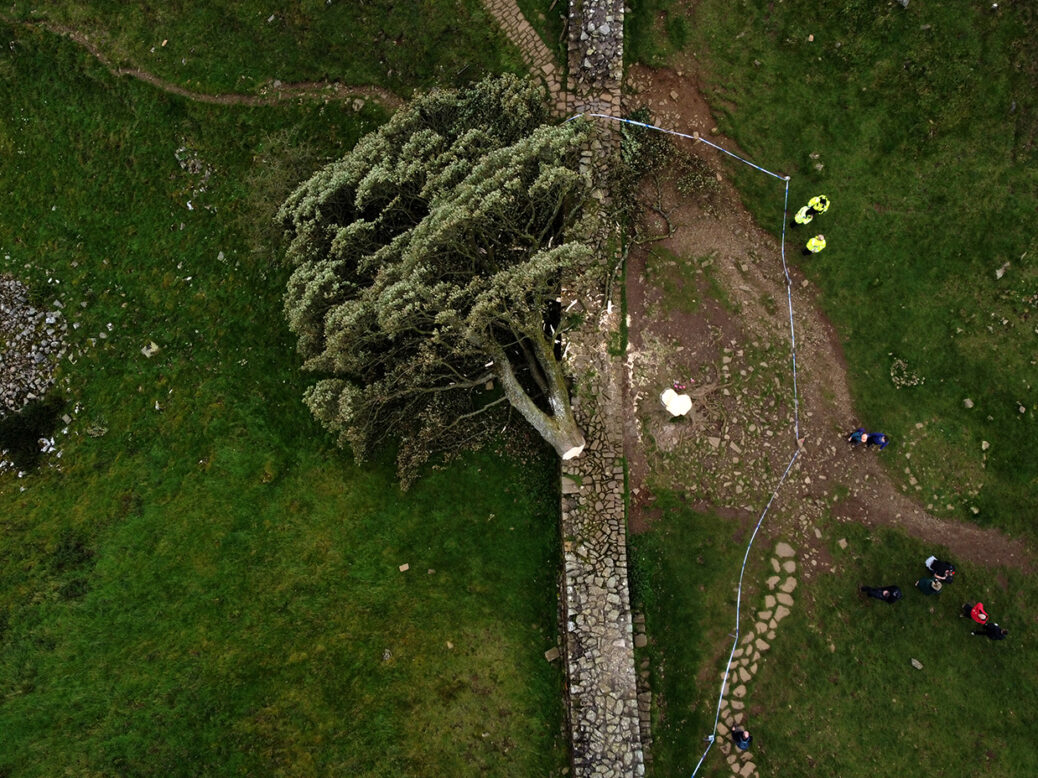
An understaffed police force that solves less than 11 per cent of victim-based crimes used 38 police officers to investigate the cutting down of a single tree, the New Statesman has learned. We can also reveal that the Crown Prosecution Service spent more than £35,000 on a King’s Counsel to convict the two men who cut the Sycamore Gap tree down.
Most crimes in the UK are not investigated at all, and less than a third of all victims of crime in the UK say their allegations were investigated thoroughly. Roughly six per cent of violent crimes result in a charge or summons within a year, and for rape the figure is less than three per cent. Northumbria Police experienced the deepest cuts to any force during the austerity era, losing more than 1,100 officers between 2010 and 2023. The most recent report on Northumbria Police by the police watchdog identified “a shortage of qualified detectives” that “makes it difficult to carry out thorough investigations”. The case of the Sycamore Gap tree was different, however: this was a tree with an Instagram account. Also, it had been in a film.
After a protracted Freedom of Investigation process, Northumbria Police told us that in its 19-month investigation into the illegal felling of one tree: “The main investigation team consisted of four officers” – although the force said these officers were “not exclusively working on the investigation. In addition, 34 officers were used in support for example as part of arrest, search and interview teams.” The force said it had not recorded how many person-hours were spent on the investigation, and could not provide an estimate of what the investigation cost.
In response to a separate Freedom of Information request, the Crown Prosecution Service said it spent £35,230.62 on the prosecuting counsel’s fees alone. That’s just the barrister (a King’s Counsel); the “time spent by internal lawyers, paralegals, and administrative staff” is not recorded.

In July of this year, two men were successfully convicted of having illegally felled the tree and were each sentenced to four years and three months in prison. A prison place typically costs about £52,500 per year. In total, it seems possible that the state will spend around a million pounds of taxpayers’ money avenging one famous tree.
As she sentenced the two criminals, Mrs Justice Lambert reflected that the tree had stood as a symbol of the “untamed landscape” of the area. This wasn’t true, however. The Sycamore Gap tree was deliberately planted in the 19th century by a wealthy landowner and cultivated as a decorative feature. It was as wild as a pot plant. The long sentence handed out was not, therefore, for harming something wild and unique, but for harming the feelings of people who mistakenly thought it was wild and unique.
Even when dangerous criminals are caught, they often receive shorter sentences that the Sycamore Gap vandals. This paedophile committed more than 40 indecent acts against a child, beginning when his victim was aged ten; he got three years. This man was found guilty of controlling and coercive behaviour, assault by beating and false imprisonment of his victim, who was a heavily pregnant woman; he got three years. This man forced his way into someone’s home, carrying knives and a meat cleaver, and stamped repeatedly on his victim’s head before burgling them and then declaring his intent to kill their neighbour; he got less than four years. These thugs beat a man until both of his lungs collapsed, his ribs and facial bones were broken and his brain bled; they got less than four years.
Local authorities cut down nearly 455,000 trees in the decade to last August. Fortunately none of these trees had Instagram accounts, or we’d be imprisoning 125 council officials a day (within six months we’d have jailed everyone in local government). Many of the trees removed by councils were older than the Sycamore Gap tree, or more important to local biodiversity, or both. Many were near people’s homes or in parks, where they provided shade and privacy and beauty, all of which are much more important than the photo opportunities of tourists.
The argument the police originally gave for committing resources to the Sycamore Gap investigation was that the felling of the tree had damaged the local economy, but tourism in the area has not suffered, and a new tourist attraction has been created in its place. A section of the trunk is now on display for the outpouring of mawkish, tree-based sentiment: BBC News, the national purveyor of click-friendly emotional content, reported breathlessly that “people can hug the Sycamore Gap tree again”. What the Sycamore Gap tree represents now is an infantilised culture, a country that has given up on solving complex problems and wastes its tears, its public money and prison places on celebrity vegetation. It would be better used as firewood.
[Further reading: The end of the woke policing myth]
Content from our partners


Related


Join the debate
Subscribe here to comment