
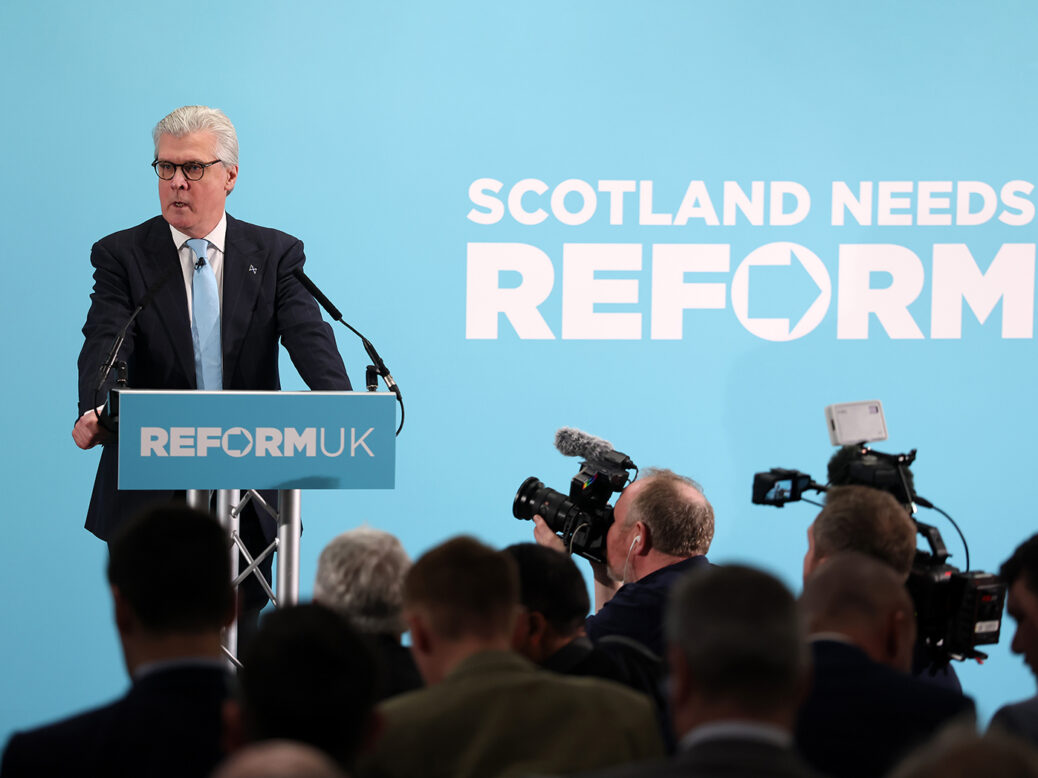
They came, they saw, they are probably about to be conquered. Westminster’s three biggest hitters – Keir Starmer, Kemi Badenoch and Nigel Farage – arrived in Scotland on Thursday as the Holyrood election campaign ramps up. It’s not clear if their presence will have amounted to much, however.
There was a time when a visit from a prime minister or opposition leader was an occasion of some note north of the border. These days, not so much. They may still be the tallest of poppies in London, but modern Scotland is more likely to look inward, to Edinburgh, when it talks and thinks about its domestic politics.
These three have specific problems with a Scottish audience, of course. Starmer is fatally unpopular in the north, as in the south, east and west, and is dragging the Scottish Labour party down with him as May approaches. Badenoch, despite her improved performance at the despatch box and rising poll ratings, has made little impact on the Caledonian psyche. Her Scottish party is heading for a sorry single-digit number of MSPs in the next parliament. Nigel Farage is… well, Nigel Farage. How do you think Scots react to him?
But it’s not just the obvious weaknesses of this current crop of Westminster leaders. When it comes to the various types of election that confront them – UK, devolved, local – Scottish voters have shown themselves to be a sophisticated bunch. They are perfectly capable of sending a majority of new Labour MPs to London 18 months ago, humiliating the SNP in the process, and then electing that same SNP to run the Scottish parliament in May. It’s not just Starmer’s crisis or the rise of Reform that is driving down Labour support. The SNP is still seen by many as the party that will stand up exclusively for Scotland against the “distant” mother parliament, government and Whitehall.

We Scots are a thrawn bunch: “don’t tell us what to do” might be the nation’s motto. Increasingly, the electorate is looking for its leaders at Holyrood to show genuine independence of mind and action, to be willing to stand up to their own bosses in London, and to pursue their own paths. This explains Sarwar’s recent disowning of his friend Starmer. “I’m going to lead the election campaign, I’m our candidate for first minister, this election is about Scotland,” he said. “And the best thing the Prime Minister can do, the Cabinet can do, and Government ministers across the UK can do is be behind their doors, at their desks and changing outcomes for people across the country.”
Ouch. But it needed said. The SNP jibe that Scottish Labour is merely a “branch office” of the UK party is an old one, but has not lost its power. If Sarwar is to have any chance of reining in the Nats’ poll lead he must show Scots he is his own man, and is not tied to the apron strings of a weak and disliked PM. Even then, with the latest poll this week putting the SNP on course to win 61 of Holyrood’s 129 seats, and Labour and Reform heading for joint second place with 18 each, that looks an increasingly forlorn hope. In these circumstances, did it help for Starmer to ignored Sarwar’s advice and fly north?
Farage at least had something real to do, unveiling his new Scottish leader, Malcolm Offord, a private equity millionaire who has defected from the Tories. That will make headlines, and Offord is a strong-minded figure who will focus Reform’s campaign on improving economic growth and the public services, and much less on issues such as immigration. He is also a supporter of devolution, which removes one criticism the opposition might have had of Reform. But even Farage was upstaged, as during the press conference it emerged that Badenoch had sacked Robert Jenrick over his own apparent intention to defect to Reform, a defection that Farage has now supervised and finalised. Once again, the psychodrama of Westminster politics affected the ability of a London politician to tell Scots how it is. Och, you lot and your silly wee games…
All this in a week in which the SNP was able to deliver the final budget of this Scottish parliament. If all budgets are political, none is quite so political as the pre-election budget: it is a powerful weapon for any ruling party to wield. The Nats, ostensibly at least, did not miss their mark. A tax cut for lower earners caught the headlines, and this bit of jiggery pokery allows them still to claim that a narrow majority of Scots are paying less tax than their equivalents elsewhere in the UK, even if the rest pay more. There was enough pork barrel in it to give SNP activists across the nation something to take to the doorsteps – investment in the islands here, rail improvements for the Borders there, free breakfast clubs and summer holiday swimming lessons for all primary school children, a rise in the Scottish Child Payment for babies in the first year of their lives, more cash for colleges and the NHS.
There was plenty to criticise in the budget. That tax cut amounts to a not-exactly-whopping £3 per month, for example. Middle earners such as teachers and nurses are being dragged into higher income tax bands due to fiscal drag. Local government has been left high and dry once again. And all the experts are still warning what they have been warning for years now: that the level of government spending in Scotland is unsustainable, indeed, unaffordable – a cliff edge is approaching towards the end of the decade.
Still, the SNP has an election to win, and it has placed its bets on what will give it the best chance of doing so. It can argue that, for better or worse, these are Scottish decisions taken by Scottish politicians. You can back them or sack them in just a few months, unlike the one-day drop-ins from London. It can point to the daily messiness of Westminster and ask, over and over again, if this is really how we want to do our business, or to have it done for us. I should say that I don’t see it that way myself, but plenty do, and it looks, right now, as if it will be a winning formula in May for John Swinney.
[Further reading: Robert Jenrick defects to Reform]
Content from our partners

Related
Join the debate
Subscribe here to commentAnd of course Scottish Labour are polling twice as strongly as their Welsh counterparts; of the 3 parties the article focuses on only Reform have any sort of Welsh footprint so this analysis is increasingly true for both devolved nations on the island of Britain after years of having “Scottish” and “English and Welsh” politics (aside from Welsh speaking areas)