
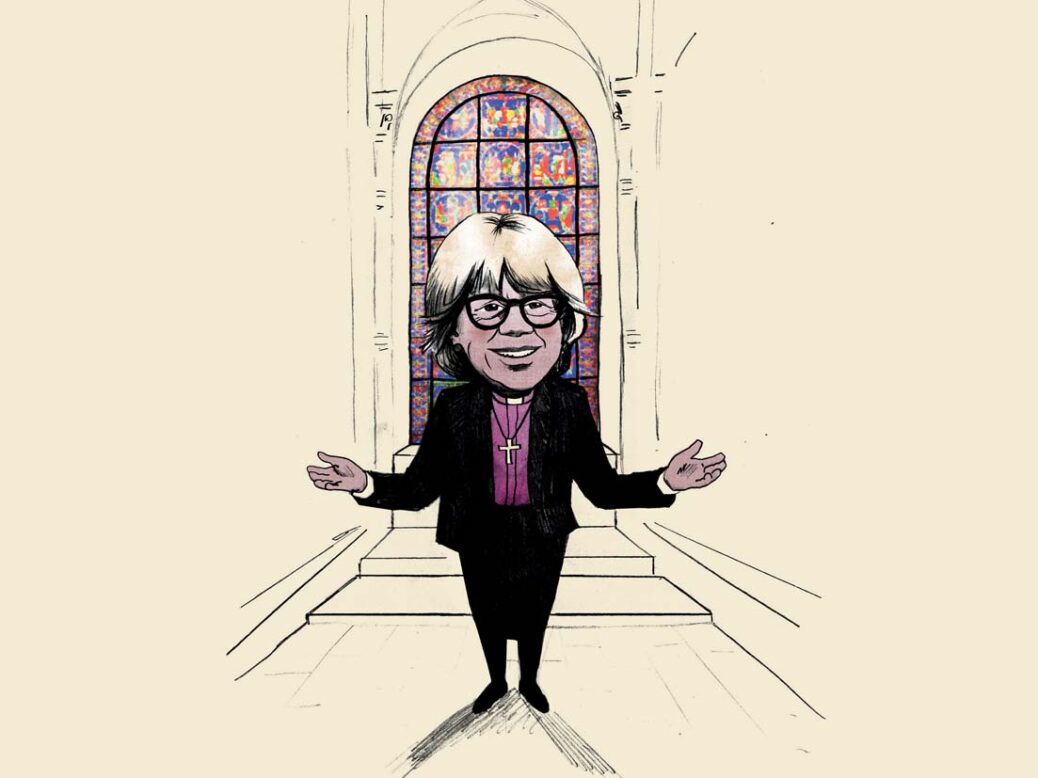
The news that Sarah Mullally had been named the next archbishop of Canterbury, the first woman to hold the post, did not make the front pages when it was announced on 3 October 2025. These were instead populated by the news that an Islamist terrorist had killed two people at a synagogue in Manchester on Yom Kippur. This fact serves as a reminder that she takes up her post as head of the established church at a febrile time, one in which armed guards stand outside Jewish schools and more than half of the population believes Islam is incompatible with British values. Speaking at Canterbury Cathedral after her appointment was announced, Mullally described a nation that was “wrestling with complex moral and political questions… witnessing hatred that rises up through fractures in our communities”.
If the nation is divided itself, so too is the Church. It remains mired in seemingly unending debates about women in leadership, gay marriage (on which Mullally’s more liberal position is condemned by conservative Anglicans overseas as “unbiblical and revisionist”), and the future of the centuries-old parish system, at a time when some question whether innovation is required to ensure growth.
The office Mullally now holds is much depleted in terms of power and influence, in a country in which the Church of England’s worshippers make up less than 2 per cent of the population. A YouGov poll carried out on the day of her confirmation in January found that 73 per cent of respondents “did not care” about the CofE.
The humbling of the Church is part of a wider trend, tracked by the American sociologist Robert D Putnam, who has warned of the steep decline in membership of civic society organisations in the postwar period. Levels of trust in public institutions are falling in the UK and around the world. Recent scandals – including that which toppled her predecessor, Justin Welby – have not helped matters.

Against this backdrop, the ceremonies that accompanied Mullally’s enthronement on 25 March might have felt antiquated and peripheral, rather than momentous. They include her paying homage to the King – an acknowledgement that the monarch is the “Defender of the Faith and the Supreme Governor of the Church of England”. Yet they are also a reminder to the public that England remains a country with an established church, in which bishops sit in the Lords and schools are required to offer a daily act of worship of a “broadly Christian character”. That each of us belongs to a Church parish, with a priest responsible for the cure of our soul.
Despite these challenges, Mullally takes office in more interesting socio-religious times than those navigated by Welby; there is increasing tolerance for conversations about the value of spiritual belief. But this terrain is not without peril. The growing interest in Christianity is tinged with something darker. Mullally was enthroned amid calls for a more pugnacious national church, and warnings that Islam is filling the vacuum created by its failure to assert itself, and Christianity, as the nation’s inheritance. The Church’s leadership is already grappling with how to respond to the shouts of “Christ is King” at Tommy Robinson’s Unite the Kingdom marches. At a recent conference in Oxford, the conservative writer Mary Harrington diagnosed the revival of interest in spiritual matters as evidence of “the breakdown of the material preconditions for modernity”. This was, she suggested, “at least as frightening as it is welcome”.
In her acceptance speech at Canterbury Cathedral in October last year, Mullally spoke of how “in an age that craves certainty and tribalism, Anglicanism offers something quieter but stronger: shared history, held in tension, shaped by prayer, and lit from within by the glory of Christ”. She leads a church that, in the face of gloomy op-eds about its increasing irrelevance, still feels it has something to offer the nation. Is England listening?
Sarah Mullally was born in Woking in 1962, the daughter of an electrical engineer and a hairdresser. She attended a state school, before completing a nursing degree at the Polytechnic of the South Bank. She came of age in Thatcher’s Britain, amid rising unemployment, strikes and recession. She was 25 when the “Faith in the City” report, commissioned by the then archbishop of Canterbury, Robert Runcie, warned of “smouldering anger and quiet despair” in urban areas (it was denounced as “pure Marxist theology” by one cabinet minister). Jack Guinness, whose father was the vicar of St Stephen’s in Lambeth, where Mullally worshipped from the ages of 18 to 39, recalled in a recent piece for the Times the level of need on the parish doorstep and the impact of the Brixton riots of 1981. John Sentamu, who would go on to become the archbishop of York, had fires lit outside his vicarage.
In the years in which Mullally worshipped as part of this evangelical, multicultural congregation, she was working her way up the nursing profession. Her first appearance in the Church Times was in an advert for chaplains at Chelsea and Westminster NHS trust, where she served as director of nursing. In 1999, at aged 37, she was appointed the chief nursing officer – the youngest person ever to hold the post. She was ordained in 2001 and left the NHS to serve the Church full time in 2004.
Much has been made of this background as a nurse – including in her own speeches. “Washing feet has shaped my Christian vocation as a nurse, then a priest, then a bishop,” she told Canterbury Cathedral upon her appointment. Two decades on from her departure from the Department of Health, her interventions in the Lords have consistently returned to the NHS. During the Covid-19 inquiry, she drew attention to the fact that the Bangladeshi population had a death rate around five times higher than that of the white British population. More recently, she has proved a robust opponent of the Assisted Dying Bill on the grounds that it is both unsafe and unethical. It would, she warned last year, “signal that we are a society that believes that some lives are not worth living”.
While no class warrior, Mullally is the product of state institutions – in contrast to archbishops of Canterbury who have gone before her, the majority of whom were privately educated – and has spoken of being conscious that “I don’t necessarily always see people like me in the roles that I’ve done”. Christine Hancock, who was general secretary of the Royal College of Nursing when Mullally became chief nursing officer, told me: “I think nursing gives you that classlessness. Your patients are… from wildly different backgrounds and yet they’ve all got the same issues… The mass of healthcare in this country is classless.” In wards, as in pews, all are equal.
Welby – who was, before being ordained, an oil executive – was often accused of imposing a managerial, corporate model on the Church. He commissioned the Conservative peer Stephen Green (a former CEO of HSBC who is ordained in the CofE) to lead work on the “talent management” of future leaders in the Church. Bishops attended a leadership-development course with content such as “applying concepts around value creation, value destruction and resource allocation” to ministry. Dioceses were asked to bid for grants from a £198m “strategic development funding programme”, which became, in the words of the economist asked to evaluate it, a “lightning rod” for a lack of trust within the Church.
The extent to which Mullally will seek to dismantle Welby’s programmes remains unclear. The historian George Owers, an Anglican convert, has dismissed her as the “lanyard-class archbishop”, a disappointment for those who hoped for “a spiritual big-hitter who could speak a more traditional, uncompromising language, tone down the Church of England’s invariably progressive mood music, and challenge [its] creeping culture of bland managerialism”.
At times, Mullally seems more interested in pragmatism and the “front-line” work than in lofty mission statements. She has spoken of wanting to “roll up my clerical sleeves” and get to work. “As a nurse, I’m used to fixing things,” she told Premier magazine. “If you give me a problem, I want to help you fix it.” She has been unapologetic in pointing out dysfunction in the Church where she sees it. “In the NHS, I was clear to whom and for what I was accountable, and I was supported, challenged and appraised by them,” she wrote recently. “I have gazed into the heart of the Church of England and found, at its core, incoherent governance structures, in which a number of bodies that need desperately to be joined up are free-floating.”
The work she has done to date, chairing the Church’s funding planning group and recommending widespread changes to structures and roles, mark her out as an enthusiastic reformer of systems. She was not among the bishops who criticised Welby’s approach during his tenure. But she has secured the support of figures such as Marcus Walker, chair of the Save the Parish campaign group, who has praised her for securing increased funding for parishes in deprived parts of the country.
Those who disliked Welby’s “meddling” in political affairs will not be mollified by her. In 2022, when bishop of London, she suggested the Conservative government’s immigration policies had been “successful in at least one respect”: “they have created a real sense of fear and dread among migrants of approaching the authorities”. She also chastised Rishi Sunak’s government over its anti-strike legislation, and in December firmly rebuffed Conservative MPs critical of the Church’s £100m fund for communities affected by the historic transatlantic slave trade.
But Church history gives the lie to any suggestion that such interventions are a departure. There was a time when the pronouncements of the archbishop of Canterbury were more thunderous in tone and more perilously undertaken. Canterbury Cathedral was the site of the murder of one of Mullally’s predecessors, Thomas Becket, in 1170, following a conflict with King Henry II over Church rights. In England, Christianity has always been political, from its earliest missions to convert its rulers to its role in shaping the country’s laws, and tensions over land, wealth and power.
At Mullally’s installation at Canterbury Cathedral, she became the first ever woman to be enthroned as archbishop, following in the footsteps of the 105 men who went before her. Her appointment has prompted talk of women in the Church “breaking the stained-glass ceiling”. In a recent interview with the “Gogglebox vicar” Kate Bottley, Mullally described her nomination as “the result of all those men and women who faithfully campaigned for the ordination of women”.
The Church has always offered women a route to independence and autonomy, in part as an alternative to marriage and motherhood. Medieval abbesses were revered for their learning and piety. The priesthood, however, is another thing. When Mullally began her nurse training, the day when women would be permitted to be ordained was 14 years away – their admittance to the episcopacy, another 20.
Mullally has been candid about the sexism she has encountered in both the NHS and the Church. In 2003 she told a conference that “sex kittens, angels, domestic workers and handmaidens” were still the enduring media images of nurses. In a recent interview with the dean of Southwark, she described having become “guarded” – accustomed to people choosing not to receive the Eucharist from her, or sniping at the back of church. She once wept at the podium of the General Synod, the Church’s governing body, recalling the “micro-aggressions” she has experienced. In a blog discovered by the Times some years ago, Mullally recalled a man seeking her out “to tell me that I was a ‘vile sinner’ and that I would be condemned to a life without God” for being a female priest. She is, she has written, “always cautious of poorly handwritten envelopes”.
Many large churches within the Church do not accept women’s ordination, let alone their elevation to the episcopacy. Mullally now leads an institution that is committed to including within its embrace those that reject the theology that has enabled her appointment. Documents produced by the Church’s leadership describe how “arrangements” may be made for “those whose theological conviction leads them to seek the priestly or episcopal ministry of men”. Churches that do not believe in women in leadership can request that only men are appointed as their clergy and that a bishop who shares their theological convictions ministers to them. This is not an insubstantial number. As bishop of London, Mullally led a diocese in which around 17 per cent of the parishes had opted for “episcopal oversight” from male colleagues, including two of the largest evangelical churches in the country. Her navigation of this is regarded as a success story.
Though the division over women in leadership remains, the lack of opposition to Mullally’s appointment on the basis of her sex – few have threatened to leave the Church – represents a “massive shift in the culture, to an extent brought about by the reality of women in ministry, which has become much more ordinary”, says Emma Percy, a senior lecturer in feminist theology and ministry studies at the University of Aberdeen. But there is another way of reading the times, she suggests. “In a lot of spheres of life, when [roles] become less important is when women can get to take the big jobs… There is a sense in which it is as a role it has less significance and therefore in a sense people aren’t fighting for it.”
It may also be an indication that those likely to leave the Church over the ordination of women have already done so. The Global Fellowship of Confessing Anglicans, a group of conservative Anglican churches established after the Episcopal Church in the US ordained a gay bishop, has described Mullally’s position on homosexuality as “more concerning” than her womanhood.
Mainstream media attention is likely to be focused on Mullally’s safeguarding record, which came under intense scrutiny in the wake of her nomination – coming, as it did, after Welby’s unprecedented resignation in the wake of the Smyth scandal. In 2020, while Mullally was bishop of London, Alan Griffin, a rector in the City of London, took his own life while under investigation over unfounded allegations of child sex abuse. Griffin was not accused by an alleged victim. Rather, his name was on a list of 42 clergy included in the “Two Cities” report, a sort of handover document written by a former head of operations in the diocese, detailing various allegations of misconduct. Mullally claims she received the report but hadn’t read it, instead trusting the safeguarding team to discern what was hearsay and what demanded further investigation. While there have been suggestions that her gender and nursing background would make her handling of abuse more empathetic, some survivors remain highly critical of her approach.
Percy’s hope is that Mullally will bring “authenticity and passion” to the role. She fears that in the Church of England, “we’ve pushed Anglican blandness to a very strong level”. She would like to hear the new archbishop speak in a way that resonates with Britons who would never ordinarily enter a church, and makes them appreciate that “this is a woman who has held the beginnings of life and the ends of life in her hands”.
The health service that has played such a foundational role in Mullally’s life has also shaped that of her Church. In Christianity and Social Service in Modern Britain (2006), the late American historian Frank Prochaska argued it was once the part played by the Church in ensuring the nation’s welfare that made it “relevant”. When they welcomed the advent of the welfare state after the Second World War, Prochaska wrote, the Church’s leaders “failed to appreciate the consequences of endorsing a collectivist, secular world without redemptive purpose”. The CofE was no longer crucial to meeting the practical needs of many, and instead faith became increasingly “a private matter of individual conscience”.
Today, Mullally leads an institution that – though it remains the nation’s established Church – is dramatically less representative of that nation than in earlier centuries. Congregations are ageing, churches closing and the public’s attitude towards the Church is best described – its national lead on evangelism concluded a few years ago – as “benign indifference”. While attendance is slowly ticking upwards, the scale of the decline over the decades is precipitous, falling by around 40 per cent over the past 30 years.
Antithetically, Mullally also takes office at a time in which the country has shrugged off the hostility to Christianity so prevalent in the heady days of New Atheism. As John Curtice recently observed, “the long-term decline in the proportion who identify as Christian, or indeed with any religion, has seemingly come to a halt”. If she can shake off in the mind of the public the baggage of the Church she represents, Mullally might find an audience more tolerant of and open to Christian teaching than her recent predecessors.
This is a difficult task in a Britain in which it is bishops’ political interventions, rather than their theological reflections, that are seized upon by the media. It is easier to talk about foodbanks than Christ being the bread of life. Recent polling by Whitestone Insight reveals the seemingly contradictory attitudes held by the public, with 52 per cent believing that “if Britain continues to move away from its Christian roots, it will be to the detriment of future generations”, but 41 per cent asserting that “Christianity should only ever be a private matter with no influence on public life at all”. Sixty per cent agreed that the country had “lost any meaningful shared sense of what is right and wrong”.
The assisted dying debate has brought back to the public sphere serious, ethical conversations about life and death, and the extent to which humanity should rule over both. Perhaps now is indeed the right time for the national Church to have appointed as its head a woman who has, in her own words, “sat with people in the final hours of their lives” – as both a nurse and a priest.
The NHS was once described by Nigel Lawson as “the closest thing the English have to a religion”. Today, the health service, like the Church of England, faces a deep crisis of public confidence. Might Sarah Mullally, who embodies both these national religions, be uniquely placed to minister to England’s weary soul?
[Further reading: It’s better for a church to become a mosque than a shell]
Content from our partners


Related

Join the debate
Subscribe here to comment“Might Sarah Mullally, who embodies both these national religions, be uniquely placed to minister to England’s weary soul?”
I’d very much prefer not to be ministered to or nursed by anyone who needs to believe in imaginary supernatural beings, and who thinks that their personal delusions should a priori allow them to dictate that an adult of sound mind suffering with a terminal and painful illness can’t make their own decision on whether or not to prolong their own life.