
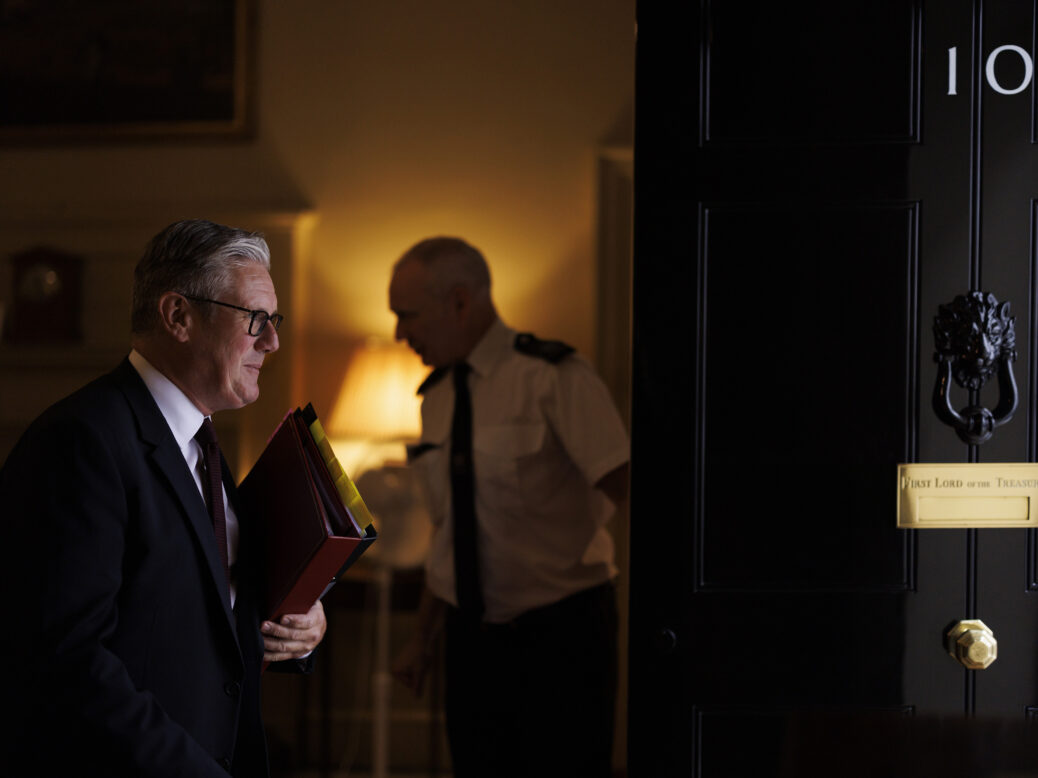
It was time for change and the country united behind the leader who could deliver it. They win a landslide. But within a year it all crumbles into dust. The only conversation is who will lead us next? But that’s enough about Boris Johnson, what now for Keir Starmer?
This is the new conundrum of British politics. Twice in a row parties that have been gifted big parliamentary majorities, which in normal times would guarantee governing stability for two full terms, have descended rapidly into chaos. The answer lies somewhere in the triumvirate of foundations, factionalism and fragmentation. Let’s explore them.
It now goes without saying that our political and democratic structures and culture simply cannot cope with the complexities and challenges of the 21st century. A linear, predictable and therefore largely controllable world has given way to one that is messy, unpredictable and therefore largely uncontrollable by conventional means. The crisis of governance is then compounded by the crisis of economics. The post war model of near-guaranteed growth and shared returns between capital and labour has long broken down. Highly concentrated pockets of tech and finance wealth produce private fiefdoms of political power that lobby successfully for the conditions to become wealthier still. In the absence of firm economic and democratic foundations, in a world where people feel their lives are both poorer and beyond their control and even their government’s control, they are increasingly prepared to roll the dice in a very different direction.
As a cog in the wheels of New Labour back in the mid-90s, I witnessed at first hand a serious political project which had a deep feel for modernity and Britain’s place in it; a systematic sense of political economy in the shape of supply side reforms and an approach to state governance through new public management. It was topped off by vision, charisma, ambition and drive. And all this in the most benign economic and social context in which there were few distributional problems and little social polarisation. (We didn’t know that the flames of both were being fanned.)

Now, in the most malign economic, social and environmental circumstances, Starmer thought he could run the country better by just being a grown up and rolling up his sleeves. He would deliver better public services and economic growth simply by saying he would. Sadly, it would prove to be delivery without a vehicle and growth without an engine.
There is no going back to the long 90s. That time has gone. Today we need new and deep thinking about how to run a complex 21st-century economy and state, but more importantly, how to negotiate the cultural and political complexities of 21st-century society. Without these foundations, as we are witnessing, any political project sinks.
This takes us to factionalism, or more precisely, hyper-factionalism. What has happened to the Labour Party since 2020 is unprecedented. The party has in effect been hijacked by tiny vanguard of very right-wing activists who are as effective at internal party control as they are dangerous. Going back to 2015, under the auspices of the ironically named Labour Together, Morgan McSweeney and his wealthy backers hatched a plot to return the Labour Party to their rightful ownership. While Tony Blair, Peter Mandelson and Jonathan Powell were preparing the lifeboats of the second referendum campaign to set up a new centrist political party, McSweeney and his allies had another plan.
For them leadership of Labour was the means, the end was the total eradication of the left. They wanted to ensure nothing like Corbynism or even Milibandism could happen again. And that’s where the problem started. McSweeney had what he later briefed was a three-phase strategy: first to win control of the party, second to use that control to eradicate the left and third to win and govern the country.
But their raison d’être was and still is the eradication of the left. Like being stuck in some early Freudian developmental stage, they can’t seem to progress to a higher purpose. And any means would justify their low ends of outright party control – the lies, the coercion, the promises broken, the fixing. The hidden purpose of Labour Together was to tear Labour apart.
For a long time only the left cared. What mattered to everyone else was beating the Tories and getting the “grown-ups” back in. Political normality would be restored. But when you stand and win on a platform of Corbynism without Corbyn and then immediately trash the policies and people that got you elected, you build a cage from your victory in two ways. First you poison your own claim to honesty. Starmer’s leadership election direct mail letter to members in 2020 had printed on the envelope “contains Integrity; Authenticity; Unity”. You can’t win on cynical lie and expect it not to come back and haunt you and sink you. And second, you deny yourself any deeper platform. The bitter irony is that a professionalised version of the Corbyn economic agenda is what our country needed and still does.
And to add to his weakness, Starmer’s leadership was bizarrely premised on the unique deal in which McSweeney picked Starmer as much as Starmer picked McSweeney. Never in the history of British government has an adviser held such equal and unaccountable power.
So, we are painfully finding out that people only skilled in the dark arts of party factionalism have few of the skills needed to run a country. Every promotion and demotion, every policy and initiative is calibrated through the lens of factional advantage. It is faction before party and before country. But in making the Labour Party safe from the left, they made it even safer for the establishment, just when establishment politics no longer worked. This is why Reforms vote has more than doubled since the election, and Labour has halved.
Factions are necessary features of the contestation of ideas and personalities within all political projects. But the hyper-factionalism of the Morgan Tendency is now destabilising the government, paving the way Farage and Reform and destroying Labour. And it goes back to the fundamentals – a total lack of intellectual curiosity and imagination because ideas are associated with the left and are therefore by definition bad. It leaves government by desiccated technocrats. Politics for them is only about the unhindered administration of what is, but in a stubborn world that won’t submit to their command-and-control nostrums it’s a sure route to failure. You can bully and boss a party for a while, especially one desperate to win. But you can’t bully and boss a county.
And this is the big problem. A progressive future can only be negotiated, not imposed. By cutting off every other voice other than your own small clique you deny yourself the oxygen of ideas, constructive criticism, essential feedback loops and eventually accountability. One-sided politics means blind-sided government. And in your isolation the power goes to your head. It is a recipe for ossification. It also unnecessarily alienates the very people who should be your supporters, there for you when the going gets stuff. People coerced to self-censor in the hope of advancement, or the very least the avoidance of punishment, will only resent you. A project that is so narrow, brittle and mean-spirited inevitably has a short shelf life. The recent re-shuffle further right shortened its life.
And so finally we come to fragmentation. 1951 was the high point of the two-party system, when Labour and the Tories soaked up 98 per cent of the votes cast. There have been blips when the duopoly has reasserted itself around temporary issues or leaders, like Boris and Brexit, and Starmer kicking the Tories out, but the trend in vote share is remorselessly down. Despite a voting and parliamentary system purposely designed to prop up a government and an official opposition, a multiparty reality keeps encroaching. In 2024 Labour and the Conservatives got only 57 per cent of the popular vote between them on a turnout of under 60 per cent. Today the polls show less than 40 per cent combined. Instead of two parties we have five competing for seats in England and six in Scotland and Wales. With the independents, a potentially (or maybe not) energic new left party and revitalised Greens, it’s a very different and challenging terrain from the past.
Because of the scale of party competition in a first past the post system, parties can win on a tiny fraction of the vote. It leads to electorate chaos. Labour, we know, secured 65 per cent of the seats on only 34 per cent of the vote last summer. This is a numerical mandate, not a moral one. If everything in the economy and society was going swimmingly then this would barely register. But the cost-of-living crisis and issues like small boats have focused people’s attention on seeming governing failures, combining to create a crisis of legitimacy.
All these reasons help to explain why a government can have a huge majority but no authority. So, what happens now?
It feels too late for Starmer to build the intellectual and cultural foundations to sufficiently reset the party, the government and the country. The problem is not just the absence of intellectual and cultural foundations; it’s the fact that they don’t think intellectual and cultural curiosity are essential facets of leadership. Starmer famously remarked that “there is no such thing as Starmerism” and there never will be. With no Starmerism there can be no Starmerites and no one to draw on. Right here is the self-confessed reason this project could never work. He never did his homework and didn’t see why he should. Like any good barrister he would judge every decision on a case-by-case basis. That fundamentally misunderstands how politics works. He once exclaimed to the Economist that “I just want to get things done”, without knowing why or how.
Starmer and Corbyn have something important in common – they’re both accidental leaders. Corbyn was only supposed to give the radical left a voice in the 2015 leadership election. He wasn’t meant to win and had few of the skills to lead. In 2020 Starmer was only meant to be the bridge out of Corbynism before handing the party back to the “grown-ups”. He wasn’t supposed to win in 2024 and wasn’t ready to lead either.
Without a lodestar, lacking any serious and deep political economy, devoid of a theory and practise of how we govern the state and public services, with no sense of the culture to build and sustaining long term political coalitions and alliances, relying on patronage not purpose, there is only the politics of surviving the day. Starmer is the latest but least qualified leader to manage Labour in its most heightened moment of crisis.
This is not some cry for instant transformation. I don’t believe just switching leader will make everything right. What the party and the country needs is the calm radical realism of purpose, direction and operational know-how. We don’t want for policy ideas, nor a country thirsty for big change. What we lack is the ability at the top to tell a convincing story of what our country is and could be – someone who knows it’s their job to build coalitions not just within Labour but across the progressive spectrum to counter the looming shadow of a united hard and far right. Key to this is support for proportional representation. Labour needs the most left-wing viable leader, who understands that countervailing forces in society are essential if people are to shape capital rather than let capital shape them. There are still more three years to get this right. There is never a perfect leader, but the times demand someone who is at least good enough.
For Labour the future looks fragile. Without a reset the high net worths, the membership and the unions will desert them. But worse, the party’s reputation for fairness, for any heart and any soul, will have been lost. Possibly for good.
This week we lost the liberal Hollywood icon Robert Redford. At the end of his celebrated political film The Candidate, the beautiful but vacuous election victor asks his advisers: “so what do I do now?” Indeed Keir, indeed!
[Further reading: Labour vs the left]
Content from our partners

Related

Join the debate
Subscribe here to comment