
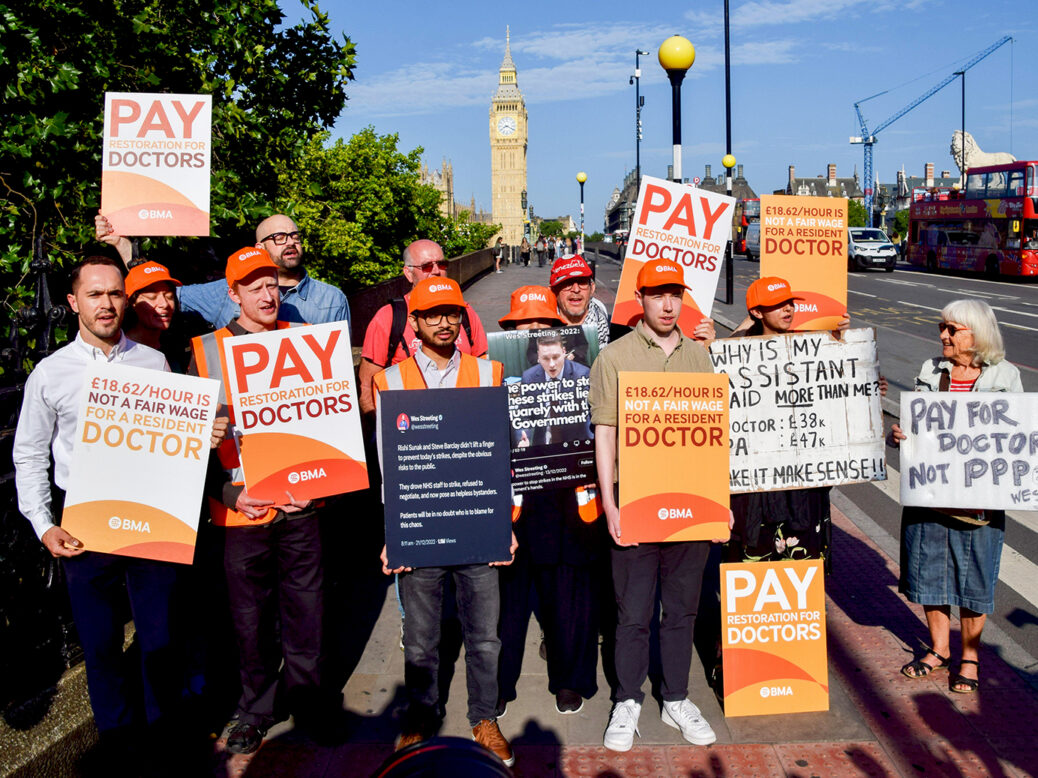
Resident doctors have today begun a five-day strike over pay. Wes Streeting has said he will try to keep disruption to a minimum, but previous strikes in 2023 led to more than a million appointments being cancelled. The doctors’ union, the British Medical Association (BMA), is asking for a 29 per cent pay rise for resident doctors, who have so far received an uplift in pay of almost 30 per cent since 2022-23, according to the Nuffield Foundation.
That sounds like a lot. Are resident doctors (formerly known as junior doctors) being reasonable?
The BMA says this is a question of “pay restoration”; salaries have not kept pace with inflation, and a newly qualified hospital doctor is now paid significantly less, relative to the price of everything else in the economy, than they were in 2008. There are lots of ways to slice the data. Starting at 2008 gives the biggest possible drop in real-terms pay, which is why the BMA is using it for its negotiations. It also uses the RPI measure of inflation, because it says student loans grow by RPI (which is true, but RPI is also, conveniently, higher than the inflation measures used by everyone else). However, it is still true to say that doctors’ salaries have reduced in real terms since the peak of their pay growth in 2008.
To give a sense of by how much, the numbers start to change: institutions such as the Institute for Fiscal Studies and the Nuffield Foundation prefer to measure from 2010, because that’s as far back as proper comparable data goes, and to use the more standard inflation measures of CPI or CPIH. Doing so still shows doctors’ pay being compressed, even after the recent rise, by somewhere between 4.1 per cent for those in core training and 10.3 per cent for those in their second foundation year.

Some critics of resident doctors point to their generous pensions – the NHS contributes a further 23.7 per cent of their salary to their pension – but this is just another part of their salary; it too can be compressed by inflation.
The problem I see in the BMA’s logic was revealed by a series of adverts the union created in 2023, which claimed that resident doctors were paid less than people who make coffee in Pret a Manger. “You can make more serving coffee than saving patients,” the ads read. This was a misrepresentation. In reality, Pret workers could have made up to £14.10 an hour if they got their full bonus and location allowance, while a first-year junior doctor could have been said to be making as little as £14.09 per hour if only their basic wage was counted across a 40-hour week. In fact, a first-year foundation resident doctor was on average taking home considerably more (their average pay when the ads went out was more than £37,000) than a barista.
But that wasn’t the most revealing thing about those ads. More important was the outrage they implied: it was presented as shocking that a mere milk-frother should be paid an amount comparable to a doctor (although, to be clear, they weren’t). Shocking, and counterintuitive: surely being a doctor is a better career than being a barista?
And, of course, it is. Walk into any Pret and ask any member of staff if they would like to have the job security and pay progression that are effectively mapped out in the career of a doctor. All of them would. The BMA would argue that doctors earn this by spending a long time getting very expensive qualifications, then doing a hard and socially useful job. Which is true. But it’s also well rewarded by the standards of the wider economy. It is still true there is no degree that pays as well as a medical degree five years after graduation.
The barista, after a year, might be paid more if the minimum wage rises. The foundation year one doctor (average pay £43,400 according to Nuffield) will receive a significant pay increase because they are now a foundation year two resident doctor with a different pay scale (average pay £51,600), and then they will enter core training (£67,400).
This is one of the issues with using inflation as the main negotiating point. It is true to say that the average wage of a doctor at a given point in their career is lower in real terms than it was in the past. But this does not mean that a given doctor is actually being paid less. Data collected by the Office for National Statistics from 2003 to 2017 suggests that, on average, fewer than one in five British workers are promoted each year. So while the BMA can argue that the average British worker has achieved pay restoration while newly qualified doctors haven’t, lots of people remain average British workers for their whole working lives, while doctors don’t remain newly qualified.
The other issue is that inflation is not the same for everyone; it matters less the more you are paid. No full-time doctor makes less than the median wage, even in their first year after qualifying, and their pay progression is rapid from that point; by the sixth to the eighth year after qualifying they are typically making around double the median wage. A GP partner on £160,000 a year experiences inflation very differently to a supermarket worker or barista on £25,000 a year. Lower-income households spend more on essentials, and the lower your income, the more of the price of your consumption is affected by the cost of energy and materials (basic foods such as pasta and vegetable oil increased more sharply in 2022, for example, doubling in price in some cases). People on higher incomes are much more likely to have savings – which benefit from inflation. By using inflation (and the highest inflation measure) to justify its pay demands, the BMA is pretending doctors are just like other people, but they’re not.
This doesn’t mean doctors don’t have a right to be annoyed about the compression of their pay. As I’ve written previously, our tax system disproportionately raises money from people in exactly the sort of pay brackets doctors are in, with some very high marginal rates, while they have very large student loans to pay off and their salaries no longer have the same power in the housing market. Their story is part of a wider story of the middle classes in Britain remaining fairly static in real earnings while people on lower incomes rise to meet them and the pay of a small elite takes off. And in that sense the doctors’ strike, while its numbers may be debatable, augurs something very real and more widespread: the creeping spread of middle-class rage at the disappearing prospects of professional life.
This piece first appeared in the Morning Call newsletter; receive it every morning by subscribing on Substack here
[See also: Keir Starmer is no politician – but this could be his strength]
Content from our partners



Related



Join the debate
Subscribe here to comment