
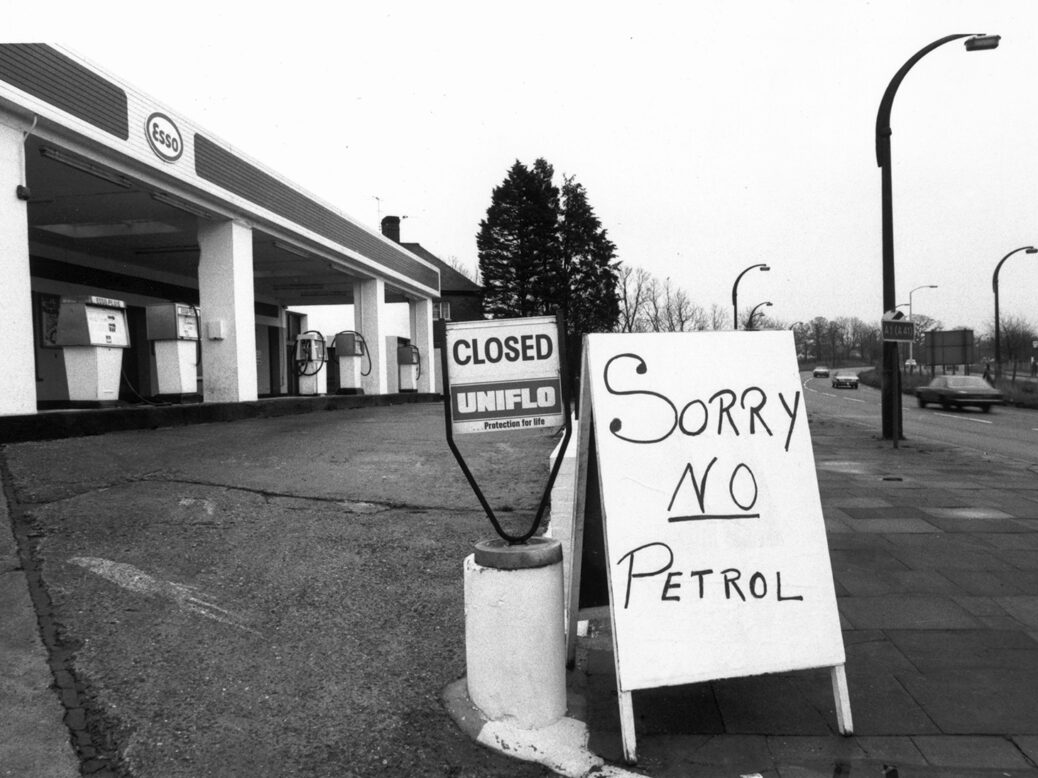
The Chancellor is grappling with the ramifications of a war in the Middle East which has created an inflationary spike and fuel shortages. The political class are anxiously watching economic graphs. There are three words that keep popping up in Whitehall, parliament and the newspapers. Not “cost of living”. The three words are “balance of payments”. The year, you can already guess, is 1976. The embattled Chancellor is not Rachel Reeves, but Denis Healey. A cap, a hand, and the rest is history.
The Sterling Crisis and IMF Loan of 1976 are perhaps the most misunderstood economic events in recent British history. Columnists and politicians love to reference them, particularly in reference to the current Iran crisis and our own beleaguered Labour government. But they barely understand the events they’re describing. The point is not that our current crisis is the same as then, despite some passing similarities. In fact, in many ways, the current crisis is worse than 1976.
The reason why is simple. We cannot afford our current standard of living. We do not produce enough of what we want – or enough of what the rest of the world wants – to pay for the things we cannot produce ourselves. Add on top of that a global economic crisis, like the US-Iran war, and the economy begins to buckle. As the world scrambles to secure fuel supplies, food, fertilisers, plastics and other essentials in its wake, we will struggle to secure our own supply. Even if we do so, we will have to sell off more of our businesses, our property, our future tax revenue to pick up the bill.
We have allowed ourselves to get into this position by forgetting the iron law of international economics: every country must pay its way. Ensuring this was the goal of politicians like Jim Callaghan and Healey. This is what maintaining our balance of payments meant in practice. It is the very heart of what it means to deal with the cost of living. And it has been forgotten by our current political class.

For 40 years, this issue has been banished from politics. Our economy is based on the myth that we can enjoy, in perpetuity, a free lunch. A lunch paid for by the savings and credit provided by the rest of the world to feed our insatiable appetite for new goods and services. It is a belief in consumption without consequence. The US-Iran war is not the cause of the crisis; this naïve attitude to trade is the cause. The war is just another shock to a decrepit system.
At its simplest level, the balance of payments is the sum of all the resources that we export to the rest of the world minus all the resources that we import from the rest of the world. This includes everything among the goods and services we consume every day, from the food we eat to the films we stream. However, it also includes the money we borrow from abroad and the dividends we earn from overseas investments, as well as a host of other financial flows.
If your economy is in balance, it means that for everything you draw on from the rest of the world, you are providing something of equal value. This does not represent a like for like exchange. We need refined oil for transport, but we can export accounting services to pay for it. If your economy is in surplus, like Germany’s, it means that the rest of the world is consuming more of your resources than you require from them. What you do with that surplus is up to you. You can save it for a rainy day, repay your debts or invest in your productive capacity. General government debt in Germany has fallen from 81 per cent in 2010 to 64 per cent today. This gives Germany much more flexibility in dealing with shocks and is funding a huge rearmament programme to deal with the growing Russian threat.
If your economy is running a balance of payments deficit, like Britain, you can do two things. One is devaluation. This is why the pound is now worth a sixth less than it was before the financial crisis. This pushes up prices at home for everything that we import, particularly food and fuel, and is part of the reason we all feel so poor. The other mechanism is more insidious: selling your assets to the rest of the world. It’s why from utility companies to iconic brands, 40 per cent of British business is foreign owned. It’s why a third of all government debt is in foreign hands. Politicians who celebrate our record levels of foreign direct investment do not understand that what they are actually cheering is the destruction of British capitalism. It is like selling your home to pay for weekly shop and claiming it is financial genius.
Callaghan and Healey knew what was needed to respond to geopolitical shocks like those of the 1970s: increased production. The classic, mistaken, story is that the IMF Loan was caused by government profligacy. This was not the case. The British state had increased spending in the first half of the decade, but mostly to hold down wage demands through greater provision of social security and public services. The government overcorrected in trying to improve living standards during this period rather than a more realistic policy of maintaining living standards at pre-1973 levels. However, government spending was not out of line with other European countries and was lower than West Germany which did not require an IMF Loan. The issue was the sudden jump in the prices of imported goods, particularly oil, which doubled the cost of imports in just three years.
The accepted wisdom was that the only way to pay this new world of higher oil prices was to boost our productive capacity, which would reduce oil imports and increase national income to pay for more expensive imports while reducing the impact of future shocks. They accelerated production of North Sea oil not just to meet domestic consumption but to generate export revenues to balance our trade. Labour also shifted resources towards industry and away from public spending, with industrial production increasing by 12 per cent in just three years between 1976 and 1979. This helped to turn the economy around. Britain went from a £1bn balance of payments deficit in 1976 to a £5bn surplus in 1981. We had gone from living off the kindness of strangers to standing on our own two feet.
The irony is that today’s Labour politicians remain trapped in the intellectual framework of Thatcherism, a philosophy they claim to reject. In her 826-page memoir, The Downing Street Years, Thatcher references the balance of payments only once. The reason why she gave it so little attention is obvious. It would have been impossible to have implemented her political programme if she had been forced to run a balanced trade policy. Rolling back the frontiers of the state required a new politics of consumer consumption fuelled by cheap debt and tax cuts to keep her core vote happy enough to ignore mass unemployment and deindustrialisation. Speaking about the overheating economy of the late 1980s, she let the mask slip, writing that persistent balance of payments deficits “worried me because it confirmed that as a nation we were living beyond our means”. Yet, under her leadership and ever since, we have been doing exactly that.
This is not simply an abstract accounting exercise. In the wake of the Iranian conflict, the IMF predicts the UK will run a balance of payments deficit of 3.4 per cent of GDP in 2026 – equivalent to £115bn. This means that we are sending the equivalent of nearly £4,063 per household overseas to pay for our imports, cover our debts and provide returns to overseas shareholders to avoid rampant inflation. If we had a balanced economy, this is money that could be spent on domestic investment, rebuilding our energy infrastructure or investing in new industries. It would give government far more wiggle room to support households and help shield the most vulnerable.
The real rollercoaster is not fossil fuels, but our international financial position. This has left Britain at the mercy of the great trade blocs in Washington, Beijing and Brussels. It is why we are in hock to the bond markets. Tragically, Labour did have a plan in opposition to boost domestic investment by £28bn a year, quadrupling government capital investment, through a green investment plan. It abandoned this radical agenda and according to the OBR, government capital investment will be just 0.1 per cent of GDP higher by the end of the decade.
Business investment is falling, further reducing our productive capacity. Focusing purely on green technology was a mistake. We cannot just live off green technology. We need to boost production across the board, including fossil fuels, critical raw materials, machine tools as well as high-value services. However, the principle of shifting resources away from domestic consumption towards investment was sound. The government needs to rediscover this boldness and embrace a new politics of production.
The alternative is to defend a status quo, a politics of consumption that is unable to deliver on its own terms. Despite the promise of endless growth, most people have experienced a 20-year cost of living crisis. Despite the promise of financial discipline, we are addicted to borrowing. Despite the promise of wealth, we have had to sell off large chunks of our economy to pay for day to day spending. The storm clouds darken with every new global shock. Only time will tell if the lightning from this Middle Eastern war brings economic conflagration – or some much needed political illumination.
[Further reading: Iran’s new ocean imperium]
Content from our partners


Related
Join the debate
Subscribe here to comment