
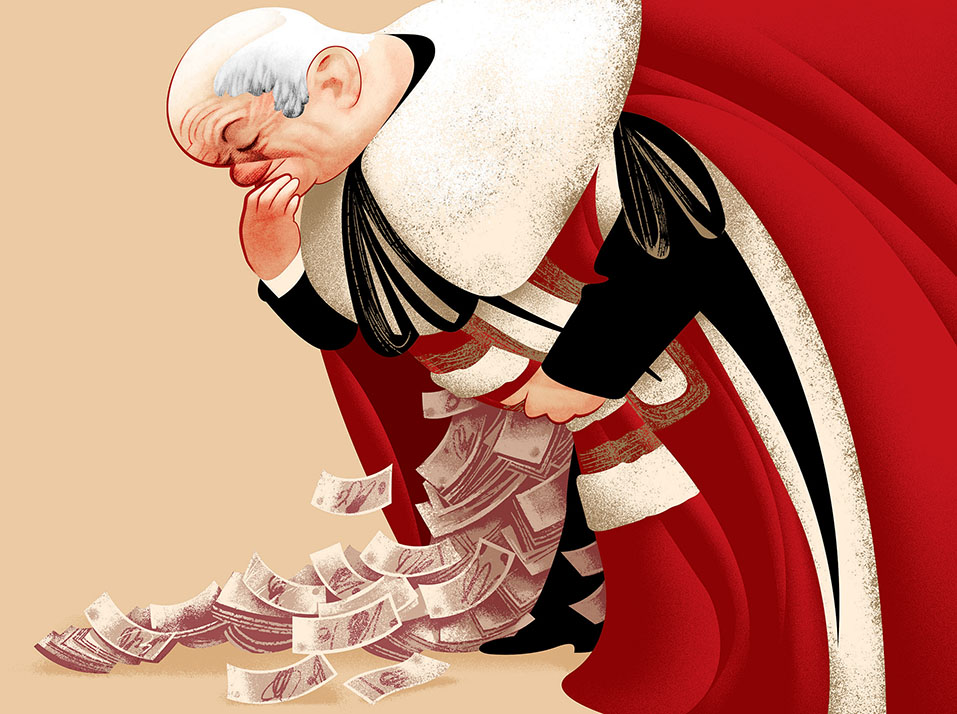
The clock inside the Moses Room had malfunctioned, but even in the House of Lords, where time oozes wearily along the corridors, a defective instrument may tell the right time twice a day. And so, when Lord Sikka rose to speak on the matter of political donations and asked: “Will any party rise to the challenge and rid us of inbuilt political corruption?” the gathered peers winced a little. Using a term like “inbuilt political corruption” in the House of Lords is dangerous territory; you could be talking about anyone, or indeed, everyone.
The debate in the Moses Room (so named because it has a massive painting of Moses on the wall) was an important one. Sikka, a rebel accountant who has long campaigned against corruption, warned that political donations are increasing and that the Electoral Commission does not have the means or the resources to understand who is really behind them. And yet beneath this debate on a threat to British democracy was another troubling question: where exactly was the democracy they sought to protect?
The Moses Room itself wasn’t exactly drenched in earnest representation of the people. What was really notable about this group expressing concern for democracy was how many of them had tried to enter parliament by democratic means, and failed. Baroness Taylor (Labour) stood in the 2010, 2015 and 2017 general elections; on every occasion the people of Stevenage declined to have her as a parliamentary representative. Labour’s Lord Sahota also tried twice to become an MP, losing to the Tories both times. The 84-year-old Baron Wallace of Saltaire (Lib Dem) tried to get elected five times in the 1970s and 1980s, and was unsuccessful every time. Baroness Blake of Leeds (Labour) contested, and lost, seats in the 2005 and 2010 elections, but her daughter is an MP, so close enough. Baroness Shah, co-chair of the Labour to Win group, ran against Iain Duncan Smith in 2024; she did not Win. They all got a position in parliament anyway, for life, via the Lords.
Many life peers bring a wealth of experience and expertise to the upper chamber. If you don’t have those things, though, you can always become a treasurer of the Conservative Party, a route taken by 17 current peers, a number of whom have coincidentally donated large sums of money to the Conservative Party. One of them, Lord Leigh of Hurley, reassured his fellow peers that “the Conservative Party undertakes due diligence checks on its donors” and considers their “reputational impact”. It’s great to know the Tories looked into the more than £2m donated by Lubov Chernukhin, the wife of Vladimir Putin’s former deputy finance minister, and said, “Mmmm, smells like integrity.”

Baron Watson of Invergowrie has – democracy alert! – been repeatedly elected, as an MP, then an MSP, in Glasgow, before becoming a life peer in 1997. In 2005, he swapped the Labour Party for another well-known institution, prison, after drunkenly setting fire to the curtains in an Edinburgh hotel. For a lord, however, that was far from a career-ender: he was readmitted to the party in 2012 and reassumed his title. As Lord Mandelson of Foy and Hartlepool might tell you, the peerage, like a Wetherspoons in Plymouth on a Thursday night, tolerates almost any behaviour and is embarrassingly difficult to leave.
Sikka’s suggestion sounded reasonable: if donations aren’t made to buy influence, surely donors won’t mind if they all go into the same pot and are shared out? This would put donors off, but doesn’t that just underline the principle that donations are an attempt to buy power? The state, he said, could cover the shortfall (it already pays “short money” to parties for parliamentary expenses). This was not what Lord Hannan, defender of the public purse, wanted to hear. It would cost “gazillions”, Hannan warned. It wouldn’t, though: the £50m a year (£100m in an election year) donated to British political parties is small potatoes in public spending terms, equivalent to building about a mile of dual carriageway.
Nevertheless, we should applaud Lord Hannan’s fiscal rectitude. Upon being elected as an MEP in 1999, he penned an op-ed for the Telegraph in which he wondered at the expenses he could claim as a member of a parliament that represented 300 million people, including – steel yourselves! – a daily attendance rate of £180. In the British parliament, he seems less concerned by the cost of Lord Hannan of Kingsclere, although he is rather expensive. My own analysis of Lords expenses data finds Hannan has claimed £240,629. Every time Daniel Hannan rises to speak, the taxpayer hands over, on average, about £1,000.
Perhaps you think this sounds expensive. That’s because you weren’t listening to the June 2023 Lords debate on whether cafes should be required to provide baby-changing facilities, in which Hannan wondered aloud – classic Hannan – “whether the Normandy landings would have been so successful, had they all been obliged to have baby-changing facilities on every vessel”. Empty your pockets, commoner! That’s worth £1,000 at least! What else are you going to spend it on? School books? Ammunition? No: it is essential to our democracy that the taxpayer gives Daniel Hannan barrister-level money, on a weekly basis, to stand up and read out his gold-plated takes, such as why we should keep the Elgin marbles; why ultra-processed foods are good, actually; why Elon Musk deserves to be given his platform, actually – and we must ensure that he can do this for the rest of his life. How could a modern democracy fail to do that? However tight the fiscal position, Britain must underwrite the production of Hannanterjections. Sack the teachers! Sell the dialysis machines! Liquidate the National Insurance Fund! Austerity must never deprive us of the opinions of Lord Hannan of Kingsclere!
British politics can have a wistful, atemporal quality, particularly when parliamentarians are debating things that have already happened. This debate was arguably one example. Last summer, a British cryptocurrency investor based in Thailand gave Reform UK £9m, the biggest single donation ever made by a living donor. (Nigel Farage said of his benefactor, Christopher Harborne: “I’ve not promised him a single thing in return.”) Labour’s total donations for its once-in-a-generation 2024 general election campaign were £9.5m. The next election has already been paid for.
Nevertheless, as Baroness Taylor of Stevenage reassured her fellow peers, the government was taking exactly the action that would have prevented the thing that has already happened from happening, had it not already happened. There was poetry in what she offered: “stringent eligibility criteria”, “thresholds for unincorporated associations”, “know your donor checks”. There would, inevitably, be an independent review. The barn door has been fixed, and the horse, if it comes back, can almost certainly be persuaded to stay.
The question of electoral integrity had been solved in time for lunch. Their lordships evacuated the Moses Room to make way for, among others, the Earl of Effingham, who was at least elected to the second chamber, having received six first-preference votes (six whole votes!) in a hereditary peers’ by-election that had an electorate of 37 people. Democracy, thou skittish mare, rest easy! Their lordships have seen to it!
[Further reading: The dark side of the Enlightenment]
Content from our partners



Related
This article appears in the 18 Feb 2026 issue of the New Statesman, Class warrior
Join the debate
Subscribe here to comment