
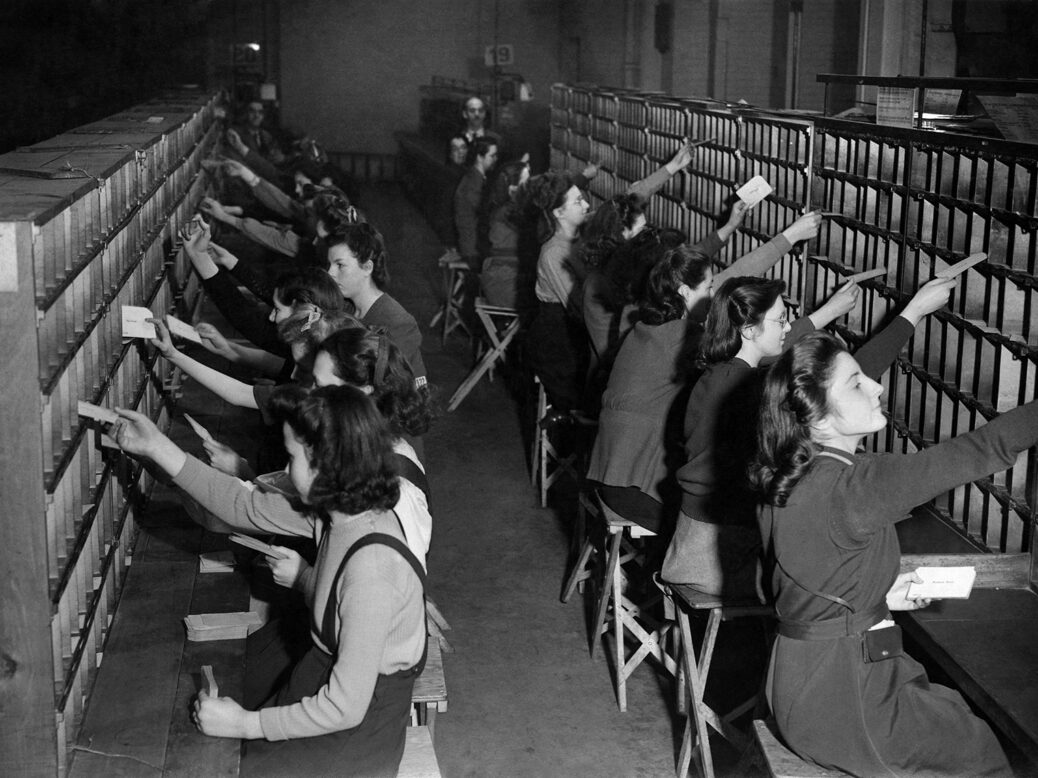
The Angry Young Women of the internet seem to be a slightly more palatable flip-side of the toxic masculinity they are so furious about. Both are creatures of social media, which is largely a vehicle for communicating with those who agree with you, or for having a fight. This is not only making us more stupid, but has a direct role in the sheer viciousness and intolerance we see on both the extreme left and right.
While I have contempt for Enoch Powell and frustrated respect for Keir Starmer, both had a point about our “island of strangers”. The internet has made us a world of strangers. We’re more connected than at any time in history, yet apparently unable to connect. This leaves us unable to focus on our common cause and work together for the good of people or planet.
My reading of books and publications like the New Statesman tells me this is no accident: keep us divided over minor differences, leaving those we should be really troubled about – and who control the online world – to torch the planet, unimpeded by people of any colour, sex, gender, religion or class.
Catriona Stewart, Northwich, Cheshire
Class dismissed
Last week’s Cover Story has raised a few questions for me. So, women who have greater privilege than working-class women feel undervalued? Surely this isn’t a gender issue but a feeling that society is failing in many ways, and that working-class women cope with disappointment better having had centuries to get used to it?

Anna worries men don’t talk about “what the Department for Work and Pensions is doing to disabled people”. Isn’t this due to her only seeming to associate with middle-class blokes and not those directly affected, such as working-class men, or those who are disabled and excluded from the groups she obviously frequents?
The story highlights the need for people of different classes (and genders) to mix in order to understand that everyone is different and faces unique (but at times) adjoining challenges.
Ian Jones, North Shields
A Shropshire middle-aged man
Tom McTague’s references to AE Housman were a bit misleading. Housman was born in 1859, and his collection of poems A Shropshire Lad was published in 1896, when he was 37. When the First World War broke out he was 55. He was hardly “that great poet of the Great War generation”, which suggests he was of that generation, rather than a big influence on it. The claim that, “Housman, after all, was writing his reactionary poetry as a young man in the late-19th century” rather stretches the definition of “young man”. Then we have the question: “Aren’t there Housmans in each new generation of young men – romantic and reactionary, obsessed with notions of heroism and history?” Housman was obsessed with his mortality and that of others, as well as who might be obsessed by notions of heroism and history.
Dave Sissons, Sheffield
I share the editor’s fondness for AE Houseman. With the Iran situation in mind he might have also quoted:
The laws of God, the laws of man,
He may keep that will and can;
Not I: let God and man decree;
Laws for themselves and not for me;
And if my ways are not as theirs
Let them mind their own affairs.
Those words are in Housman’s Last Poems. They could serve as Trump’s last words as well.
Colin Richards, Spark Bridge, Cumbria
Accommodating Commodus
When comparing Donald Trump to the most egregious Roman emperors, Nero and Caligula are the two most commonly mentioned. But there is a third, and Katie Stallard’s “Donald Trump and the art of the cage fight” brings him to mind. Commodus was narcissistic and often in the company of gladiators to boost his public image. Betrayed in a conspiracy by those nearest to him, was strangled in his bath by his wrestling partner, Narcissus.
Tom Stubbs, Surbiton, Greater London
Emperor’s new cloth
Freddie Hayward tell us that the spat between the White House and Pope Leo “shows that Trumpland is built upon paradoxes”. Here’s another: King Charles has been invited to the US on a state visit. He is supreme governor of the Church of England, created 500 years ago as a result of a monarch’s displeasure with a pope. Charles could offer Roman Catholic members of Trump’s administration the chance to attend confirmation classes at Lambeth Palace with a view to converting to CofE, subject to their being prepared to accept the authority of Archbishop Mullally.
Les Bright, Exeter, Devon
Solitary men
I was pleased to read in the latest edition Anoosh Chakelian’s piece on Britain’s social crisis. As someone who has spent ten years working in front-line support roles in homelessness, addiction and sexual violence services, I found it captured the scale of the problems we are facing, without being mean, patronising or voyeuristic. Anoosh describes what she sees, and in doing so conveys the severity of how an increasing number of people in Britain are living.
Addiction and poor mental-health are driven by loneliness and disconnection, the conditions for which have thrived in the slow death of community and the advance of a hyper-individualistic and atomised society. People need to feel part of something in order to be happy. They need to share in collective experience and achievement. Successive governments have failed to understand this, and until they do, the suffering we see today will only become more acute and widespread.
Edmund Cotton, Glastonbury, Somerset
AI incredulity
I am a retired, relatively simple bloke who received, like millions of others, only an elementary education, believing I know at least a thing or two. I read Will Dunn’s essay on AI with an increasing level of incredulity, not to say anxiety. Where does all this stop? Or doesn’t it?
Martin Skerritt, Dersingham, Norfolk
Questionable assets
According to Duncan Weldon’s description of a leveraged buyout in his review of Hettie O’Brien’s The Asset Class, private equity transfers money it has borrowed to the firm it is buying. The result is that “the target company goes into debt to fund its own purchase”. This is not predatory capitalism, it is parasitic. How is that even legal?Sebastian Kraemer, London SW2
A renewed faith
I’m not a fan of organised religion, but I greatly admire Rowan Williams. Terry Eagleton’s excellent encapsulation of Williams’s Solidarity has inspired me to read both his book and Eagleton’s. Superb.
Sally Litherland, Salisbury, Wiltshire
I’ll pass, thanks
In contrast to Rachel Cunliffe, I felt I had become an adult only when I felt able to refuse to attend the family Passover Seder with its “unintelligible Hebrew songs and strange rituals”.
Adam Moliver, Cheltenham, Gloucestershire
The adventures of Nicholas Tesard
Maybe Nicholas Lezard has a separate gig going in the Tes? I’ll be buying the next edition in the hope of reading some of his sometimes inauthentic, but almost certainly hilarious, tales of plenary. Thanks for the tip, Margaret Bluman.
Tom Austin, Cambridge
Write to letters@newstatesman.co.uk
We reserve the right to edit letters
[Further reading: Keir Starmer is all alone]
Content from our partners


Related


This article appears in the 22 Apr 2026 issue of the New Statesman, All alone
Join the debate
Subscribe here to comment