
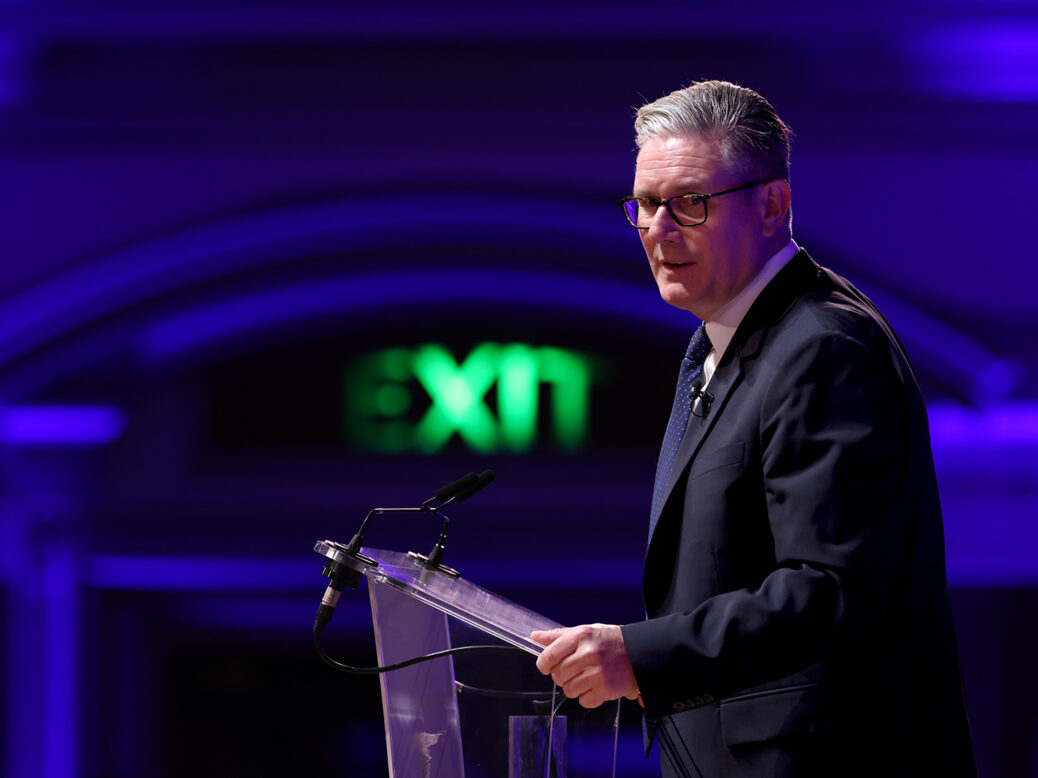
On 27 February, the Labour left saw a brief window of opportunity. Labour’s candidate had just come a miserable third in the by-election for the once-safe Greater Manchester seat of Gorton and Denton. Zack Polanski’s Green Party had won its fifth MP. After months of criticising the Prime Minister and his leadership, this was the evidence Keir Starmer’s left-wing critics needed to prove that things weren’t working. Then Israel and America bombed Iran.
The Iran war has meant the aftershocks from Gorton and Denton have been more muted than they might have been. It is far harder to make the case that the UK needs a change of Labour leader when the one in place looks to be deftly managing Britain’s role in a global crisis. But this hasn’t stopped the left from preparing to strike once that moment has passed.
On the evening of 17 March, the soft-left group Mainstream held its first Westminster reception in the dimly lit basement of a pub on Whitehall. Founded out of Compass, the progressive think tank set up by Gordon Brown’s former speechwriter Neal Lawson, Mainstream has been closely associated with the leadership campaign of Andy Burnham. Not all of the 17 MPs who attended were Mainstream members, but all shared frustrations with the leadership. One MP who attended – and who is not yet a Mainstream member – had come along to find out more about what this newly formed soft-left grouping has to offer.
Mainstream’s interim chair, Kerry Postlewhite, opened proceedings. Though she was a 2024 Labour parliamentary candidate, she was deeply critical of the party’s current leadership. “For me, this isn’t just about those individual decisions. It’s how those decisions get made. When power is concentrated with a very small group, where politics is from an echo chamber, when only one narrow faction is listened to,” she said, “you don’t just get bad decisions, you get avoidable mistakes.”

Across the wider left, there has been some effort to organise against the perceived failings of the Labour leadership. On 15 February – the 120th anniversary of the formal adoption of the name “The Labour Party” – 25 MPs, including members of the Socialist Campaign Group as well as others on the soft left, called on the leadership to “end the factional agenda and restore party democracy”.
The group – which included MPs such as Richard Burgon, Rachael Maskell and Clive Lewis – warned that “a narrow factional agenda is being imposed on the party”, pointing to examples such as Labour’s National Executive Committee blocking Andy Burnham from running for selection as the candidate in the Gorton and Denton by-election.
Among this group, worries have begun to bubble up about the party leadership’s decision to begin asking MPs if they plan to seek re-election, three years out from the latest possible general election. Asking MPs if they wish to stand again will begin a process of trigger ballots, which are set to begin later this year, sparking deep anxiety among left-wing Labour MPs, some of whom have had to face them before. Trigger ballots are a procedure run by branches and affiliates of a Constituency Labour Party with an MP who would like to run again for election. The ballot decides whether the MP may run again, or must face challengers and go through the reselection process. Ian Byrne, for example, the MP for Liverpool West Derby, was forced to fight a selection contest in 2019 owing to a trigger ballot, as was Sam Tarry (the partner of Angela Rayner). Byrne was successful in his reselection ballot; Tarry was not and was deselected. In short: no one on the left feels safe.
Another potential flash point is the upcoming National Executive Committee elections, which will take place at the party’s annual conference in Liverpool later this year. The current NEC is broadly made up of Starmer loyalists. On Wednesday (18 March), several candidates for the upcoming elections, coordinated by Mainstream and Momentum, put out a call to “Reset Labour”, backed by 19 left-wing Labour MPs. A statement put out by the group reads: “In the face of the growing electoral threat to the Labour Party exposed by the Gorton and Denton by-election – and ahead of difficult elections… members from across our Party’s progressive majority are uniting behind a call to urgently reset the Labour Party.”
Mainstream and Momentum both hail from the left of the party but represent slightly different Labour traditions. Momentum was founded to support the leadership of Jeremy Corbyn and is closer to MPs in the SCG, while Mainstream represents the broader soft-left. A Mainstream source explained that while they did “some of the pushing”, the organisation of this joint statement has been “more organic”. Sources involved in organising “Reset Labour” were clear that the statement is just intended to signal “common ground” and is not intended to be a joint slate or a formal alliance.
The Mainstream source said: “The progressive ecosystem around Labour has been having all kinds of conversations, in Parliament and beyond, to identify a political analysis of where the party is at and identifying opportunities above and beyond factions to land those common analyses.” The NEC elections, they argue, are a way of resetting the party, refashioning it to be more progressive.
Paula Barker, a Mainstream MP who signed the pledge, pointed to recent scandals such as the Mandelson affair and the departure of Morgan McSweeney and called for Starmer to take a more “inclusive approach”. Barker said: “Our party is a broad church and that should be welcomed and celebrated.” Byrne, who also signed up to the call, said: “Restoring democracy in the party is absolutely fundamental to saving it from the existential threat it faces.”
The Labour left is clearly unhappy with the direction their party has been pursuing. The aftermath of May’s local elections is likely to bring these objections into sharper focus. For now, informal alliances are emerging across the broad spectrum of Labour’s left flank. Fed up with the government, left-wing Labour MPs are still waiting for the most opportune moment to strike.
[Further reading: How ready is Britain for fuel shortages?]
Content from our partners


Related


Join the debate
Subscribe here to comment