
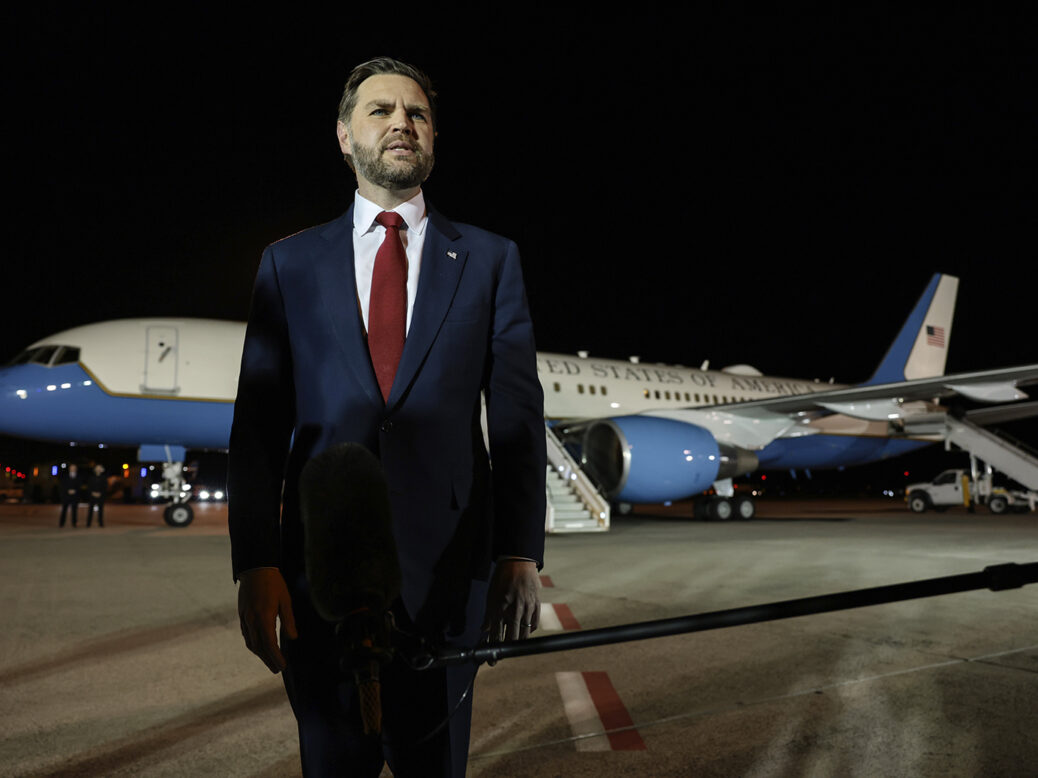
Donald Trump likes to dangle his courtiers in front of audiences to gauge their popularity, like a butcher holding up a pair of chickens by the legs. More charitably, you might say the President fosters a culture of competitiveness between his staff members as part of a leadership development programme that is intended to elicit their best work in order to help them reach their full potential as public servants. You might say.
Whichever it is, on the day Trump started his war with Iran, he asked a room of 25 donors: should he support JD Vance or Marco Rubio for the nomination in 2028? One report suggests the room overwhelmingly cheered for Rubio. The Secretary of State is a native Floridian, to be fair. Vance’s heartlands lie farther north and west. But the big man would have heard the cheers. And cheers are what matter in his book.
What is definitely true is that over the past four months, Vance has descended from heir apparent to contender-among-many. Doubts about his monopoly over the succession really gained traction in Washington after the successful attack on Caracas in the early hours of 3 January. Rubio was seen as the hawk behind the operation and got a reputation as a man who got things done.
Vance has the relatively powerless role of vice president, while Rubio has notched up extra jobs alongside the most powerful cabinet position, Secretary of State – from National Security Advisor to USAID director to chief archivist. This was feasible because those agencies were being gutted, and so the roles were largely nominal. But it also reflected the fact Trump clearly sees his erstwhile rival for the Republican nomination in 2016 as a competent pair of hands, boosting Rubio’s image within the movement as a loyal and effective operator. With Trump’s approval rating among the loyalist base, if not the country, still at Pyongyang levels, this matters for anyone wanting to secure the nomination in ‘28.

How has Vance responded? He has bagged himself a job as “corruption czar”. The czar for rooting out corruption, that is, not excelling at it. In recent weeks, Vance has also been given the job of negotiating a ceasefire with Iran, taking the lead from real estate experts and diplomatic novices, Steve Witkoff and Jared Kushner. He is clearly conscious that the war he reportedly advised against is firmly opposed across the United States and within the Maga movement itself, particularly among its splenetic youth wing. At a recent event he said: “I recognise that young voters do not love the policy we have in the Middle East, I understand.”
The benefit of Vance’s new role is that he could be associated with the end of an unpopular war. It also burnishes his international credentials, which are relatively sparse, especially compared to Rubio’s. But it’s a risk for him: an agreement has so far proved elusive. Poor terms in the agreement would make him look weak – and invite the ire of his boss, who repeatedly says that Vance is responsible for the adventure. As Trump has said: “if it doesn’t happen, I’m blaming [him]. If it does, I’m taking full credit”. Don’t worry, it’s all part of the leadership development programme.
Vance’s recent visit to Hungary to stump for Viktor Orbán was also ill-fated. He can obviously read the polls, and knew that Orbán’s chances were slim. This means that he is willing to put his name to causes he cares about, particularly sovereigntist politicians in Europe, even if they put him on the losing side. The humiliation he faced after Orbán’s seismic loss spent political capital at a time when his stock was falling. This failure to adapt to the situation in order to further his career – this is, of course, relative to his peers: he does it all the time – suggests that his will to power is not as attuned as Rubio’s.Trump is an unquestionably unique figure; once he goes, the laws of “normal” politics might start to make themselves felt again.
Given that the Democrats are very much favourites for 2028, Vance might be looking to skip the next cycle in order to mature out in the wilderness before roaring back to the nomination once Gavin Newsom, or whoever wins the Democratic crown, has sullied themselves in office. A failed run in 2028 might stick to him like a limpet, not least if Trump tries some extra-constitutional manoeuvre again. Vance, 41, is a full 13 years younger than Rubio, 54. While 2026 has hardly been a banner year for the vice president, he has time – another 41 years potentially, given the age of the past two presidents.
[Further reading: Donald Trump is WEAK on Catholicism]
Content from our partners



Related
Join the debate
Subscribe here to comment