
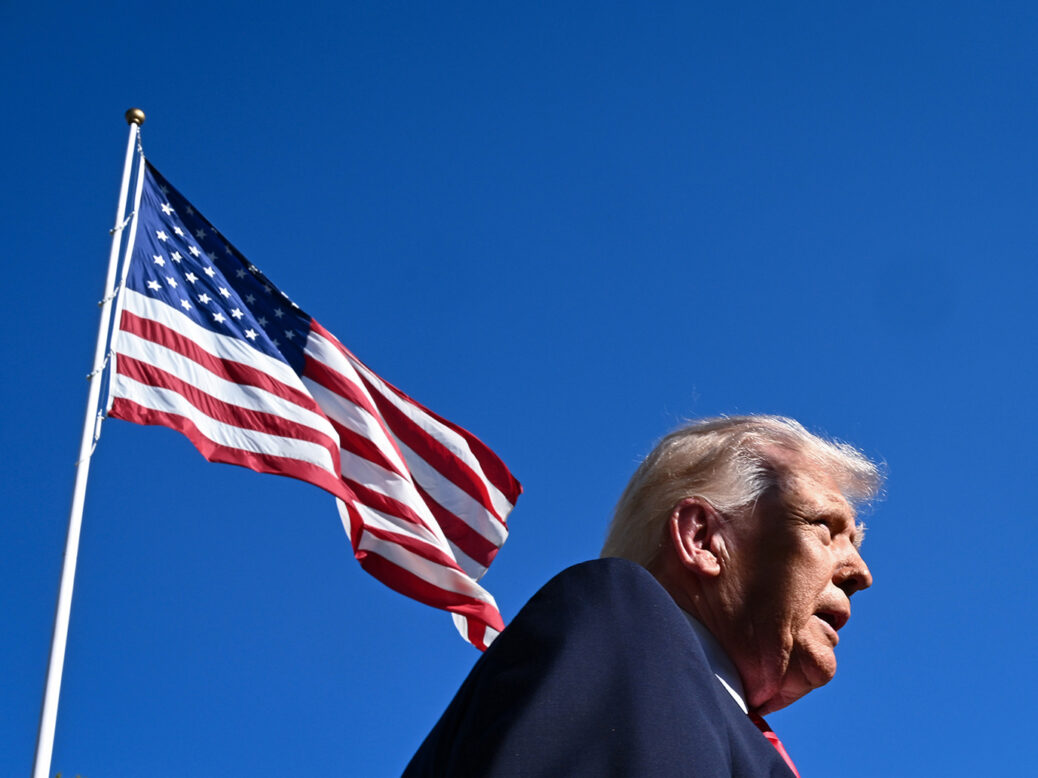
On Sunday (12 April), Donald Trump declared that the United States would begin a naval blockade of the Strait of Hormuz after talks with Iran failed to reach an agreement. “Effective immediately, the United States Navy, the Finest in the World, will begin the process of BLOCKADING any and all Ships trying to enter, or leave, the Strait of Hormuz,” the US president wrote on his social media platform, Truth Social. Trump also claimed that the US Navy would “seek and interdict every vessel in International Waters that has paid a toll to Iran”.
This raises many questions, the first and most important being whether Trump is serious about enforcing a naval blockade, or if this is merely another negotiating tactic in an ongoing cycle of brinkmanship. The president has form for issuing bloodcurdling threats on social media, only to walk them back hours later, before the financial markets open and the price of oil and gas resumes its vertiginous rise.
By threatening a blockade, Trump may hope to pressure the Iranian regime by indicating that he is prepared to cut off its exports of oil, thereby throttling the country’s economy and cutting off a valuable source of income for the Islamic Revolutionary Guard Corps (IRGC). Presumably, part of Trump’s logic is also that China will pressure Iran to come to terms because it wants oil to resume flowing freely from the Gulf. The problem with this strategy is that while Xi Jinping would surely prefer an end to this war and no US blockade, China has built up considerable stores of oil and gas and it is far from certain that Beijing would prevail upon Tehran to concede.
Iran’s theory of victory similarly rests on restricting the flow of shipping through the Strait of Hormuz and widening the conflict to global energy markets; it apparently believes that the Iranian regime can withstand the pain longer than the US. Iranian officials may well assess that time is on their side: the US midterm elections are in November. American consumers are already feeling the impact of rising prices and the war with Iran is deeply unpopular among voters.

“I don’t understand how blockading the strait is somehow going to push the Iranians into opening it,” Mark Warner, the most senior Democrat on the Senate Intelligence Committee, said in response to Trump’s decision to declare a blockade. “I don’t see the connection there.”
It is also unclear whether Trump intends to follow through on his threat to interdict other ships in international waters that may have already paid a toll to Iran. This raises the extraordinary prospect of the US Navy stopping ships around the world, including those owned by nations allied to the US. It is worth considering what might happen if the US attempted to interdict a ship sailing under a Chinese flag, for instance, and what steps Beijing might take to protect those vessels.
Similarly unknown is whether Trump envisages other nations, including the UK and other members of Nato, taking part in this blockade. He told Fox News on Sunday, for instance, that Nato supposedly now wants to get involved in helping to “clean out the strait”. Towards the end of his long Truth Social post announcing the action that morning, he noted that, “Other countries will be involved with this Blockade”.
What is clear is that Trump himself does not appear to know what will happen next. Asked during the same interview with Fox on Sunday whether he thought oil and gas prices would be lower by the time voters go to the polls in November, his response was not reassuring. “I hope so. I mean, I think so,” the president said. “It could be [the same] or maybe a little bit higher. It should be around the same. I think this won’t be that much longer.” He said he had told his economic advisers, “I’m sorry fellas, we’re in great shape. We have to go and take a little journey to Iran and we have to stop them from having a nuclear weapon.”
Threatening a blockade is less obviously fraught with risk than ordering a ground assault or seizing Kharg Island, as Trump has reportedly previously contemplated. Still, it risks seriously escalating this conflict. In Trump’s best-case scenario, Iran takes him at his word and requests further negotiation to end the war. Iranian officials could indicate an openness to further talks, an extension of the current ceasefire, and a return to protracted dialogue that enables both sides to avoid returning to a costly war and permits Trump to suspend his threats, insisting that, once again, he has forced the Iranian regime to the negotiating table.
Yet it is equally plausible that Tehran decides to call Trump’s bluff, testing his threshold for economic pain and his willingness to resume a war that he shows every sign of being desperate to bring to an end. “The way you get leverage in a negotiation like this is by credibly threatening to go back to fighting,” James Acton, co-director of the nuclear policy program at the Carnegie Endowment for International Peace, told the New Statesman on 10 April. “So, the question you have to ask, when it comes to the United States and Iran, is who is more willing to go back to fighting? In my opinion, that’s Iran, and it’s frankly not close.”
[Further reading: Michael Ignatieff: Global Orbánism is over]
Content from our partners



Related

Join the debate
Subscribe here to commentThis is what happens when voters elect a Farage lookalike