
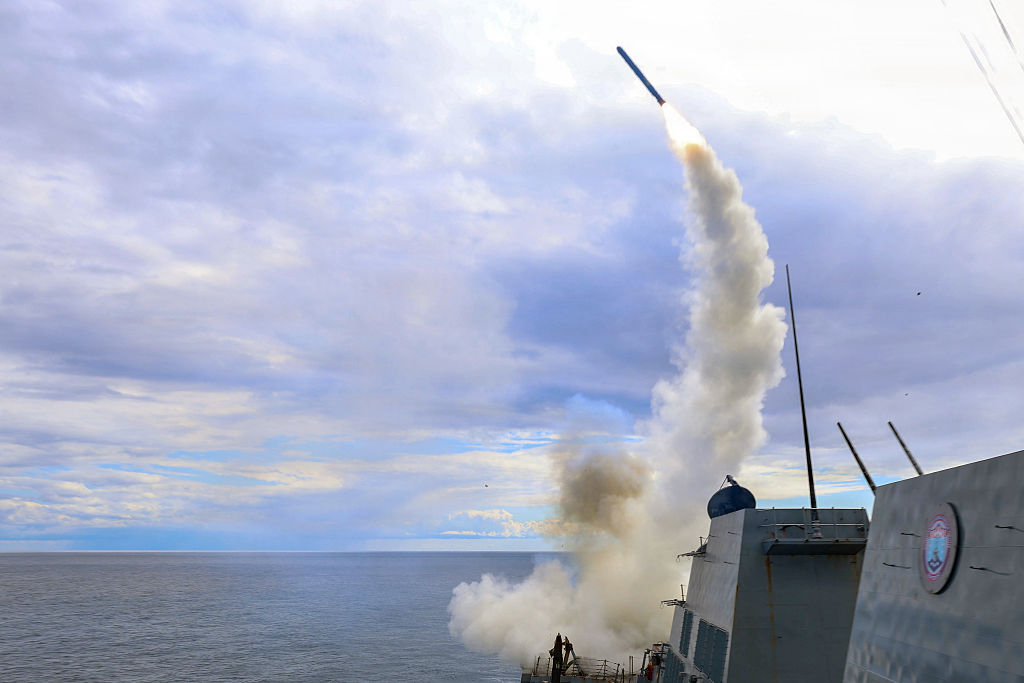
Late on Friday 13 March Donald Trump announced that the United States had attacked Kharg Island, Iran’s most important oil export hub. “Moments ago, at my direction, the United States Central Command executed one of the most powerful bombing raids in the History of the Middle East,” the US president wrote on his social media platform Truth Social. He claimed they had “totally obliterated every MILITARY target in Iran’s crown jewel, Kharg Island”.
Trump then warned that while he had “chosen NOT to wipe out the Oil Infrastructure on the Island” during this attack, he would “immediately reconsider this decision” if Iran continued to “interfere with the Free and Safe Passage of Ships through the Strait of Hormuz”.
The Kharg Island ultimatum appears intended to pressure the Iranian regime to allow shipping to resume through the Strait by signaling that the US is prepared to bomb, or perhaps even seize, the territory. An estimated 90 per cent of Iran’s oil exports left the country through Kharg’s terminals before the war, which can accommodate large tankers, unlike the shallower waters that surround much of Iran’s coast.
The Trump administration’s calculation may well be that without access to Kharg, the Iranian government would be deprived of its most important source of income. This could decimate the country’s economy and perhaps imperil the regime’s ability to pay the security forces and the soldiers of the Islamic Revolutionary Guard Corps (IRGC), who have so far helped to keep the regime in place following the assassination of the Supreme Leader Ali Khamenei on 28 February.

Destroying the island’s military facilities may also be intended to prepare the ground for an amphibious assault on Kharg once more US forces arrive in the region, or at least to credibly threaten the island’s seizure in the weeks to come. On 13 March, the US deployed another 2,500 Marines to the Middle East.
Yet Iran has cards too. Confronted with what the surviving leadership appears to regard as an existential threat, the regime has opted to widen the war and leverage its proximity to the Strait of Hormuz to take the fight to the global economy, wagering that soaring energy prices and the associated economic pain will force the US to back down first. What’s more, as I wrote in the New Statesman earlier this week, if the US were to seize Kharg Island, Iran could opt to direct its own missiles on “a US-controlled Kharg, adopting an ‘if we burn, you burn with us’ strategy”.
Committing US ground forces to an already unpopular war with no clear endgame would be an extraordinary political risk for a US president with historically low approval ratings, whose party risks losing the house in midterm elections later this year.
Both sides are now engaged in a perilous cycle of brinkmanship, whose immediate consequences are being borne by the region’s civilians, but could yet reverberate around the world. By striking Kharg, Trump is effectively signalling to Iran’s new leadership: surrender now or we will destroy your economy. But thus far, the response has been: two can play that game.
[Further reading: John Healey: “There’ll be no repeat of Iraq’s mistakes”]
Content from our partners



Related
Join the debate
Subscribe here to comment