
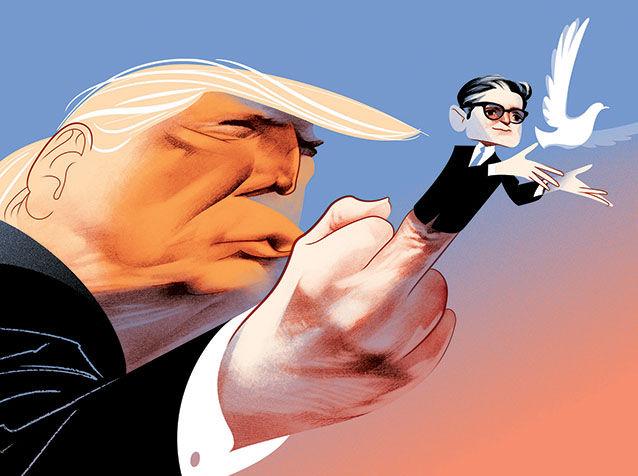
In 2015, the German TV news channel, n-tv, reported on a “purity ball” taking place in the city of Shreveport, Louisiana. These events look like mass weddings: couples walk together to a spot at which they join hands and recite vows, before signing a piece of paper, having their pictures taken and dancing. But the girls in their flowing white dresses are too young to get married and their tuxedoed partners are their fathers. The report showed a 13-year-old girl, Hannah Johnson, looking into her father’s eyes and swearing to God, her family and her future husband that she would not go on dates with boys or choose her own partner. As she swore to follow a life of “sexual purity”, her father, Mike Johnson, held her gaze and nodded slowly.
Mike Johnson is now speaker of the House of Representatives, the fourth most powerful political office in the United States after the presidency and the vice-presidency. On 20 January he addressed parliament to mark the 250th anniversary of his country’s independence from ours, and to deliver a message. It was the same message that daughters receive at chastity balls: we love you, honey, and we’ll love you for as long as you remain pure and obedient.
Our own Speaker, Lindsay Hoyle, was there to warm up an uncertain crowd. A couple of hours before Johnson’s speech, Donald Trump had posted on social media that the UK government’s deal on the Chagos islands – which he had previously supported – was “an act of GREAT STUPIDITY” and “another in a very long line of National Security reasons why Greenland has to be acquired”. Hoyle began by talking about “the democratic world vs the undemocratic world”, although he didn’t say to which world Trump belonged. Having reminded everyone of the context beyond the room – that the unstable 79-year-old in charge of the world’s most powerful military is threatening an act of war against a Nato ally – Hoyle then tried to put the crowd at ease by mentioning Bolton Wanderers and rugby league, neither of which the US House speaker has heard of, or could possibly have the slightest interest in. Johnson – bespectacled, suited, the generic American politician – rose to speak.
The only person with his back to Johnson was William Gladstone, who sits (in Lowes Cato Dickinson’s painting of his first cabinet of 1868) facing away from those gathered in parliament’s committee room 14. Perhaps he prefers it that way: this is the room in which the Parliamentary Labour Party and the Conservatives’ 1922 Committee meet for weekly outpourings of discontent. Gladstone might have shared Johnson’s piety but he was also a firm believer in free trade, and would have viewed the Trump administration’s halfwit mercantilism – outdated even in his day – with contempt.

In the US, Johnson begins each working day by heading to the Congressional Prayer Room, where he seeks the Lord’s guidance. Which American city should they send Immigration and Customs Enforcement agents, perhaps followed by troops, into next? Which of the President’s demented whims should be pandered to today? All of them, obviously – but which one first, O Lord? In parliament, Johnson and his wife were given the full tour and a slap-up dinner at which he marvelled at silverware older than his country. The Johnsons felt they had returned, he told the gathered parliamentarians, “to the spiritual birthplace of our own nation”. He had prepared “a bunch of jokes”, he told the audience, but it didn’t feel appropriate to the moment.
What is it that makes this moment so serious, Mike? Johnson said he had spoken “at length” with Trump the previous day, and that he felt his mission in the UK was “to calm the waters” between our countries, although obviously the main thing stirring those waters is Trump using them as his personal bidet. Johnson said we would “face and overcome together the challenges of our present day”. It went unsaid that the key challenge of the present – a lunatic in the White House openly threatening to invade an island populated by EU citizens – is one we’ll have to face by just letting it happen, and hoping it won’t happen to us.
A strengthening of the special relationship between the US and Britain would, Johnson said, send a message to “tyrants everywhere”. Was this one of his jokes? If so, it was at our expense, because there is one tyrant in particular – Donald “Maybe We Like a Dictator” Trump – to whom this message would be addressed, and the message would be: yep, it seems you can do what you want. In the bad countries – Russia, China and Iran – Johnson warned, “We see a callous disregard for basic human rights.” In America human rights are sacred, except in rare cases such as when Trump’s masked militias want to drag someone from their home and detain them without cause, or if they want to shoot an unarmed woman three times for getting in their way. But that’s not tyranny, that’s dealing with what Johnson called “internal challenges”, the true enemies of freedom: the unpatriotic intelligentsia who “view our history only through the lens of its sins… Even great heroes like Sir Winston Churchill are questioned for their legacy,” he intoned, shaking his head. He mentioned Churchill several times, but avoided his famous quote: an appeaser is one who feeds a crocodile, hoping it will eat him last.
Johnson’s home state of Louisiana was the first to implement a new law requiring schools to display posters listing the Ten Commandments; Texas and Arkansas have since imposed similar laws. The laws have been challenged but thousands of posters have already been printed. The Louisiana commandments are flanked by two faces: Moses and Mike Johnson. He is a religious zealot of a kind not found in British politics. Human rights are universal because “all of us are made in the image of God”, he told parliament. “Our value is inherent because it is given to us by our Creator.” When Johnson talked about “appealing to the better angels of our nature”, he literally meant angels, in which he fervently believes.
Alistair Cooke, who spent 60 years reporting on the US for BBC radio in his Letter from America series, understood how profoundly different the UK and US are, and warned in 1951 how the special relationship would end: “I don’t believe the Anglo-American alliance will be wrecked by plotters, by the communists… It will be wrecked by people on both sides of the ocean who live by the bitterness of their pride.” As Donald Trump assembles his new “Board of Peace” – at which a permanent seat costs a billion dollars, and over which he will preside, unelected, as chairman-for-life – this seems ever more prescient. On 16 January, Tony Blair (famous for avoiding war at all costs) was named as an inaugural member of the executive board, along with Marco Rubio, who opposes banning assault weapons in the US. The Egyptian president Abdel Fattah el-Sisi, who presides over a regime of torture and murder, was also invited, but the big signing – revealed on 19 January – was the well-known peacemonger Vladimir Putin. Perhaps next year Donald, Tony and Vlad will all win a Nobel Peace Prize together. They just need to make sure they let Donald keep the medal, or with Mike Johnson’s blessing, he’ll blow them, and the rest of us, to Kingdom Come.
[Further reading: Darren Jones’ vision for Whitehall]
Content from our partners


Related
This article appears in the 21 Jan 2026 issue of the New Statesman, Europe is back
Join the debate
Subscribe here to comment